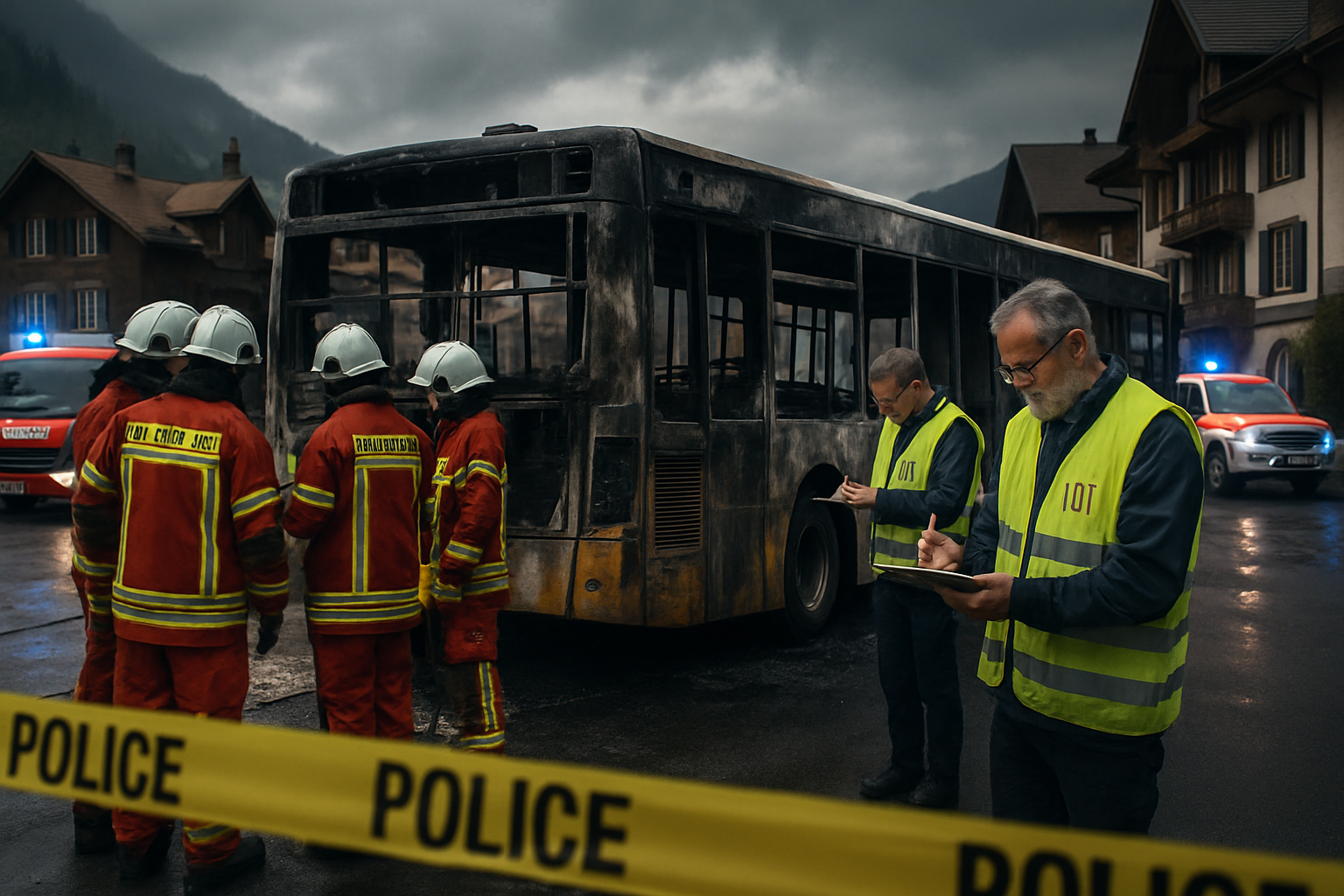
A devastating bus fire in western Switzerland that killed at least six people and injured five others has thrust transportation safety into sharp focus, as investigators pursue leads suggesting deliberate arson in what authorities are calling one of the most serious public transport tragedies in recent Swiss history.
The incident occurred Tuesday evening around 6:25 PM in Kerzers, a small town in Canton Fribourg approximately 20 kilometers from Bern. A PostAuto bus traveling from the railway station direction became completely engulfed in flames, trapping passengers and creating scenes of horror that shocked the peaceful community of fewer than 5,000 residents.
Arson Investigation Underway
Fribourg cantonal police have shifted their investigation toward a suspected "deliberate act" after witness accounts suggested a passenger may have poured gasoline on themselves before igniting the fire. Police spokesperson Frederic Papaux confirmed that "elements suggesting deliberate act by person inside the bus" are being examined based on multiple witness reports.
The investigation has captured international attention as details emerge of what appears to be a self-immolation that rapidly spread throughout the vehicle. Videos circulated on social media showing thick black smoke and flames several meters high completely destroying the PostAuto vehicle, with emergency responders unable to immediately access the burning bus due to the fire's intensity.
Finnish and Italian media outlets have corroborated witness testimonies describing a passenger with gasoline deliberately starting the fire, while Swiss federal and cantonal police work alongside transportation safety authorities to examine surveillance footage, conduct witness interviews, and analyze the wreckage for accelerants.
Growing Pattern of Transportation Vulnerabilities
The Swiss tragedy unfolds against a backdrop of mounting transportation safety concerns across Europe and globally. In recent months, the continent has witnessed a surge in infrastructure failures, extreme weather disruptions, and safety incidents that have strained emergency response systems beyond their designed capacity.
From Portugal's massive rescue operation involving 26,500 personnel following the A1 highway viaduct collapse near Coimbra, to the Sarajevo tram derailment that killed a 23-year-old and sparked the largest post-war civic demonstrations in Bosnia Herzegovina, transportation networks are facing unprecedented challenges.
"When infrastructure designed for historical climate patterns meets extreme weather and aging systems, we see cascading failures that overwhelm emergency response capabilities."
— Transportation Safety Expert
The crisis has been particularly acute during what climatologists confirm was the 18th consecutive month of global temperatures exceeding 1.5°C above pre-industrial levels, creating operating conditions that infrastructure was never designed to handle.
Switzerland's Public Transport Under Scrutiny
The Kerzers incident has prompted PostAuto to pledge full cooperation with the investigation and initiate an internal safety protocol review. The company operates one of Europe's most extensive bus networks, serving remote Alpine communities and connecting rural areas to Switzerland's efficient rail system.
While Swiss public transportation maintains one of the world's best safety records, the suspected arson attack highlights vulnerabilities that even the most advanced systems face from deliberate acts of violence. The incident occurs within broader European transportation security concerns that may influence Swiss public transport safety measures going forward.
Community counseling services have been established in Kerzers, where residents struggle to comprehend how their quiet town became the site of such tragedy. Local authorities are coordinating with federal agencies to support both the investigation and community healing process.
Global Transportation Safety Crisis
The Swiss incident represents just one point in a constellation of transportation safety challenges documented worldwide in 2026. Data compiled by international safety organizations reveals alarming patterns:
- Armenia recorded 3,261 road traffic fatalities over the past decade, nearly one death per day
- Egypt experienced a multi-vehicle crash that killed 18 fishermen near Port Said in February
- Algeria suffered 16 deaths and 367 injuries in traffic accidents within just 48 hours
- Global statistics show motorcyclists represent 41% of traffic fatalities despite being a smaller percentage of road users
Transportation experts emphasize that while statistical safety has generally improved, the complexity and interconnectedness of modern transport systems create new vulnerabilities. Infrastructure designed for historical weather patterns struggles with extreme conditions, while aging systems require costly upgrades that many regions cannot afford.
Lessons from Success Models
Despite the challenges, several countries have demonstrated that transformative safety improvements are possible through sustained political commitment and comprehensive system reforms. Sweden's Vision Zero approach has dramatically reduced traffic deaths through infrastructure design that accounts for human error rather than expecting perfect driver behavior.
The Netherlands' Safe System Approach similarly focuses on designing roads and transport networks that minimize fatal outcomes when accidents occur. Australia's urban speed management programs have shown significant success in reducing pedestrian and cyclist fatalities.
These models emphasize that effective transportation safety requires coordination across multiple sectors: infrastructure design, emergency response capabilities, legal enforcement frameworks, public education campaigns, and international cooperation for sharing best practices.
Technology and Climate Adaptation
Advanced technology offers promising solutions for preventing transportation tragedies. Autonomous emergency braking systems, intelligent transportation networks, and predictive maintenance capabilities using artificial intelligence can identify potential problems before they become critical.
However, the global semiconductor shortage has delayed implementation of many safety systems and increased costs, while climate change creates operational environments that exceed traditional design parameters. Transportation authorities worldwide are grappling with the need to simultaneously modernize aging infrastructure while adapting to unprecedented weather volatility.
International cooperation frameworks through organizations like the European Union's Civil Protection Mechanism have proven essential during recent crises, though the scale and frequency of simultaneous emergencies increasingly strain even the most robust coordination systems.
Economic and Human Impact
The economic cost of transportation safety failures extends far beyond immediate rescue and repair expenses. Each traffic death is estimated to cost society hundreds of thousands in lost productivity, medical expenses, and legal proceedings. For countries like Algeria, recent transportation fatalities likely represent billions in economic losses affecting tens of thousands of family members and community connections.
The human toll, however, remains incalculable. In Switzerland, six families now face an unimaginable loss that could have been prevented. The community of Kerzers must rebuild its sense of security while grappling with questions about how to prevent such tragedies in the future.
The Path Forward
As Swiss investigators continue their work to understand exactly what happened on that Tuesday evening in Kerzers, transportation safety experts worldwide are studying the incident for broader lessons. The preliminary evidence of deliberate action raises challenging questions about protecting public transportation from individuals intent on causing harm.
The investigation is expected to continue for several weeks as forensic specialists work to establish the complete sequence of events. Federal authorities have emphasized their commitment to transparency while supporting the affected community and implementing any necessary safety improvements.
For the global transportation community, the Swiss tragedy serves as another stark reminder that safety cannot be taken for granted, even in the most advanced systems. The window for implementing effective preventive measures continues to narrow as transportation volumes grow and operational environments become more challenging due to climate change.
The choice facing policymakers worldwide is increasingly clear: invest now in transformative safety approaches that address both human factors and infrastructure vulnerabilities, or continue managing crises reactively as the human and economic costs mount. The victims of the Kerzers bus fire deserve nothing less than a fundamental commitment to ensuring such preventable tragedies never happen again.