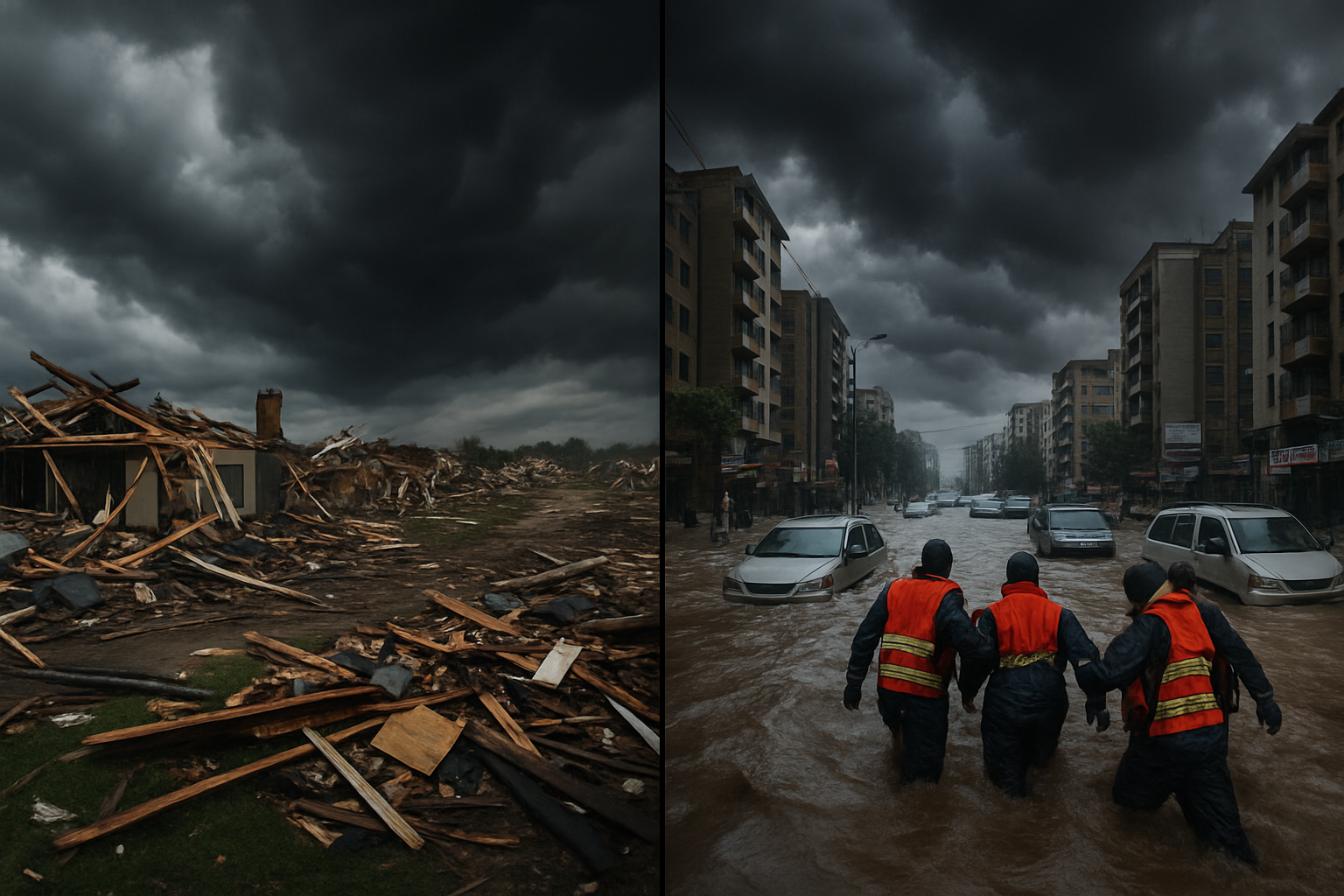
Simultaneous extreme weather disasters across three continents have claimed at least 31 lives, with deadly tornadoes striking the American Midwest while catastrophic flooding overwhelms Kenya's capital Nairobi, highlighting the accelerating pace of climate-driven emergencies that are overwhelming global response systems during the 20th consecutive month of record-breaking temperatures.
The death toll continues rising as authorities in Michigan and Oklahoma confirm at least six fatalities from suspected tornadoes that tore through communities on March 7, with a 12-year-old boy among the victims. Meanwhile, Nairobi's overnight flooding has killed more than 25 people according to local reports, with emergency services still conducting search and rescue operations across the submerged Kenyan capital.
Tornado Devastation Across American Midwest
Powerful storms swept across the central United States, generating suspected tornadoes that carved paths of destruction through rural Michigan and Oklahoma. Emergency responders are "searching debris after suspected tornadoes" according to NPR, with authorities confirming multiple fatalities including a 12-year-old child.
The National Weather Service reported that the storms stretched "across the middle of the country," bringing hurricane-force winds and spawning multiple tornado touchdowns. Photos and videos posted on social media showed "flattened homes and downed trees" across the affected regions, according to Australia's Sydney Morning Herald coverage of the international weather emergency.
Emergency services describe conditions as "It's lifting houses!" as witnesses reported seeing structures completely destroyed by the powerful twisters. The storms represent part of a broader pattern of extreme weather affecting multiple regions simultaneously, straining traditional emergency response capabilities designed for sequential rather than concurrent disasters.
Nairobi Drowns in Record Flooding
Kenya's capital experienced what authorities describe as the worst flooding in recent memory, with torrential overnight rains turning major streets into rivers and overwhelming the city's drainage systems. The Kenya Standard reports the crisis as "City in water: Shame of failed system that led to more than 25 deaths."
Flash floods struck with devastating speed, trapping motorists for hours as roads became impassable and urban infrastructure was completely overwhelmed. According to German broadcaster Tagesschau, "Heavy rains and resulting floods have left a picture of devastation in Kenya's capital Nairobi. More than 20 people have died - there is also massive damage to infrastructure."
The flooding exposed critical gaps in Nairobi's infrastructure, with the city's failing drainage system unable to cope with the intensity of rainfall. Emergency services report massive property destruction and residents left stranded across the metropolitan area of more than 4 million people.
"Flash floods in Nairobi caused over 25 deaths, destroyed property, and left residents stranded, highlighting the city's failing drainage system."
— Kenya Standard Report
Global Climate Emergency Context
These simultaneous disasters occur during what scientists describe as an unprecedented global climate crisis, marking the 20th consecutive month that global temperatures have exceeded 1.5°C above pre-industrial levels. January 2026 was confirmed as the hottest month ever recorded, demonstrating how human-induced climate change is overriding natural cooling mechanisms and creating what experts call a "climate volatility paradox."
The convergence of extreme weather events across multiple continents represents a fundamental shift from historical patterns where disasters typically occurred sequentially, allowing for regional mutual aid responses. Instead, emergency services worldwide are now confronting simultaneous crises that stretch response capabilities beyond their designed limits.
Climate scientists emphasize that current conditions provide a preview of what may become routine in the 2030s without significant climate adaptation investment. The frequency and intensity of extreme weather events are increasing beyond the adaptive capacity of traditional infrastructure and emergency response systems.
Infrastructure Failures and Response Challenges
Both the American tornado outbreak and Nairobi flooding exposed critical infrastructure vulnerabilities. In the United States, the power grid faced widespread outages as transmission lines were damaged by high winds and debris. Transportation networks experienced significant disruption, with major highways closed and aviation systems affected.
Nairobi's infrastructure crisis was even more severe, with the city's drainage systems - designed for historical rather than current climate conditions - completely overwhelmed. The flooding highlighted decades of inadequate urban planning and insufficient investment in climate-resilient infrastructure.
Emergency services in both regions reported operating at capacity limits, with traditional mutual aid mechanisms strained by the geographic scope and simultaneous nature of the disasters. The coordination challenges demonstrate the urgent need for enhanced emergency response capabilities designed for an era of permanent climate volatility.
Economic and Social Impact
The economic toll from these simultaneous disasters is expected to reach billions of dollars across agricultural sectors, tourism industries, and infrastructure reconstruction. In the American Midwest, agricultural communities face immediate losses from damaged crops and livestock, while the timing of the tornado outbreak during planting season threatens broader food security implications.
Kenya's economic hub faces massive disruption as commercial activity throughout Nairobi has been severely impacted. The flooding affects not only immediate economic activity but also longer-term development prospects, as resources must be diverted from growth initiatives to emergency response and recovery efforts.
Beyond immediate economic costs, both regions face significant social challenges including displaced families, psychological trauma from repeated extreme weather events, and increased demand for mental health services. Vulnerable populations are disproportionately affected, highlighting existing social inequalities that are exacerbated by climate disasters.
International Response and Coordination
The simultaneous nature of these disasters is testing international cooperation frameworks that were designed for sequential regional emergencies. Traditional mutual aid mechanisms assume that some regions remain available to assist others during crises, but current conditions increasingly feature concurrent disasters across multiple continents.
International humanitarian organizations report strain on global response capabilities, with resources and expertise stretched across multiple emergency zones simultaneously. This represents a fundamental challenge to existing disaster response architectures that must be restructured for permanent climate volatility.
The crisis underscores the urgent need for enhanced international coordination, shared monitoring systems, and collaborative emergency response frameworks designed specifically for simultaneous global disasters rather than isolated regional events.
Adaptation and Future Preparedness
Both disasters highlight the critical importance of moving beyond reactive emergency response to proactive climate adaptation strategies. The "build back better" approach emphasizes constructing climate-resilient infrastructure designed for future rather than historical climate conditions.
Urban planning experts emphasize that cities like Nairobi require comprehensive drainage system upgrades and flood management infrastructure that can handle increasing precipitation intensity. Similarly, tornado-prone regions in the United States need enhanced early warning systems and storm-resistant construction standards.
Community resilience emerges as a crucial factor, with local volunteer networks and neighbor assistance proving essential during both emergencies. The integration of traditional knowledge with modern technology offers promising approaches for building adaptive capacity at the community level.
Looking Ahead: The New Reality
March 2026 represents what many scientists consider a watershed moment in global climate adaptation, as the frequency and intensity of extreme weather events increasingly overwhelm traditional response capabilities. The choice between reactive crisis management and transformative infrastructure adaptation becomes more critical with each passing month.
Weather systems continue developing across multiple ocean basins, with authorities maintaining high alert levels globally. The persistence of crisis conditions over extended periods is establishing what experts call the "new normal" of extreme weather frequency that challenges all existing frameworks for emergency preparedness and response.
The window for effective climate action continues narrowing while the costs of both adaptation and inaction escalate rapidly. The current crisis demonstrates that comprehensive global coordination and unprecedented investment in climate-resilient systems are no longer optional but essential for protecting human societies during this critical climate decade.
As recovery efforts begin in both the American Midwest and Nairobi, the focus must extend beyond immediate humanitarian needs to address the underlying climate vulnerabilities that make such devastating simultaneous disasters increasingly inevitable without transformative action at all levels of society.