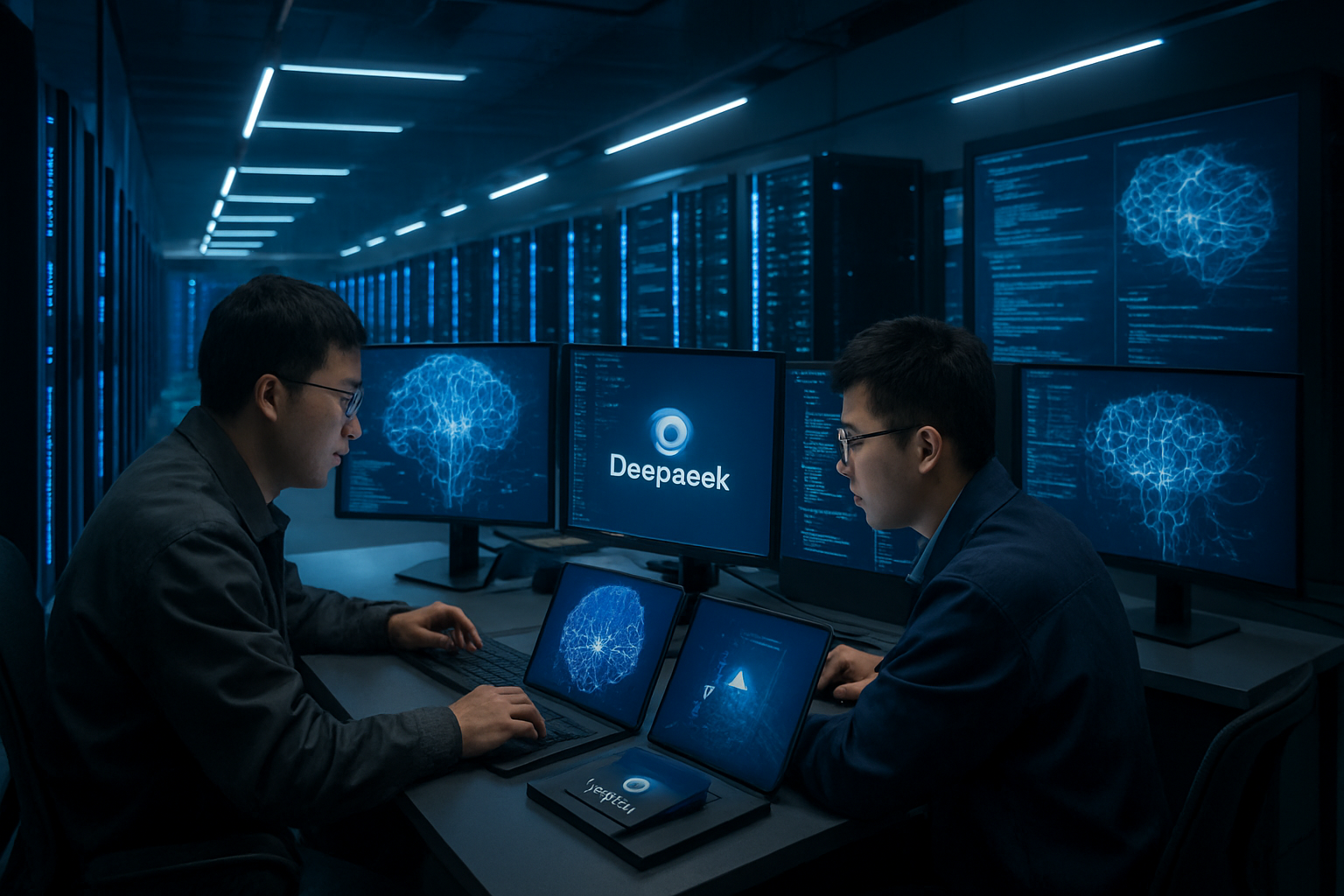
In a groundbreaking development that underscores China's accelerating drive toward technological self-reliance, AI startup DeepSeek announced that its revolutionary V4 model achieved seamless "day zero" compatibility with Huawei Technologies' newest Ascend 950PR and 950DT chips, marking a watershed moment in the global artificial intelligence competition.
The hardware-software collaboration between the two Chinese technology giants, unveiled during a Friday livestream just hours after the V4 model's release, represents a critical milestone in Beijing's strategic push to develop an indigenous AI ecosystem capable of competing with Western technological dominance. This partnership comes at a pivotal moment characterized by experts as the "April 2026 Civilizational Choice Point" – a decisive juncture determining whether AI development will serve democratic values or become a tool for technological control.
DeepSeek's Meteoric Rise Challenges Global AI Landscape
DeepSeek's emergence as a formidable challenger to U.S.-dominated AI services has fundamentally reshaped the global competitive landscape. The Hangzhou-based startup has achieved unprecedented breakthroughs throughout 2026, triggering what industry analysts term the "SaaSpocalypse" – a market disruption that eliminated hundreds of billions in traditional software market capitalization as AI demonstrated direct replacement capabilities for conventional solutions.
The company's revolutionary approach gained international attention when it successfully trained advanced models using restricted Nvidia Blackwell chips despite U.S. export controls, demonstrating sophisticated circumvention capabilities that alarmed Western policymakers. Intelligence sources suggest these systems are clustered at DeepSeek's Inner Mongolia data center, highlighting the company's strategic approach to accessing cutting-edge technology while maintaining operational security.
"This represents a fundamental shift in the global AI ecosystem," said industry analyst Chen Wei. "When Chinese AI models capture global leadership positions, it marks the first time the year-long U.S. market dominance has been successfully challenged."
— Chen Wei, Technology Strategy Institute
Strategic Implications of the Huawei-DeepSeek Alliance
The collaboration between DeepSeek and Huawei represents more than a technical achievement – it embodies China's comprehensive strategy to achieve complete technological sovereignty. Huawei's Ascend chips, developed as an alternative to restricted Western semiconductors, now demonstrate their capability to support world-class AI models, validating years of investment in indigenous chip development.
This partnership addresses critical infrastructure challenges facing the AI industry globally. With memory semiconductor prices surging sixfold and affecting major manufacturers Samsung, SK Hynix, and Micron until 2027, Chinese companies are developing memory-efficient algorithms and sustainable deployment strategies that potentially democratize AI access while reducing dependence on foreign suppliers.
Alibaba Chairman Joe Tsai previously identified three critical competitive advantages for Chinese AI development: superior power grid infrastructure providing stable AI energy, open-source commitment enabling collaborative development versus Western proprietary approaches, and complete domestic manufacturing supply chains reducing geopolitical vulnerability. The DeepSeek-Huawei collaboration exemplifies this strategic vision in practice.
Technological Sovereignty in Action
China's approach to AI development reflects a comprehensive national strategy addressing the "4-2-1 demographic problem" – where single children must support four aging parents and grandparents. This demographic pressure has accelerated AI and robotics investment as strategic responses to labor shortages and productivity challenges facing the world's most rapidly aging population.
The success of domestic AI development coincides with broader technological achievements across multiple sectors. China recently achieved world-leading nuclear power capacity of 125 million kilowatts while positioning hydrogen as a "strategic lever" for energy resilience. This integrated approach to energy and computing infrastructure provides the foundation for sustained AI advancement independent of foreign dependencies.
Chinese companies have also demonstrated remarkable scaling capabilities. Unitree Robotics expanded humanoid robot production from 5,500 to over 20,000 units in 2026, representing the fastest laboratory-to-commercial transition globally. Meanwhile, Midea Group committed 60 billion yuan ($8.7 billion) over three years for AI and embodied intelligence development, matching their previous five years' investment.
Global Competitive Response
Western technology leaders have responded to Chinese AI advancement with massive infrastructure investments despite ongoing constraints. Alphabet committed $185 billion to AI infrastructure in 2026 – the largest single-year corporate technology investment in history – while Amazon outlined plans exceeding $1 trillion over the coming decade.
However, these investments face significant challenges from the global semiconductor crisis. The World Bank projects AI water demand will reach 4.2-6.6 billion cubic meters annually by 2027 for data center cooling, equivalent to four to six times Denmark's total annual water consumption, creating additional sustainability pressures on Western AI development.
Nvidia CEO Jensen Huang previously warned that Chinese AI startups optimizing models on Huawei chips would create a "horrible outcome" for U.S. technological supremacy. His concerns reflect broader Western anxiety about China's ability to develop complete technological sovereignty – the capability to develop and deploy advanced AI without foreign dependency.
International Governance and Regulation
The DeepSeek-Huawei collaboration occurs amid unprecedented international coordination on AI governance. The United Nations established an Independent Scientific Panel with 40 global experts under Secretary-General António Guterres – the first fully independent international AI assessment body in history.
Regulatory intensification spans multiple jurisdictions, with Spain implementing the world's first criminal executive liability framework for technology platforms, creating imprisonment risks for executives. France has conducted AI company cybercrime raids, while the European Union pursues Digital Services Act violations with potential billion-dollar penalties.
These coordinated regulatory responses represent the most sophisticated global technology governance framework since internet commercialization, designed to prevent regulatory arbitrage while ensuring uniform standards across jurisdictions.
Success Models and Human-AI Collaboration
Despite competitive tensions, successful AI implementation models emphasize human-centered approaches that enhance rather than replace fundamental capabilities. Malaysia operates the world's first AI-integrated Islamic school, achieving 97.82% teacher placement while combining advanced technology with traditional learning methods.
Canadian universities have successfully deployed AI teaching assistants that maintain critical thinking standards, while Singapore's WonderBot 2.0 heritage education program demonstrates how AI can preserve cultural knowledge while leveraging technological advancement. These success models share common characteristics: treating AI as amplification tools versus replacement mechanisms, sustained human development commitment, and comprehensive stakeholder engagement.
Economic and Strategic Implications
China's systematic approach to AI development extends beyond technological capabilities to comprehensive economic strategy. The country achieved a logistics automation efficiency record of 13.9% GDP ratio through strategic AI implementation while announcing zero-tariff access for all 53 African countries with diplomatic relations, effective May 2026.
This diplomatic and economic integration demonstrates how technological capabilities support broader international engagement during domestic demographic pressures. The template could influence other aging societies globally facing similar challenges of maintaining productivity growth despite population decline.
Employment transformation represents another critical dimension of the AI revolution. While Western companies pursue traditional layoff strategies, Chinese firms emphasize comprehensive worker transition programs that emphasize reskilling versus displacement, potentially maintaining social stability during technological advancement.
Looking Forward: The Civilizational Choice Point
Industry experts characterize April 2026 as a "civilizational choice point" – a critical juncture determining whether AI development serves human flourishing and democratic values or becomes a tool for exploitation and control. The success of international coordination efforts will determine whether AI enhances human potential globally or exacerbates existing divisions.
The emergence of a multipolar AI landscape – featuring Chinese technological sovereignty, European regulatory frameworks, American corporate investments, and Global South participation – creates distributed capabilities that prevent single-entity dominance while enabling culturally sensitive development approaches.
Success in this critical period requires unprecedented coordination among governments, technology companies, educational institutions, and civil society organizations. The challenge involves balancing innovation acceleration with safety governance, commercial interests with human welfare, and national competitiveness with international cooperation.
The Path Forward
The DeepSeek-Huawei collaboration represents more than a technological achievement – it exemplifies a fundamental shift toward multipolar AI development that could reshape global technology governance for decades. The most promising path forward involves sophisticated human-AI collaboration that amplifies capabilities while preserving creativity, cultural understanding, and ethical reasoning that define human potential.
As the window for coordinated international action narrows, the decisions made in 2026 will establish human-AI relationship patterns that affect billions of people globally. The challenge lies in ensuring that AI serves humanity's highest aspirations while preserving the distinctly human qualities – wisdom, empathy, and cultural understanding – that artificial intelligence cannot replicate.
The success or failure of initiatives like the DeepSeek-Huawei partnership will ultimately determine whether the AI revolution fulfills its transformative promise or creates systemic disruption requiring dramatic corrections. The stakes could not be higher as humanity navigates this unprecedented transition from experimental AI to essential infrastructure that will define the remainder of the 21st century.