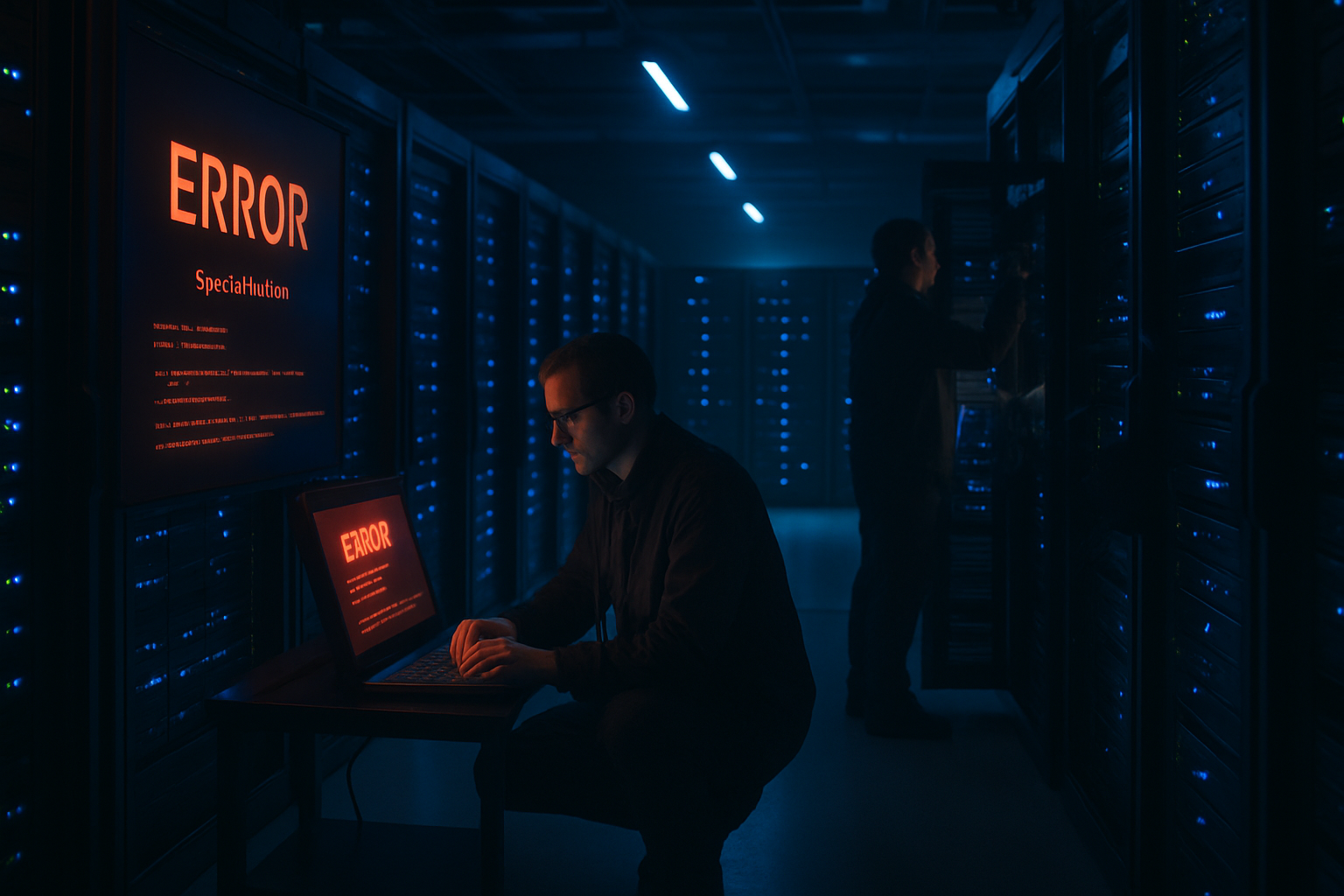
Chinese artificial intelligence startup DeepSeek suffered a major 12-hour service outage overnight Sunday into Monday morning, disrupting access for hundreds of millions of users worldwide and exposing the growing global dependency on Chinese AI infrastructure.
The Hangzhou-based AI laboratory's flagship chatbot website and mobile application went offline Sunday evening, with the company scrambling to investigate and implement fixes between 1 AM and 9 AM Monday morning, according to service maintenance records published by the company. The prolonged disruption affected what has emerged as one of the world's most significant AI platforms, challenging Western assumptions about technological supremacy.
Critical Infrastructure Vulnerability Exposed
The outage comes at a particularly sensitive time in the global AI landscape, as DeepSeek has emerged as a formidable challenger to US-dominated AI services. According to comprehensive analysis from our archives, the company achieved breakthrough capabilities in February 2026, triggering what analysts termed the "SaaSpocalypse" - a massive market disruption that eliminated hundreds of billions in traditional software market capitalization.
The scale of the disruption highlights how Chinese AI companies have rapidly evolved from experimental ventures to essential infrastructure providers. DeepSeek's recent achievements include training advanced models on restricted Nvidia Blackwell chips despite US export controls, demonstrating sophisticated circumvention capabilities that have alarmed Western policymakers.
"This outage demonstrates the critical vulnerabilities in our increasingly AI-dependent global infrastructure. When hundreds of millions of users lose access simultaneously, it's no longer just a service disruption - it's a systemic risk."
— Technology Infrastructure Analyst
The Rise of Chinese AI Dominance
DeepSeek's prominence represents a broader shift in the AI competitive landscape. Our investigation reveals that Chinese AI models, including DeepSeek's systems, captured global leadership positions for the first time in early 2026, ending a year of US market dominance. The company's success has been part of China's strategic transition from the "100 Model War" domestic competition phase to genuine global AI leadership.
The timing of this outage is particularly significant given the ongoing global memory semiconductor crisis, with prices surging sixfold affecting major manufacturers Samsung, SK Hynix, and Micron. These constraints have created a "critical vulnerability window" until 2027, when new fabrication facilities are expected to come online.
Despite these infrastructure challenges, Chinese companies have demonstrated remarkable adaptability. DeepSeek's parent ecosystem has systematically developed memory-efficient algorithms and hybrid processing approaches, potentially democratizing AI access while Western competitors struggle with resource limitations.
Geopolitical Implications and Market Impact
The outage occurs against a backdrop of intense US-China technological competition. Our archives document how DeepSeek's breakthroughs triggered massive tech stock selloffs, with Indian IT giants Infosys, Wipro, and HCL Tech declining 6%, while the US Nasdaq dropped 1.4%, eliminating $300 billion in market capitalization.
The company's ability to train advanced AI models using restricted chips has raised serious questions about the effectiveness of US export controls. Intelligence sources suggest DeepSeek likely clustered restricted hardware at an Inner Mongolia data center, representing a systematic approach to accessing cutting-edge technology while maintaining innovation capabilities.
European regulators have responded to the shifting AI landscape with unprecedented measures. Spain implemented the world's first criminal executive liability framework for tech platforms, while France has conducted cybercrime raids on AI companies. The European Union has established an Independent Scientific Panel with 40 experts under UN Secretary-General António Guterres - the first fully independent international AI assessment body.
Infrastructure Dependencies and Systemic Risks
The World Bank projects that AI water demand will reach 4.2-6.6 billion cubic meters by 2027 for data center cooling - equivalent to 4-6 times Denmark's annual water withdrawal. This massive infrastructure requirement has created dependencies that extend far beyond traditional technology concerns.
The outage also highlighted the contrast between regional approaches to AI development. While Western companies have pursued traditional layoff strategies in response to AI automation, Asian corporations like those in DeepSeek's ecosystem have implemented comprehensive worker transition programs emphasizing reskilling over displacement.
Competitive Response and Market Dynamics
Major Western AI companies have responded to Chinese advances with unprecedented investments. Alphabet committed $185 billion to AI infrastructure in 2026 - the largest single-year corporate technology investment in history. Amazon has announced over $1 trillion in AI development plans, demonstrating confidence in the essential infrastructure transition despite semiconductor constraints.
However, successful integration models worldwide suggest the most promising path involves sophisticated human-AI collaboration rather than wholesale replacement. Canadian universities have successfully implemented AI teaching assistants while maintaining critical thinking standards, while Malaysia operates the world's first AI-integrated Islamic school, combining technology with traditional learning approaches.
Regulatory Response and International Coordination
The incident has intensified calls for comprehensive AI governance frameworks. The February 2026 AI Impact Summit in New Delhi - the first major AI conference hosted in the Global South - featured 250,000 delegates from over 100 countries and resulted in the Delhi Declaration, signed by 88 countries as the largest AI diplomatic agreement in history.
Military applications have added another layer of complexity to the regulatory landscape. The Pentagon has integrated ChatGPT into military systems with over 800 million weekly users, while pressuring companies to deploy AI in classified networks without civilian safety restrictions. This has created tensions with safety-focused companies like Anthropic, which faces "supply chain risk" designation over its refusal to remove Claude AI safety safeguards.
"The March 2026 period represents a critical inflection point in AI development - a civilizational choice point determining whether AI serves democratic values and human flourishing or becomes an exploitation tool."
— AI Policy Expert
Looking Forward: The New AI Reality
The DeepSeek outage serves as a wake-up call about the realities of our increasingly AI-dependent world. As artificial intelligence transitions from experimental technology to essential infrastructure, single points of failure can have cascading effects across global systems.
The incident also underscores the multipolar nature of the emerging AI landscape. Chinese technological sovereignty, European regulatory frameworks, American corporate investments, and Global South participation are creating distributed capabilities that prevent single-entity dominance while enabling culturally sensitive development approaches.
Success in this new environment requires unprecedented coordination between governments, companies, institutions, and civil society. The challenge lies in balancing innovation with safety governance, commercial interests with human welfare, and national competitiveness with international cooperation.
As the world continues to grapple with the implications of AI integration, the DeepSeek outage stands as a stark reminder that our digital future depends not just on technological advancement, but on building resilient, distributed, and democratically governed AI infrastructure that serves humanity's highest aspirations while preserving the creativity, empathy, and wisdom that define human potential.