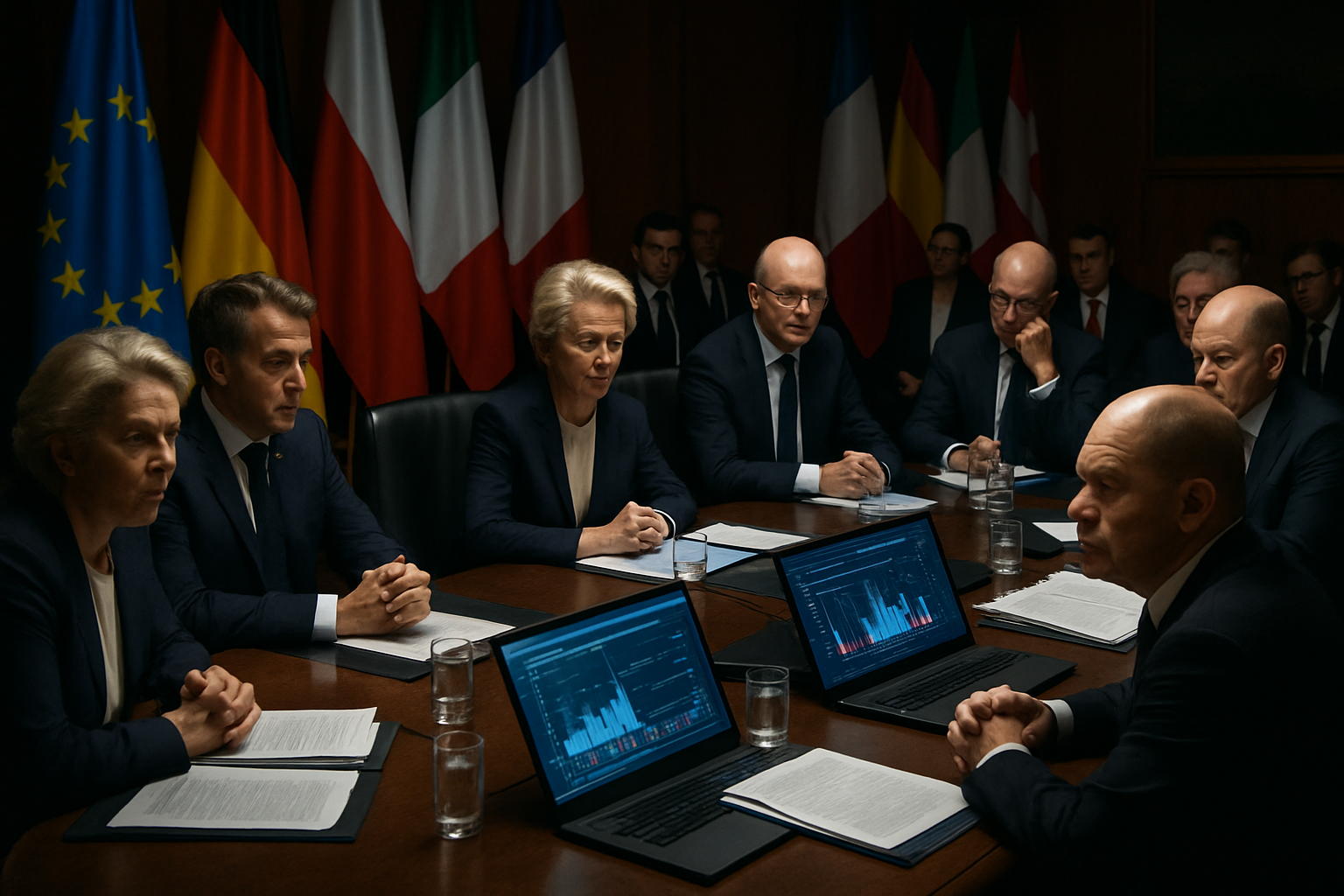
Europe faces its most severe political crisis since World War II as Denmark's Prime Minister Mette Frederiksen struggles to form a government following the worst Social Democratic performance in over a century, while Germany confronts the complete collapse of its liberal FDP party amid broader coalition instability.
The political earthquake that struck Denmark on March 25, 2026, represents far more than a national electoral setback. Frederiksen's Social Democrats secured just 21.9% of the vote—their weakest showing since 1903—creating unprecedented fragmentation with 12 parties clearing the parliamentary threshold for the first time in Danish history. Neither left nor right blocs achieved the 90-seat majority required to govern, forcing complex negotiations under King Frederik X's first government formation process.
Denmark's Greenland Gamble Backfires Spectacularly
Frederiksen's calculated electoral strategy, dubbed the "Greenland effect," was designed to capitalize on international acclaim for her defiant stance against former President Trump's territorial ambitions for the Arctic island. The snap election, called in February after working group meetings between US and Greenlandic representatives continued despite Danish resistance, was intended to convert foreign policy success into domestic political capital.
However, voters decisively prioritized economic concerns over sovereignty victories. Despite unprecedented European solidarity—including France and Canada opening the first consulates in Nuuk and NATO's Arctic Sentry mission providing security reassurance—exit polls revealed that cost-of-living issues, inflation, and housing costs dominated voter priorities.
"There is nothing today that can make me sad that the Social Democrats have once again become the Danes' absolute favourite political party," Frederiksen declared despite the historic defeat.
— Mette Frederiksen, Danish Prime Minister
The coalition mathematics present daunting challenges. Lars Løkke Rasmussen's Moderate Party has emerged as the crucial kingmaker, while Venstre leader Troels Lund categorically ruled out cooperation with Frederiksen, stating "either blue center government or opposition." King Frederik X formally appointed Frederiksen as royal investigator to explore all coalition possibilities, but the fragmented parliament suggests weeks of complex negotiations ahead.
Germany's Liberal Collapse Signals Broader Crisis
Germany's political landscape faces equally dramatic upheaval with the Free Democratic Party (FDP) confronting what analysts describe as "inevitable downfall." Party chairman Christian Dürr and the entire federal executive board announced their resignations at the May 2026 party conference following the party's failure to clear the crucial 5% threshold in consecutive state elections.
The FDP's collapse reflects three fundamental problems that have rendered the party politically irrelevant: organizational weakness, ideological confusion, and electoral insignificance. In Baden-Württemberg and Rhineland-Palatinate, the party failed to maintain parliamentary representation, marking a dramatic fall for a party that has historically served as a coalition kingmaker in German politics.
The crisis occurs amid broader German democratic challenges, with the far-right Alternative for Germany (AfD) achieving historic breakthroughs in western German regions previously considered immune to populist appeals. The AfD nearly doubled its support in Baden-Württemberg to 18%, becoming the third-largest party in a traditionally stable southwestern state.
Continental Democratic Stress Patterns
These developments are part of a broader European pattern that observers describe as the "most challenging period for continental democracy since World War II." Across the continent, traditional coalition mathematics are breaking down as voters turn away from established parties toward populist alternatives or express political fragmentation through highly dispersed vote shares.
The crisis extends beyond individual national politics. In France, municipal elections have been fundamentally altered by political violence following the death of Quentin Deranque in Lyon, with Marine Le Pen's National Rally achieving "authoritarian innovation" by evolving from rural populism to sophisticated urban campaigning. Sweden faces its own political realignment as the Liberal Party reportedly abandons decades of opposition to cooperation with the far-right Sweden Democrats.
Portugal's political system demonstrates relative stability, with José Luís Carneiro re-elected as Socialist Party secretary-general with 96.9% support, providing organizational continuity amid continental turbulence. However, even traditionally stable systems face pressure from economic uncertainty and changing voter expectations.
Foreign Interference and Democratic Resilience
The political crisis occurs amid sophisticated foreign interference operations targeting European electoral processes. Danish intelligence services issued warnings about potential Russian influence attempts during the March election, while Hungary faces documented evidence of Russian operatives supporting Viktor Orbán's Fidesz party ahead of April elections.
Despite these challenges, European democratic institutions have demonstrated fundamental resilience. Elections have been conducted with high standards of integrity, constitutional governance has been maintained, and peaceful power transitions continue even under unprecedented pressure. Slovenia's recent elections, despite foreign meddling allegations, proceeded successfully with international oversight.
Economic Pressures and Policy Implications
The political fragmentation carries significant economic implications for European integration and policy coordination. Germany's coalition weakness inadvertently strengthens extremist forces as governing partners focus on internal struggles rather than addressing citizens' concerns about inflation, housing costs, and economic security.
EU decision-making faces potential gridlock as key member states struggle with domestic political instability. Germany's central role in European leadership becomes complicated when the government lacks clear authority or mandate for ambitious policy initiatives. Denmark's situation similarly affects Nordic cooperation and Arctic policy coordination.
The crisis reflects deeper challenges facing European democracies: how to address legitimate citizen concerns about inequality, immigration, and national sovereignty while maintaining the institutional frameworks that have underpinned European success since 1945.
International Implications and Future Scenarios
The European political crisis extends beyond continental borders, affecting transatlantic relationships and global democratic governance models. The success or failure of European democracies in managing political extremism and institutional strain influences international perceptions of democratic resilience in an era of great power competition.
Coming months will prove decisive for European political development. French municipal elections serve as a 2027 presidential preview with significant implications for European leadership. German state elections throughout 2026 will test whether democratic parties can develop effective responses to populist challenges while maintaining coalition governance.
The Hungarian elections in April represent a crucial test case, with Viktor Orbán facing his most serious electoral challenge since 2010. Success for opposition forces would remove Brussels' most persistent internal critic, while Orbán's survival would demonstrate the political system's resilience despite unprecedented domestic and international pressures.
"Europe is writing the template for 21st-century crisis management that will determine the continent's trajectory for decades ahead."
— Senior EU Official
Template for Global Democratic Governance
The resolution of Europe's political crisis will establish crucial precedents for democratic governance in a complex global environment. Success in channeling political tensions through electoral competition while preserving institutional integrity would strengthen the European model of democratic development. Failure could accelerate democratic backsliding concerns that have characterized recent European political discussions.
The stakes extend beyond European governance to fundamental questions about liberal democratic viability in addressing 21st-century challenges. European institutions face a critical test of their capacity to adapt while preserving the values and democratic norms that have made the European project a global model for peaceful cooperation and prosperity.
As Europe navigates this unprecedented period of political uncertainty, the continent's response will influence global perceptions of democratic governance, international cooperation, and institutional adaptation under pressure. The success of European democracies in managing current challenges while maintaining effectiveness will determine not only the continent's trajectory but also provide templates for democratic governance worldwide.
The next several months represent a defining moment for European democracy, with outcomes that will resonate far beyond the continent's borders as the world watches how established democracies adapt to fundamental political transformation while preserving institutional integrity and democratic values.