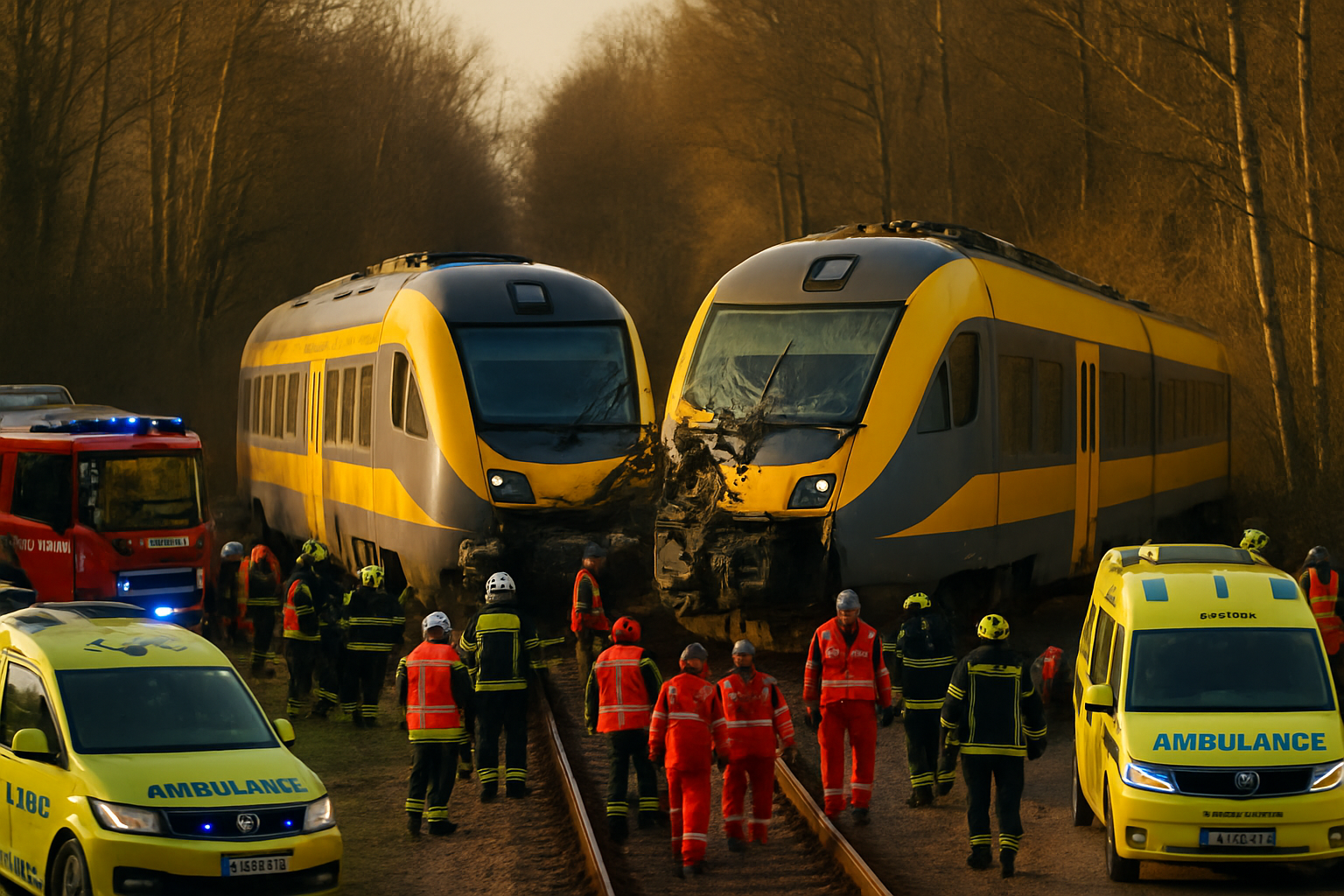
Two local trains collided head-on in Denmark on Thursday morning, injuring at least 17 people, four of whom are in critical condition, in what authorities are describing as a serious railway accident that has triggered one of the largest emergency responses in the region this year.
The collision occurred on a railway line linking the towns of Hillerød and Kagerup, approximately 40 kilometers north of Copenhagen, at around 7:00 AM local time. Public broadcaster DR showed dramatic images of two yellow and grey trains, both with significant damage to their front sections, facing each other in a wooded area following the impact.
Emergency Response and Casualties
Emergency services have confirmed that all passengers and crew members were successfully evacuated from both trains, with no one trapped inside the wreckage. The injured have been transported from the scene using both ambulances and helicopters, according to the fire department.
"It is two local trains that have collided head-on. There are injuries among the passengers. Everyone is out of the trains, so no one is trapped... Large resources have been dispatched to the scene."
— Emergency Services Spokesperson
The emergency response has been described as massive, with multiple fire trucks, ambulances, and medical helicopters deployed to the crash site. The scale of the response reflects both the seriousness of the incident and Denmark's comprehensive emergency preparedness protocols.
Investigation Underway
Danish police have launched a comprehensive investigation into the cause of the collision. Initial reports suggest the accident occurred near a level crossing, though investigators are examining all potential factors including signal systems, track conditions, and operational procedures.
The incident has prompted immediate safety reviews of the affected railway line, with replacement bus services deployed to maintain transportation for thousands of commuters who rely on this critical connection between suburban communities and the Copenhagen metropolitan area.
Transportation Safety Context
This collision occurs within the broader context of what transportation safety experts have described as one of the most challenging years for European transportation infrastructure since the COVID-19 pandemic. Denmark has experienced various railway disruptions throughout 2026, including signal failures and weather-related complications that have tested the resilience of the country's normally reliable public transportation network.
The accident comes amid ongoing discussions about infrastructure modernization across Europe, with significant investments being made in railway safety systems, predictive maintenance technologies, and emergency response coordination protocols.
International Support and Response
Sweden has offered assistance to Denmark as part of the countries' long-standing emergency cooperation agreements. Swedish Prime Minister Ulf Kristersson expressed readiness to provide support if needed, reflecting the strong cross-border collaboration that characterizes Nordic emergency response capabilities.
The incident has drawn attention from transportation safety authorities across Europe, with many viewing it as a test case for modern emergency response protocols and inter-agency coordination during major transportation accidents.
Impact on Regional Transportation
The collision has significantly disrupted railway services throughout the region, affecting thousands of daily commuters who depend on the Hillerød-Kagerup line for access to Copenhagen. Transportation authorities have implemented emergency bus services to maintain connectivity, though delays and overcrowding are expected to continue while the investigation proceeds and repairs are completed.
The economic impact extends beyond immediate transportation disruption, affecting business operations, tourism, and regional commerce that depends on reliable rail connections between suburban communities and Denmark's economic center.
Safety Technology and Prevention
Denmark has been at the forefront of implementing advanced railway safety technologies, including automated train protection systems and real-time monitoring capabilities. Investigators will examine whether these systems functioned properly during the incident and what additional measures might be needed to prevent similar accidents.
The collision highlights ongoing challenges in balancing operational efficiency with comprehensive safety protocols, particularly during peak commuting hours when train frequency is highest and margin for error is smallest.
Recovery and Future Implications
As emergency responders continue their work and investigators begin their comprehensive examination of the accident, attention is turning to lessons that can be learned and improvements that can be implemented to enhance railway safety across Denmark and the broader Nordic region.
The incident serves as a reminder of the critical importance of robust emergency response systems and the ongoing need for investment in transportation safety infrastructure. Recovery efforts are expected to continue for several days, with full restoration of normal railway services dependent on the completion of safety inspections and any necessary track repairs.
Danish authorities have promised a thorough and transparent investigation, with findings expected to influence railway safety protocols not only in Denmark but across the European transportation network. The focus remains on supporting the injured passengers and their families while working to understand and prevent similar incidents in the future.