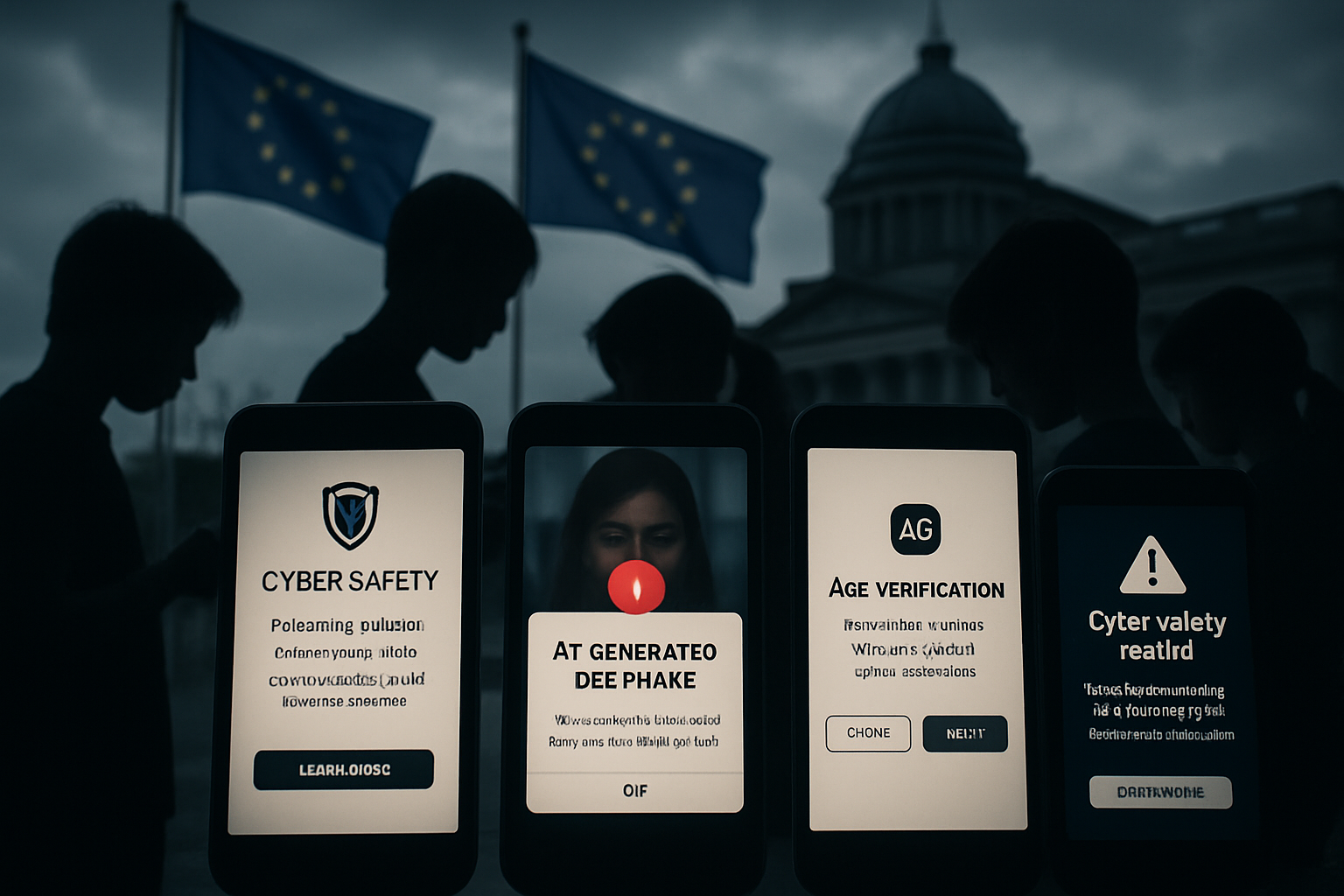
Danish authorities have issued urgent warnings about a surge in extortion schemes using AI-generated nude images, highlighting a growing digital threat to children as European lawmakers implement unprecedented social media age restrictions and platform accountability measures.
The Danish National Cyber Security Centre (NSK) confirmed to major outlets Politiken and Jyllands-Posten that artificial intelligence-powered blackmail schemes are spreading rapidly across the country, targeting victims with fabricated nude images that appear authentic. The sophisticated scams represent a dangerous evolution in cybercrime, exploiting advances in generative AI technology to create convincing fake content.
AI Deepfake Extortion Emerges as Major Threat
Police investigations reveal that criminals are using readily available AI tools to create convincing nude imagery by superimposing victims' faces onto explicit photos. The perpetrators then demand payment or threaten to distribute the fabricated images across social networks and messaging platforms.
"This represents a new frontier in digital exploitation," explained cybersecurity experts familiar with the Danish cases. "The ease with which realistic fake content can now be generated has lowered the barrier for cybercriminals significantly."
The Danish warning comes as similar AI-powered scams have been reported across multiple European countries, suggesting a coordinated criminal network exploiting the technology's rapid advancement. Law enforcement agencies are struggling to keep pace with the sophisticated methods being employed.
Smartphone Exposure Damages Child Development
Meanwhile, groundbreaking research published throughout 2025 has revealed alarming evidence about early smartphone exposure's impact on children's cognitive development. Studies cited by major international outlets show clear connections between early device usage and sleep disorders, weight problems, and diminished cognitive abilities among children and adolescents.
Dr. Ran Barzilay, a child psychiatrist at the University of Pennsylvania, conducted one of the largest studies examining the relationship between screen time and developmental outcomes. His research found that intensive early exposure to smartphones and tablets creates measurable deficits in attention, memory formation, and emotional regulation among young users.
"Although devices often make parents' daily organization easier, experts warn that early and intensive exposure to screens can have serious consequences for children's health and development."
— Research findings cited in Bosnian media reports
The studies demonstrate that children exposed to smartphones before age 5 show significantly higher rates of sleep disruption, with many experiencing difficulty establishing healthy sleep patterns that persist into adolescence. Weight management issues also correlate strongly with early device adoption, as physical activity decreases while sedentary screen time increases.
Polish Public Supports Social Media Age Restrictions
Public opinion across Europe increasingly favors protective measures for children online. New polling data from Poland reveals that a majority of citizens support banning social media access for children under 16, reflecting growing awareness of digital platforms' potential harms.
The Polish survey results align with similar sentiment across European Union member states, where concerns about children's digital welfare have reached a tipping point. Parents report feeling overwhelmed by the challenge of managing their children's online exposure while technology companies resist meaningful age verification measures.
"The Polish data represents a broader European awakening to the reality that current digital platforms are fundamentally incompatible with healthy child development," noted digital policy experts tracking the evolving regulatory landscape.
European Regulatory Revolution Accelerates
The Danish deepfake warnings and Polish polling data emerge against the backdrop of Europe's most aggressive digital platform regulation in history. Spain has implemented criminal liability for social media executives, while multiple other EU nations are pursuing coordinated age restriction policies that could reshape the global internet landscape.
Current European initiatives include Spain's comprehensive under-16 social media ban with executive criminal liability, Greece's approaching under-15 restrictions via the Kids Wallet application, and formal consultations in France, Denmark, and Austria. The United Kingdom has launched official reviews of similar measures.
These coordinated efforts represent a fundamental shift from industry self-regulation to government enforcement with meaningful legal consequences. For the first time, technology executives face potential criminal prosecution for platform violations, creating unprecedented personal accountability.
Technology Industry Faces Resistance and Adaptation
The technology sector has responded with fierce opposition to the regulatory wave. High-profile executives have characterized European measures as authoritarian overreach, while simultaneously investing billions in infrastructure to comply with emerging requirements.
Industry leaders argue that blanket age restrictions could stifle innovation and limit young people's access to educational opportunities and social connections. However, critics point to mounting evidence of platform-engineered addiction features and the documented harms of early social media exposure.
"The era of unlimited freedom in the online world may be ending for young people across Europe."
— European policy officials describing the regulatory momentum
Platform companies are now racing to develop robust age verification systems that balance effectiveness with privacy concerns. Technical solutions must distinguish between adult and minor users without creating comprehensive surveillance infrastructure that could enable broader government monitoring.
Global Implications and Implementation Challenges
The European approach has attracted international attention as other regions consider similar measures. Australia's successful implementation of under-16 social media restrictions, which eliminated 4.7 million teen accounts since December 2025, provides a working model for enforcement.
However, implementation faces significant technical and philosophical challenges. Real age verification systems may require biometric authentication or identity document validation, raising privacy concerns among civil liberties advocates. Cross-border enforcement requires unprecedented international cooperation between regulatory authorities.
The criminal liability framework for executives represents the most controversial element, as it creates personal legal risks beyond traditional corporate penalties. Success or failure of these measures will likely determine whether similar approaches spread globally or face coordinated industry resistance.
Child Safety as Democratic Test Case
Experts characterize the current moment as a critical test of democratic governments' ability to regulate multinational technology platforms. The balance between child protection, digital rights, and economic competitiveness will establish precedents affecting millions of families worldwide.
The Danish deepfake warnings underscore the urgency of effective digital governance, as criminal networks exploit technological advances faster than legal frameworks can adapt. Without coordinated international responses, sophisticated AI-powered crimes will continue targeting society's most vulnerable members.
As European lawmakers prepare for implementation throughout 2026, the success or failure of these groundbreaking measures will influence global approaches to technology governance for decades to come. The stakes extend far beyond social media regulation to fundamental questions about democracy, childhood, and human agency in the digital age.