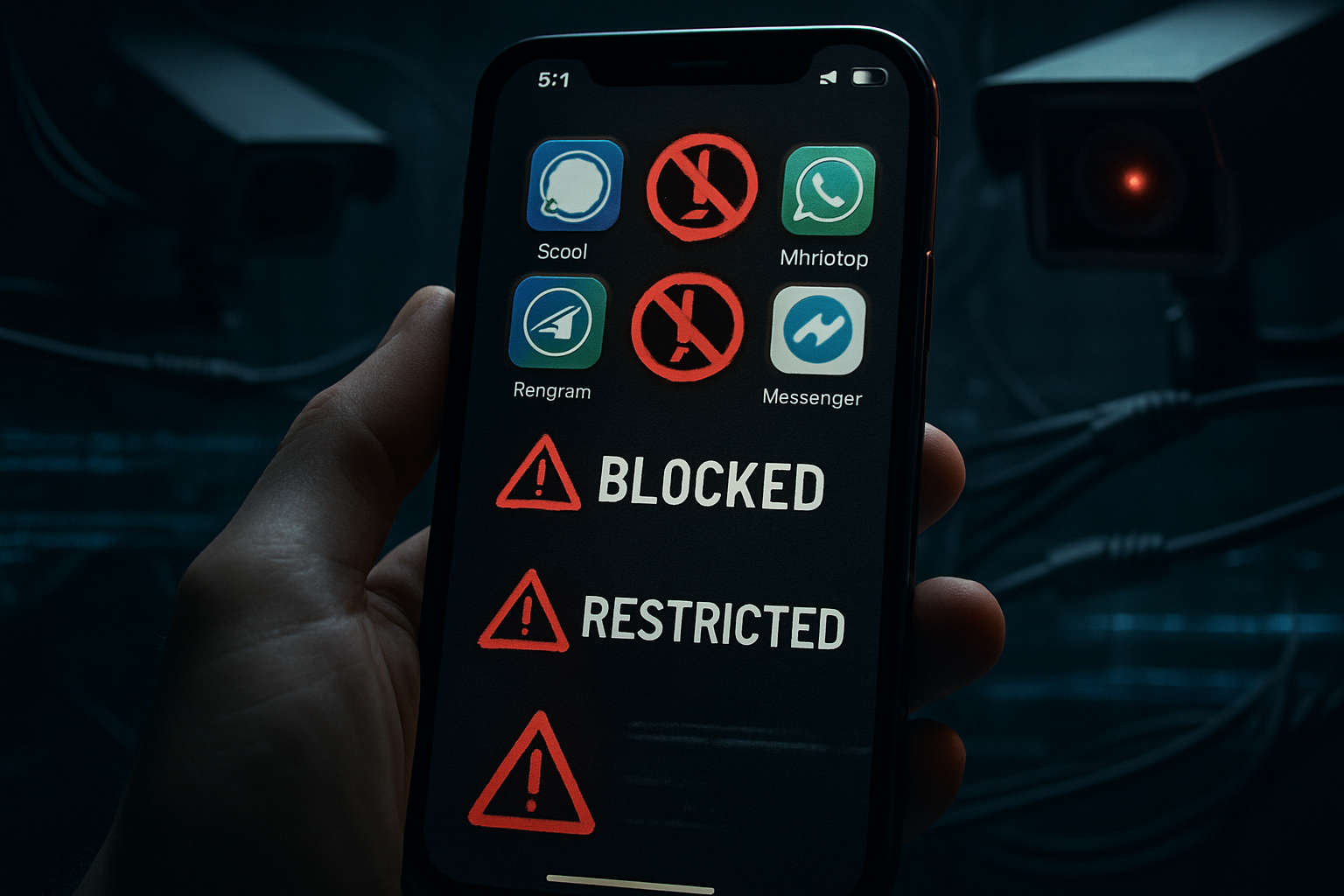
As Ukrainian drone strikes intensify across Russian territory, authorities have implemented widespread communications blackouts and internet restrictions affecting millions of users, while forcing citizens toward state-controlled messaging platforms that experts warn contain dangerous surveillance capabilities.
This comprehensive investigation reveals how Russia's systematic digital control campaign has escalated dramatically in March 2026, coinciding with unprecedented global developments in digital privacy and internet regulation that are reshaping the fundamental relationship between governments, technology companies, and citizen rights worldwide.
Russia's Digital Iron Curtain Descends
Russian authorities have implemented what sources describe as comprehensive "security blackouts" as Ukrainian drone attacks target infrastructure across the country. The restrictions, justified by officials as necessary protective measures, have effectively cut off millions of citizens from independent communication channels.
The timing appears deliberate. As Al Jazeera reports, Russians are increasingly "scrambling for information" as traditional communication methods fail them. "My phone is a brick," one Moscow resident told international media, describing the systematic degradation of internet services that has left citizens dependent on state-controlled information sources.
"The authorities have implemented blackouts citing 'security concerns,' but the real effect is informational isolation at a time when citizens most need access to independent sources."
— Digital rights researcher, speaking on condition of anonymity
This represents the culmination of Russia's "sovereign internet" campaign, which began systematically in 2022 but has accelerated dramatically following the February 2026 passage of unprecedented FSB communications control legislation. The new law grants Russia's Federal Security Service authority to shut down internet services, mobile communications, and even postal services without requiring specific security threat justification.
The Telega Deception: When Alternatives Become Surveillance Tools
As traditional messaging platforms like Telegram face systematic blocking, millions of Russians have turned to alternatives like "Telega" – an unofficial Telegram client launched in 2025 by Kazan-based company AO "Telega." However, expert analysis reveals this supposed alternative may be more dangerous than the original platform it replaces.
According to comprehensive investigations by Russian digital rights organization Meduza, Telega has been "intercepting user correspondence" from its launch. The app, while appearing to offer similar functionality to Telegram, lacks the end-to-end encryption that makes secure communication possible.
"Telega is not just inadequate – it's actively dangerous," warns one cybersecurity expert familiar with the platform's technical architecture. "Users believe they're maintaining privacy while actually handing all their communications directly to monitoring systems."
The revelation represents a sophisticated evolution in digital control tactics. Rather than simply blocking platforms, authorities now promote alternatives that appear to offer similar functionality while secretly compromising user security. This approach allows governments to maintain plausible deniability while achieving comprehensive surveillance capabilities.
Growing Public Frustration with Digital Restrictions
Despite official justifications, sources indicate growing public frustration with the systematic erosion of digital communications. A regional official in Russia's Central Federal District, speaking to Meduza, revealed the broader context:
"Telegram is not just minor details or particulars compared to the general blockages. Now Moscow has synchronized with us. Some people even gloat about this: we suffer – and you suffer too."
— Regional official, Central Federal District
This admission reveals how communication restrictions, initially targeted at specific regions, have now expanded to affect even Moscow residents. The "synchronization" mentioned suggests a coordinated national approach to digital control that transcends local implementation.
The phrase "полный хаос, в общем" ("complete chaos, in general") used by Russian officials to describe the current situation reflects the difficulty authorities face in managing public sentiment while maintaining information control. Citizens who previously enjoyed relatively unrestricted internet access now find themselves subject to the same limitations long experienced in more tightly controlled regions.
Global Context: A Worldwide Crisis in Digital Rights
Russia's actions occur within a broader global crisis affecting digital privacy and internet freedom. Our investigation, drawing on comprehensive analysis of international developments, reveals how democratic and authoritarian governments alike are implementing unprecedented restrictions on digital communications.
The Netherlands recently suffered one of Europe's largest telecommunications breaches, with the Odido hack affecting 6.2 million customers – nearly one-third of the country's population. Cybersecurity experts describe the stolen data as a "gold mine for criminals," including location information, communication patterns, and personal identification details.
Meanwhile, global cybersecurity incidents have surged 20.6% in the fourth quarter of 2025 according to Jordan's National Cybersecurity Center, with 1,012 attacks documented, 1.8% classified as serious threats to national infrastructure.
The Infrastructure Vulnerability Crisis
A critical factor complicating global digital security efforts is the ongoing semiconductor shortage, which has created what experts term a "critical vulnerability window." Memory chip prices have increased sixfold, affecting major manufacturers including Samsung, SK Hynix, and Micron, with supply constraints expected to persist until 2027 when new fabrication facilities come online.
This shortage affects not just consumer electronics but the security infrastructure governments and companies need to protect against sophisticated cyber threats. Criminal organizations are actively exploiting these resource limitations, using artificial intelligence to enhance their capabilities.
"Personal data has become the currency of the digital age. We're seeing criminals use AI chatbots as 'elite hackers' for automated vulnerability detection and data theft."
— Maria Christofidou, Cyprus Data Protection Commissioner
International Cooperation and Enforcement Challenges
Despite these challenges, international law enforcement has achieved some notable successes through coordinated action. The recent takedown of LeakBase, one of the world's largest stolen data trading forums, required cooperation between Dutch police, Europol, the FBI, and agencies from 13 countries. Similarly, the dismantling of the Tycoon2FA phishing service involved 330 domains across multiple jurisdictions.
However, experts warn that traditional enforcement mechanisms remain inadequate against digitally native criminal organizations capable of instantly relocating operations across jurisdictions. Estonia's ongoing collaboration with Ukraine in combating international phone scamming operations, despite wartime conditions, demonstrates both the potential for cooperation and the extensive resources required.
The speed of technological change and the ease with which criminal operations can relocate compound coordination challenges, requiring unprecedented levels of international cooperation and resource sharing.
Alternative Approaches: Education Versus Enforcement
While European nations increasingly turn to regulatory enforcement and criminal liability frameworks for technology executives, other countries are exploring alternative approaches. Malaysia emphasizes parental responsibility through digital safety campaigns, with Communications Minister Datuk Fahmi Fadzil stressing that parents must control device access rather than relying on platforms as "digital babysitters."
Similarly, Oman has implemented "Smart tech, safe choices" educational initiatives focusing on conscious digital awareness and teaching citizens to recognize what they term "digital ambushes" – situations where attackers exploit natural security curiosity.
This philosophical divide between government intervention and individual agency represents a fundamental choice in digital governance approaches. European regulatory enforcement contrasts sharply with Asian education and awareness strategies, reflecting different cultural and political approaches to technology governance.
The Stakes: Democratic Society in the Digital Age
March 2026 represents what many experts consider a critical inflection point for global digital governance. The convergence of authoritarian digital control measures, democratic regulatory responses, and escalating cybersecurity threats is creating unprecedented challenges for maintaining both security and freedom in digital spaces.
Russia's systematic information isolation strategy, combined with the promotion of surveillance-enabled alternatives, provides a template that other authoritarian regimes may adopt. Meanwhile, democratic nations struggle to balance legitimate security concerns with the preservation of digital rights and international communication capabilities.
The success or failure of current international cooperation efforts will establish precedents for 21st-century technology governance affecting billions of people globally. The stakes extend beyond individual privacy to include the preservation of democratic society itself amid escalating cyber threats and systematic privacy erosion.
Looking Forward: The Need for Coordinated Action
Experts emphasize that addressing these challenges requires unprecedented international cooperation combining technological innovation with human expertise, proactive prevention with responsive enforcement, and local adaptation with global coordination.
The window for effective coordinated action appears to be narrowing as criminal capabilities advance faster than defensive measures, and authoritarian regimes refine their digital control techniques. Success will require sophisticated approaches that preserve creativity, cultural understanding, and democratic governance while harnessing technology's transformative potential.
As one senior digital rights advocate concluded: "The fundamental question is whether digital technologies will serve human flourishing and democratic values, or become surveillance and control tools beyond democratic accountability. The decisions made in 2026 will determine the answer for decades to come."
The crisis in Russia, while severe, represents just one front in a global struggle over the future of digital communication, privacy rights, and the balance between security and freedom in an increasingly connected world. The outcome will shape not just how citizens communicate, but how democratic societies function in the digital age.