Djibouti's veteran leader Ismaïl Omar Guelleh has secured his sixth consecutive presidential term with an overwhelming 97.8% of the vote, according to official results announced Saturday, extending his rule over the strategic Red Sea nation to 27 years.
The 77-year-old incumbent claimed victory on his social media accounts on Saturday morning following Friday's election, marking a historic achievement that positions him among Africa's longest-serving leaders alongside Cameroon's Paul Biya and Equatorial Guinea's Teodoro Obiang.
Official results showed Guelleh received 97.8% of votes cast in the election, with the remaining 2.2% scattered among opposition candidates. The landslide victory enables the veteran leader to govern until 2031, extending his uninterrupted rule that began in 1999 when he succeeded his uncle, Hassan Gouled Aptidon.
Constitutional Changes Enable Extended Rule
Guelleh's candidacy for a sixth term was made possible by constitutional amendments passed in 2025 that removed presidential age limits, clearing the path for the 77-year-old to seek re-election. The amendments sparked debate about democratic legitimacy, as critics argued they were implemented without broader public consultation.
The changes reflect a broader pattern across the African continent where constitutional modifications have enabled long-serving leaders to extend their rule, raising questions about democratic governance and term limits enforcement.
Prior to the constitutional amendments, Guelleh had already served longer than most African leaders, having taken office when Bill Clinton was still serving as U.S. President and Vladimir Putin had just begun his first term in Russia.
Strategic Importance in Global Politics
Djibouti's strategic location at the southern entrance to the Red Sea has made the small nation of approximately one million people a crucial hub for international military operations and maritime security. The country hosts military bases for the United States, China, France, and Italy, making it one of the most strategically significant locations in the Horn of Africa.
The continued stability under Guelleh's leadership has been viewed favorably by international partners who rely on Djibouti as a base for counter-piracy operations, anti-terrorism efforts, and monitoring of crucial shipping lanes through which billions of dollars in global trade passes annually.
China's growing influence in the region through infrastructure investments under the Belt and Road Initiative has further elevated Djibouti's geopolitical importance, with the nation serving as a key gateway for Chinese economic engagement across Africa.
Election Conduct and Turnout
The election proceeded smoothly across the small nation, though reports from the capital and other urban centers described varying levels of voter participation throughout the day. International observers monitored the electoral process, given the significant regional security implications of Djibouti's political stability.
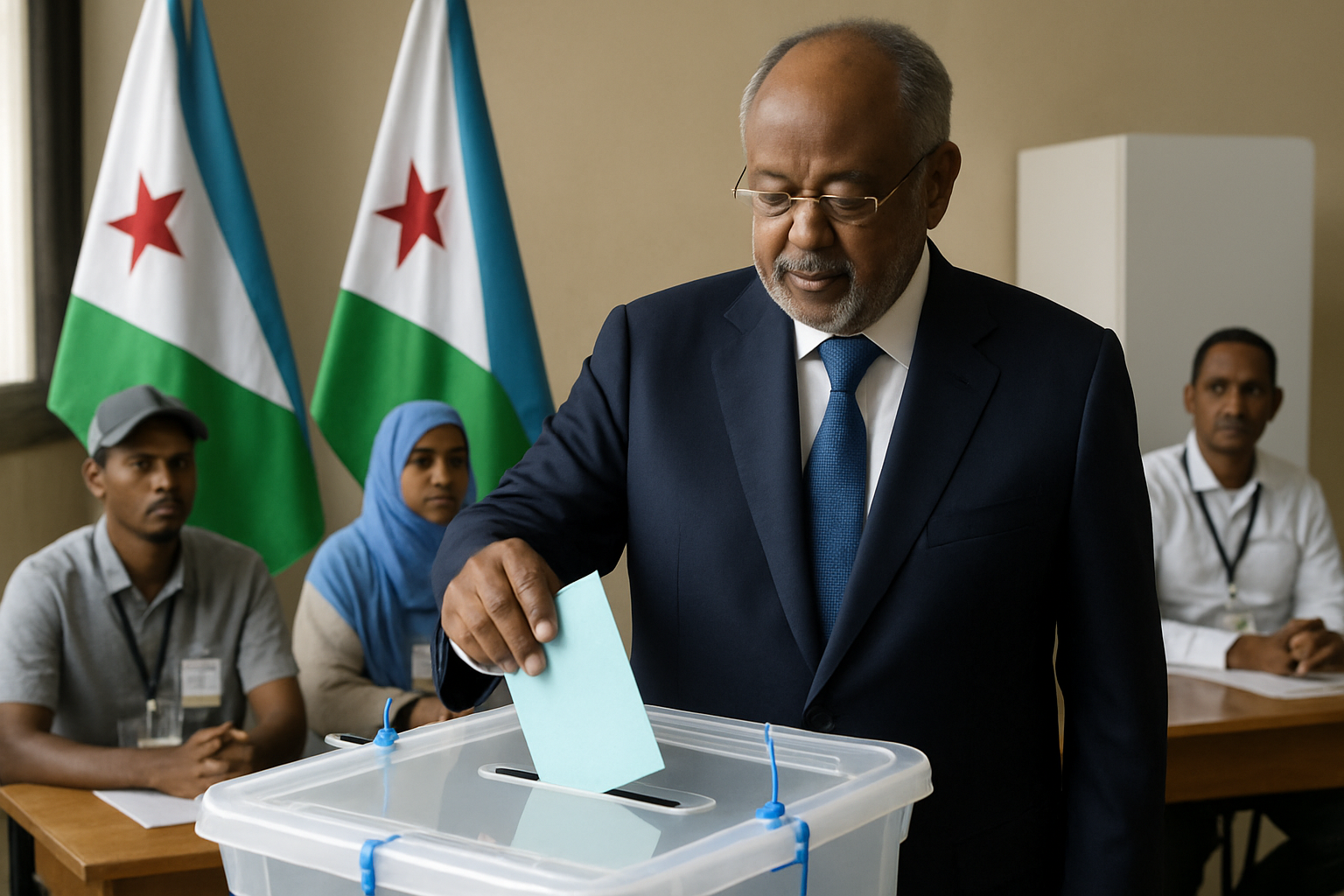
Guelleh cast his vote at the City Hall polling station in Mouloud, as captured in images that showed the veteran leader participating in the democratic process he has overseen for more than two decades.
The overwhelming victory margin reflects both the incumbent's political dominance and the limited nature of opposition competition in the small Red Sea nation, where alternative political movements face significant structural challenges.
Regional and International Implications
Guelleh's extended tenure places him in an exclusive group of African leaders who have governed for multiple decades. His 27-year rule surpasses that of many of his continental peers and positions him as one of the world's longest-serving current heads of state.
The election results have significant implications for Horn of Africa stability, given Djibouti's role as a mediator in regional conflicts and its hosting of peace negotiations between various regional actors. The continuity provided by Guelleh's extended rule has been viewed by some international partners as beneficial for long-term planning and regional security cooperation.
However, the concentration of power in one individual for nearly three decades also raises questions about democratic development and political succession planning in the small nation.
Economic Development and Challenges
Under Guelleh's leadership, Djibouti has pursued an ambitious infrastructure development strategy, leveraging its strategic location to become a regional logistics and transportation hub. Major projects include port expansions, railway connections to neighboring Ethiopia, and free trade zones designed to attract international investment.
The nation's economy has benefited significantly from hosting international military facilities, which provide substantial revenue streams and employment opportunities for the local population. However, critics point to persistent challenges including youth unemployment and the need for economic diversification beyond the services and logistics sectors.
Guelleh's extended mandate will provide continuity for ongoing development projects while maintaining the stable political environment that international partners have come to rely upon in an often turbulent region.
Democratic Legitimacy Questions
The overwhelming victory margin and the constitutional changes that enabled Guelleh's sixth-term candidacy have sparked discussions about democratic governance in Djibouti. Opposition groups and civil society organizations have raised concerns about political space and the concentration of power in the executive branch.
International observers continue to monitor democratic institutions in Djibouti, particularly given the strategic importance of maintaining stability in a region that has experienced significant political upheaval in neighboring countries.
The election results reflect the complex balance between democratic governance and stability that characterizes many African nations, where long-serving leaders argue that continuity is essential for development and security in challenging regional environments.
Looking Ahead: The Next Five Years
Guelleh's sixth term will extend his presidency until 2031, making him one of the few African leaders to serve continuously for over three decades. His administration will face ongoing challenges including youth employment, climate adaptation, and maintaining Djibouti's strategic relevance in an evolving global security environment.
The veteran president's extended mandate provides an opportunity to cement his development legacy while preparing for eventual political transition in a nation where his leadership has become synonymous with stability and strategic importance.
As Djibouti continues to serve as a crucial hub for international cooperation in the Horn of Africa, Guelleh's historic sixth term victory ensures continuity in a region where predictable governance has become increasingly valuable for global partners navigating complex security and economic challenges.