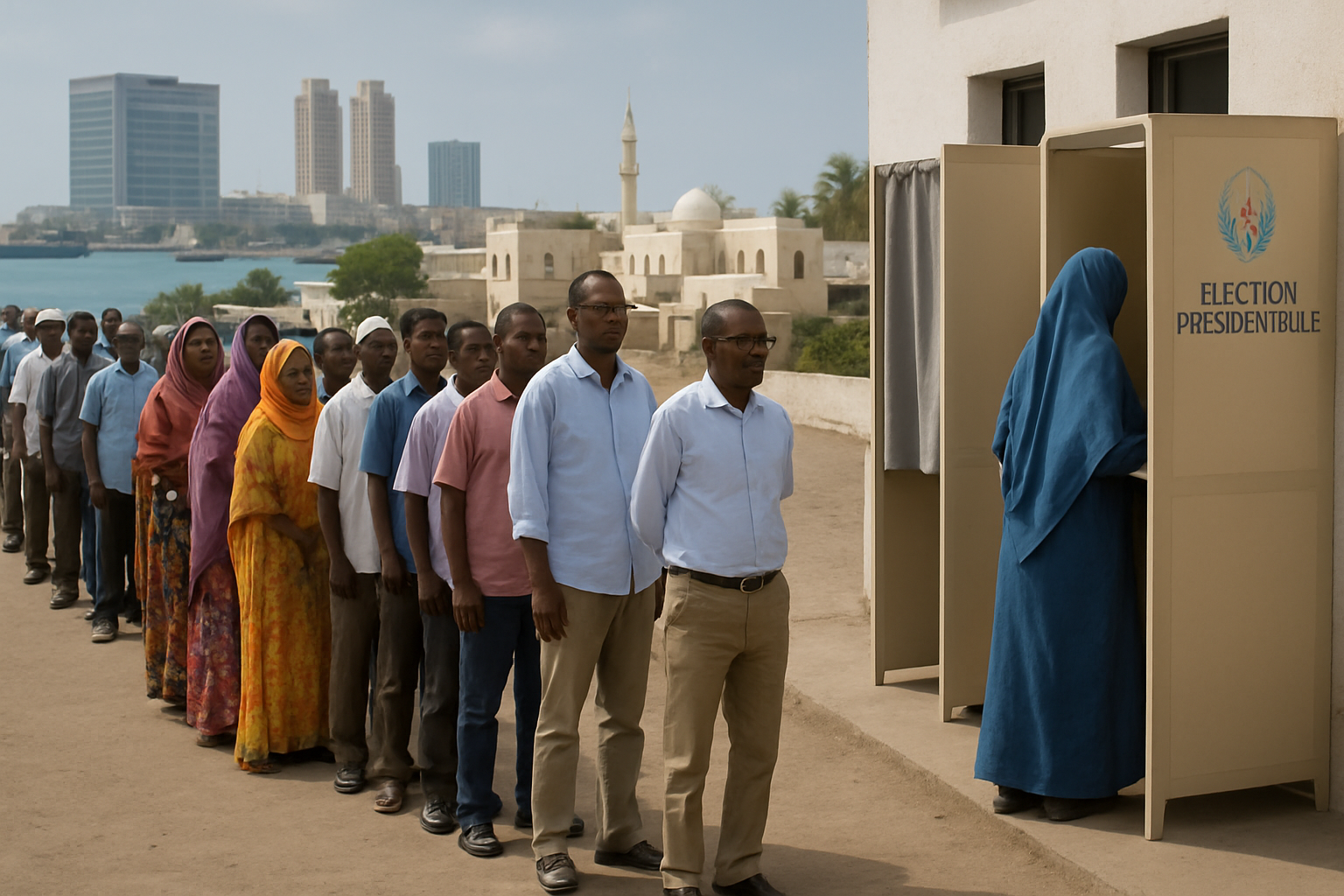
Citizens of Djibouti headed to the polls Friday in a pivotal presidential election as incumbent Ismail Omar Guelleh seeks a sixth consecutive term, with early reports indicating significantly low voter turnout that could impact the legitimacy of the Horn of Africa nation's democratic process.
Voting commenced across the strategically located Red Sea nation amid conflicting reports about citizen participation. While the Ethiopian News Agency initially reported strong turnout with voters gathering in large numbers at polling stations nationwide, subsequent reporting from multiple international outlets painted a starkly different picture of sparse participation in the capital and surrounding areas.
The election carries unprecedented constitutional significance following last year's decision by politicians to scrap presidential age limits, enabling the 77-year-old Guelleh to run for an additional term. This constitutional amendment has drawn scrutiny from international observers who question the democratic legitimacy of removing term restrictions without broader public consultation.
Constitutional Changes and Democratic Concerns
The removal of presidential age limits represents a dramatic shift in Djibouti's governance structure. The constitutional change, approved by parliament in 2025, cleared the path for Guelleh to extend his rule beyond what would have been constitutionally mandated retirement. Critics argue this follows a troubling pattern across Africa where incumbent leaders modify fundamental laws to extend their tenure.
Guelleh, who has governed Djibouti since 1999, would become one of Africa's longest-serving leaders if successful, joining the ranks of leaders like Cameroon's Paul Biya and Equatorial Guinea's Teodoro Obiang who have ruled for decades. His presidency has spanned nearly a quarter-century of significant geopolitical changes in the Horn of Africa region.
Strategic Importance in Regional Context
Djibouti's presidential election carries implications far beyond its borders due to the country's strategic position at the entrance to the Red Sea shipping lane. The nation hosts military bases for multiple global powers, including the United States, China, France, and Italy, making political stability crucial for international maritime security.
The timing of the election coincides with increasing tensions in the Red Sea corridor, where maritime security has become a critical concern for global trade. Djibouti's ports handle significant traffic for landlocked Ethiopia and serve as a vital link between Africa and the Arabian Peninsula.
Low Turnout Raises Questions
The most striking aspect of Friday's election was the dramatically different accounts of voter participation. While initial reports suggested robust turnout, later coverage from Africanews and other outlets described "only a trickle of people showing up at polling stations in the early hours in the capital."
This disparity in reporting highlights potential challenges in transparent election monitoring and raises questions about voter enthusiasm for the democratic process. Low turnout could undermine the legitimacy of results, particularly in an election where constitutional changes have already sparked controversy.
International election observers will be closely monitoring participation rates as well as the conduct of voting and counting processes to assess whether the election meets international standards for free and fair democratic participation.
Opposition Challenges and Political Landscape
While specific details about opposition candidates were limited in available reporting, the election represents a crucial test for Djibouti's multi-party democratic system. The country has maintained relative stability compared to some regional neighbors, but questions persist about the space available for genuine political competition.
The constitutional changes enabling Guelleh's continued candidacy have altered the political calculus for opposition parties, who must now contend with the possibility of indefinite incumbent rule rather than constitutionally mandated transitions.
Economic and Social Context
Djibouti faces significant economic challenges despite its strategic advantages. High youth unemployment, limited natural resources beyond its strategic location, and dependence on port revenues create pressure for economic diversification. The election outcome will influence approaches to addressing these structural challenges.
The country's small population of approximately one million people makes it unique among African nations, but also creates vulnerabilities in terms of economic resilience and political representation. Ensuring broad-based participation in governance becomes crucial for maintaining social stability.
International Implications
The election results will be closely watched by international partners who rely on Djibouti's stability for their strategic interests in the region. Any signs of political unrest or disputed results could complicate military base operations and regional security cooperation.
The United States, China, and European powers all maintain significant military or economic interests in Djibouti, making peaceful democratic transitions a priority for international stakeholders. The country's role in counter-terrorism operations and maritime security makes political stability essential.
Looking Ahead
As vote counting proceeds, attention will focus on both the margin of victory and the overall participation rates. A decisive victory with strong turnout would provide legitimacy, while contested results or very low participation could create challenges for governance and international relations.
The election represents a critical juncture for Djibouti's democratic development. Whether the country can maintain political stability while addressing constitutional concerns and economic challenges will influence its trajectory for years to come.
Results are expected within days, but the broader implications of this election - for democratic governance in the Horn of Africa and for international strategic partnerships - will unfold over the months and years ahead.