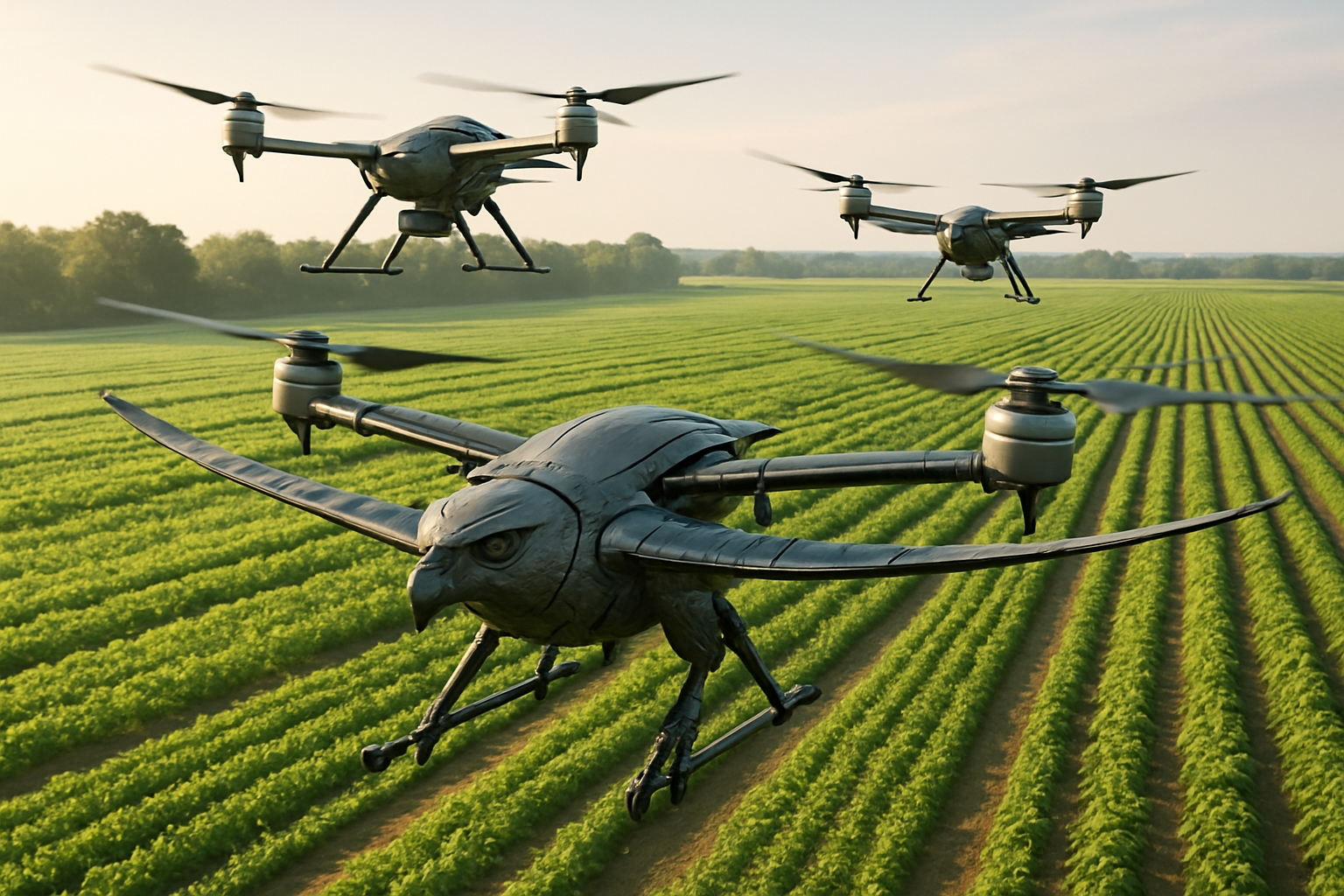
Revolutionary falcon-like drones are taking to the skies to protect valuable almond and fruit crops, as Canadian company AERIUM Analytics unveils biomimetic technology that could transform agricultural pest management worldwide.
The breakthrough innovation represents a dramatic evolution from traditional scarecrow methods to sophisticated aerial protection systems. These "scarecrows of the sky" are designed to look and behave like peregrine falcons, nature's most efficient aerial predators, to ward off crop-destroying birds that cause millions of dollars in agricultural losses annually.
According to reports from Australia, where the technology is being deployed to protect fruit and almond crops, the falcon drones offer a humane and environmentally sustainable alternative to chemical deterrents or harmful physical barriers that have dominated crop protection for decades.
Biomimetic Technology Meets Agricultural Necessity
The AERIUM Analytics drones represent a sophisticated integration of cutting-edge robotics with millennia of evolutionary perfection. By replicating the flight patterns, visual appearance, and behavioral characteristics of peregrine falcons, these systems tap into the deeply ingrained fear response that crop-destroying birds have developed toward their natural predators.
"This technology addresses a critical agricultural challenge while respecting environmental balance," explains agricultural technology specialist Dr. Sarah Martinez, who has studied precision farming innovations. "Rather than eliminating birds entirely, these systems redirect their behavior, allowing ecosystem balance to be maintained while protecting valuable crops."
The timing of this innovation is particularly significant as global agriculture faces unprecedented pressures. January 2026 marked the hottest month in recorded history, the 18th consecutive month exceeding 1.5°C above pre-industrial levels, forcing farmers to adapt traditional practices to rapidly changing environmental conditions.
Global Agricultural Renaissance Accelerates
The falcon drone breakthrough emerges within a broader surge of agricultural innovation spanning continents. In Paraguay, farmers in the districts of San Pedro del Paraná, Timbo'i, and Pindoyu have achieved remarkable success with watermelon production during challenging summer conditions, supported by the Ministry of Agriculture and Livestock (MAG).
Despite facing significant challenges including drought, pests, and diseases, Paraguayan producers achieved excellent fruit quality through advanced techniques including sophisticated irrigation systems, precise fertilization, strict pest and disease management, and strategic use of pollinating bees. This success demonstrates how traditional agricultural knowledge, when combined with modern techniques, can overcome even severe environmental stressors.
"This successful production is a testament to the hard work and dedication of producers, representing a strategic investment by the Ministry in sustainable agricultural practices."
— Ministry of Agriculture and Livestock (MAG), Paraguay
The Paraguayan achievement is particularly significant because it occurred during a period when climate change has disrupted traditional growing seasons worldwide. Their success in diversifying local watermelon production through technical monitoring allows them to satisfy demand over longer periods while commanding better prices by avoiding summer oversupply.
Technology Integration Revolutionizes Farming
Memory from previous agricultural developments reveals a pattern of sophisticated technology-traditional knowledge synthesis becoming the hallmark of 21st-century farming success. From Finland's breakthrough in winter raspberry cultivation to Papua New Guinea's mechanized corn production generating millions in revenue, farmers worldwide are demonstrating that innovation thrives when cutting-edge technology enhances rather than replaces traditional ecological wisdom.
The falcon drones exemplify this principle perfectly. While the technology represents aerospace-grade engineering and artificial intelligence, its effectiveness depends entirely on understanding natural predator-prey relationships that have existed for millions of years. Similarly, Paraguay's watermelon success combines modern irrigation and fertilization science with generations of farming knowledge about seasonal patterns and crop management.
This integration is becoming essential as climate change accelerates beyond natural variability. With 18 consecutive months of temperatures exceeding critical thresholds, farmers can no longer rely solely on historical weather patterns. They need adaptive technologies that can respond to rapidly changing conditions while maintaining the sustainability principles that ensure long-term viability.
Economic and Environmental Implications
The economic implications of these agricultural innovations extend far beyond individual farm operations. Australia's adoption of falcon drones to protect almond and fruit crops addresses an industry that contributes billions to the national economy while employing hundreds of thousands of people across rural communities.
Traditional bird control methods often involve significant ongoing costs through chemical applications, physical barriers, or labor-intensive deterrent systems. The falcon drones, while requiring initial technology investment, offer long-term cost savings through reduced crop losses and minimal ongoing operational expenses.
Paraguay's watermelon success demonstrates how agricultural innovation creates economic multiplier effects throughout rural economies. Successful harvests support not only individual farmers but also transportation, processing, marketing, and distribution networks that employ thousands of people in rural areas where employment opportunities are often limited.
Climate Adaptation Becomes Agricultural Imperative
These innovations represent fundamental shifts in how agriculture adapts to climate change. Rather than simply accepting increased losses from environmental stressors, farmers and agricultural technology companies are developing proactive solutions that maintain productivity while working within natural systems.
The falcon drone technology exemplifies biomimetic innovation - learning from nature to solve human challenges. As climate change alters migration patterns and feeding behaviors of crop-destroying bird species, these adaptive systems can modify their operation to maintain effectiveness.
Paraguay's success in overcoming drought and pest pressures through integrated management demonstrates that climate adaptation requires comprehensive approaches combining multiple technologies and techniques. No single solution - whether advanced irrigation, pest management, or pollinator support - would have achieved their success in isolation.
International Cooperation Drives Innovation
The global nature of these agricultural breakthroughs reflects increasing international cooperation in sharing agricultural innovations. Canada's development of falcon drone technology for deployment in Australia demonstrates how agricultural solutions transcend national boundaries, with innovations developed in one climate zone proving effective in entirely different agricultural systems.
This pattern extends to Paraguay's success, which builds on international knowledge sharing and technical assistance. The Ministry of Agriculture and Livestock's achievement reflects broader trends where developing nations are becoming centers of agricultural innovation, often advancing beyond traditional agricultural powers through necessity-driven creativity and international cooperation.
Memory from recent agricultural developments shows South-South cooperation increasingly replacing traditional North-South aid relationships. Countries facing similar climate challenges are sharing solutions directly, leading to more culturally appropriate and economically sustainable innovations.
Sustainable Development Through Agricultural Innovation
These agricultural innovations represent a fundamental shift toward sustainable development models that integrate economic prosperity, environmental protection, and technological advancement. The falcon drones eliminate the need for chemical bird deterrents while providing more effective crop protection than traditional methods.
Paraguay's watermelon production success demonstrates sustainable intensification - achieving higher yields through better management rather than expanding agricultural area or increasing chemical inputs. Their integrated approach using pollinating bees exemplifies how agricultural systems can support rather than degrade biodiversity.
This approach aligns with broader global trends toward circular economy principles in agriculture, where waste streams become inputs for other processes, natural systems provide essential services, and technology enhances rather than replaces ecological functions.
Implementation Challenges and Solutions
Despite their promise, these innovations face significant implementation challenges. The falcon drone technology requires substantial initial investment in sophisticated equipment, pilot training, and maintenance systems that may be prohibitive for smaller agricultural operations.
Paraguay's success required coordinated government support through the Ministry of Agriculture and Livestock, demonstrating that agricultural innovation often needs policy frameworks that provide technical assistance, financial support, and knowledge sharing networks to achieve widespread adoption.
However, the economic benefits of both innovations suggest pathways for overcoming these challenges. Falcon drone systems could be deployed through cooperative arrangements where multiple farmers share costs and equipment. Paraguay's model demonstrates how government technical assistance can enable farmers to achieve success that generates sufficient returns to justify continued investment in advanced practices.
Future Agricultural Technology Landscape
These developments preview a future where agricultural technology seamlessly integrates biological understanding, environmental sustainability, and economic viability. Falcon drones represent just the beginning of biomimetic agricultural technologies that could revolutionize pest management, pollination, and crop monitoring.
As climate change continues accelerating, the adaptive capacity demonstrated by Paraguay's farmers and the technological sophistication of falcon drones become templates for agricultural resilience worldwide. Success depends on continued innovation, international cooperation, and policy frameworks that support farmers in adopting new technologies while maintaining sustainable practices.
The convergence of these innovations during February 2026 marks a potential turning point in global agriculture - demonstrating that human ingenuity, technological capability, and international cooperation can maintain food security while protecting environmental systems essential for long-term sustainability.
Strategic Significance for Global Food Security
The falcon drone technology and Paraguay's agricultural success provide templates for addressing global food security challenges through innovation rather than intensification. As the world's population continues growing while arable land becomes increasingly constrained by climate change, these approaches offer pathways to maintain and increase agricultural productivity without environmental degradation.
These innovations demonstrate that agricultural technology can enhance rather than replace natural systems, creating win-win solutions for farmers, consumers, and ecosystems. Success requires recognizing agriculture not as an industrial process but as a complex interaction between human knowledge, technological capability, and natural systems that must be maintained in balance for long-term sustainability.
The timing of these breakthroughs during the hottest period in recorded history underscores their strategic importance. Climate change will continue disrupting traditional agricultural systems, making adaptive innovations like falcon drones and integrated management techniques essential for maintaining global food security while protecting the environmental foundations on which all agriculture ultimately depends.