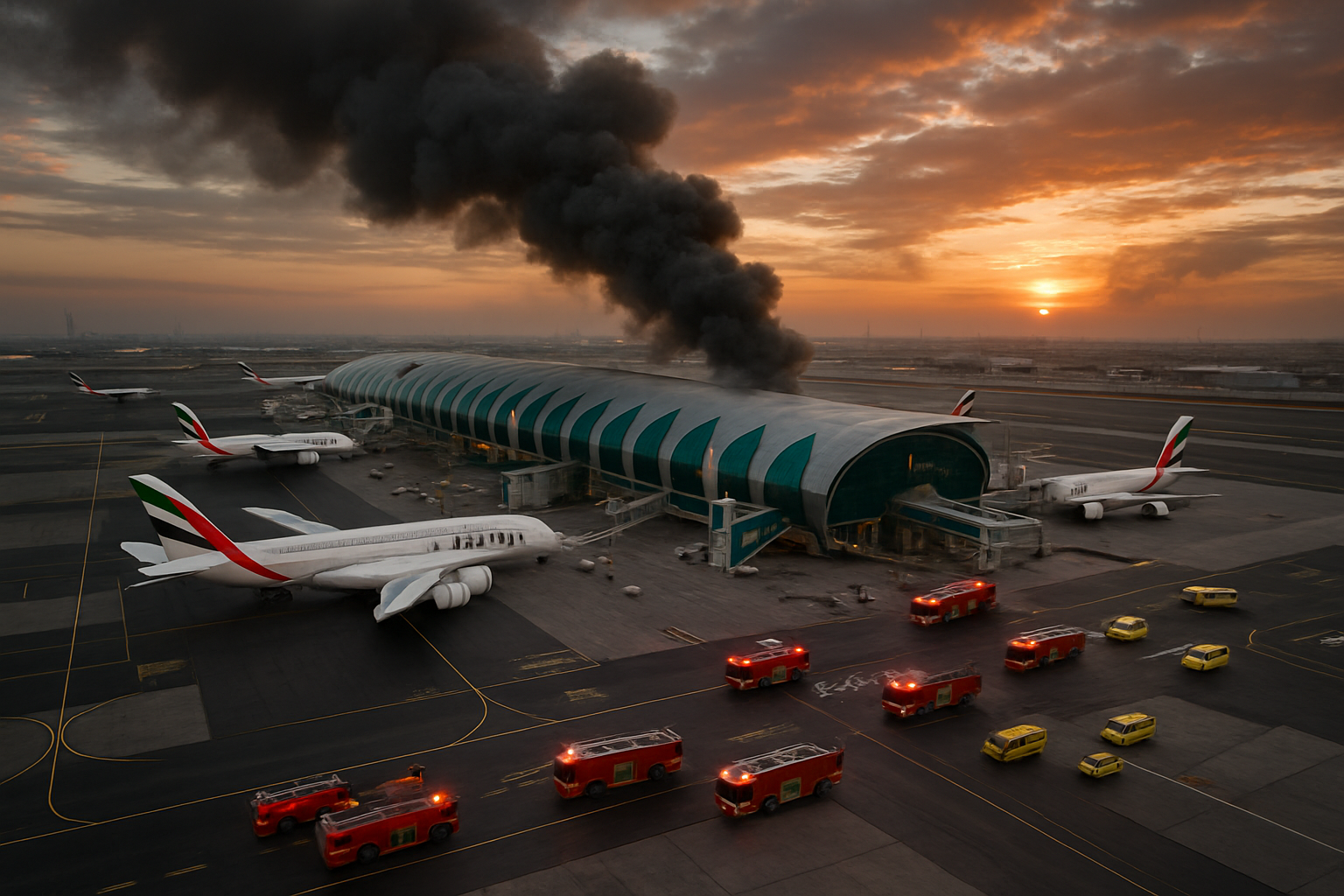
Dubai International Airport has temporarily suspended flight operations following a drone attack that resulted in a fire near the facility, marking the third such incident since Iran began its systematic attacks on Gulf nations on February 28, 2026.
The Dubai Civil Aviation Authority announced the suspension of flights at Dubai International Airport as a precautionary measure to ensure the safety of all passengers and staff. The incident occurred early Monday morning when a drone struck a fuel tank in the vicinity of the airport, causing a fire that has since been brought under control with no injuries reported.
Third Attack in Regional Campaign
This latest incident at Dubai International, one of the world's busiest travel hubs handling over 86 million passengers annually, represents the third attack since Iran launched its retaliatory campaign "Operation True Promise 4" against Gulf nations. The Iranian Revolutionary Guard declared "no red lines remain" following the US-Israeli "Operation Epic Fury" strikes that killed Supreme Leader Ali Khamenei on March 1.
The fire, which erupted after the drone impact to a fuel storage facility, has been successfully contained according to the Dubai Media Office. Aviation authorities have not indicated when they expect normal operations to resume, leaving hundreds of thousands of passengers affected worldwide.
Regional Aviation Crisis Deepens
The suspension of operations at Dubai International compounds an unprecedented aviation crisis across the Middle East. Over 18,000 flights have been cancelled worldwide since the conflict began, representing the most extensive aviation disruption since the COVID-19 pandemic. Eight countries have simultaneously closed their airspace, including Iran, Iraq, Israel, UAE, Qatar, Syria, Kuwait, and Bahrain.
Major airlines including Emirates, Air France-KLM, Wizz Air, and Bulgaria Air have suspended operations affecting hundreds of thousands of passengers globally. The closure of Dubai International, which serves as a critical Europe-Asia connectivity hub, creates cascading effects throughout global aviation networks.
Impact on International Travelers
The suspension now temporarily halts emergency repatriation efforts for Kenyans and other nationals trapped in the region following recent tensions. Mass evacuation operations, described as the largest since the Arab Spring in 2011, have been underway with Australia reporting 115,000 nationals trapped and Germany coordinating extraction of 30,000 stranded tourists.
Traffic has been temporarily halted on road and tunnel links connecting to the airport, police confirmed, while some flights have been diverted to Al-Maktoum International Airport. Travelers are being advised to contact their respective airlines for the latest updates regarding their flights.
"Dubai Civil Aviation Authority announces the temporary suspension of flights at Dubai International Airport as a precautionary measure to ensure the safety of all passengers and staff."
— Dubai Media Office
Energy and Economic Implications
The ongoing conflict has created a severe global energy crisis, with oil prices surging past $100 per barrel for the first time since 2014, heading toward warnings of $200 per barrel. Iran has effectively closed the Strait of Hormuz through naval mining operations, blocking 40% of global oil transit and stranding over 150 tankers worth billions in cargo.
Natural gas prices have exploded by 24% in Europe and 78% in the US, reaching €47.32/MWh, the highest level since February 2025. Qatar has halted LNG production at its Ras Laffan and Mesaid facilities, affecting approximately 20% of global exports, while major shipping companies Maersk and MSC have suspended Persian Gulf operations entirely.
Nuclear Diplomacy Breakdown Context
The current crisis stems from the complete collapse of US-Iran nuclear negotiations despite achieving a "broad agreement on guiding principles" in Geneva talks - the most progress since the JCPOA collapse in 2018. The fundamental disagreement proved insurmountable, with Iran excluding ballistic missiles and proxy groups as "red lines" while the US demanded a comprehensive approach including missiles, armed groups, and human rights issues.
Iran continues uranium enrichment at 60% purity with over 400kg of weapons-grade material, sufficient for multiple weapons if weaponized. The crisis occurs amid broader nuclear governance challenges, including the expiration of the New START Treaty on February 5 - the first time in over 50 years without US-Russia nuclear constraints.
Regional Coalition Under Strain
The systematic Iranian attacks have severely strained an unprecedented regional coalition that had supported diplomatic solutions. The UAE has reported one civilian killed in Abu Dhabi from missile debris, Kuwait has experienced 32 injured from airport drone strikes, and Qatar intercepted 65 missiles and 12 drones using Patriot systems, with 8 people injured by falling fragments.
Egyptian President Abdel Fattah al-Sisi condemned the attacks on "sisterly Arab countries," warning of "comprehensive chaos" across the region. The attacks have forced coalition members to balance their alliance with the United States against mounting Iranian pressure, undermining decades-old security arrangements.
Historical Significance and Global Response
This incident occurs as part of what UN Secretary-General António Guterres has called the "greatest test of multilateral cooperation and crisis management in the modern era." The rapid transition from diplomatic breakthrough to military escalation demonstrates the fragility of crisis management mechanisms in the multipolar era.
The International Energy Agency has released a record 400 million barrels from strategic petroleum reserves - the largest intervention in the agency's 50-year history. Financial markets have crashed worldwide, with Pakistan's KSE-100 experiencing its largest single-day decline in history at -8.97%.
Recovery Timeline Uncertain
Unlike weather-related aviation disruptions, recovery depends entirely on the resolution of military operations and diplomatic tensions normalization. Aviation industry analysts cannot provide long-term scheduling while critical airspace remains closed, and even when operations resume, clearing the backlog of stranded passengers and cargo will require weeks.
The closure of Dubai International exposes fundamental vulnerabilities in global transportation networks and their dependence on Middle Eastern hubs for Europe-Asia connectivity. The aviation industry faces a fundamental reconsideration of route planning, risk assessment procedures, and the need for enhanced contingency planning in an era of increased geopolitical volatility.
Template-Setting Crisis
March 16, 2026, represents a watershed moment in international relations, with implications extending decades beyond the current crisis. Success in containing the escalation could provide a framework for nuclear crisis resolution and strengthen diplomatic precedents. Failure may accelerate military solutions, reshape Middle Eastern geopolitics for decades, encourage nuclear proliferation globally, and undermine diplomatic credibility worldwide.
The stakes include regional war prevention, global energy security, nuclear governance credibility, and international law enforcement of post-WWII order principles - all tested simultaneously in what experts describe as the most dangerous international crisis since the end of the Cold War.