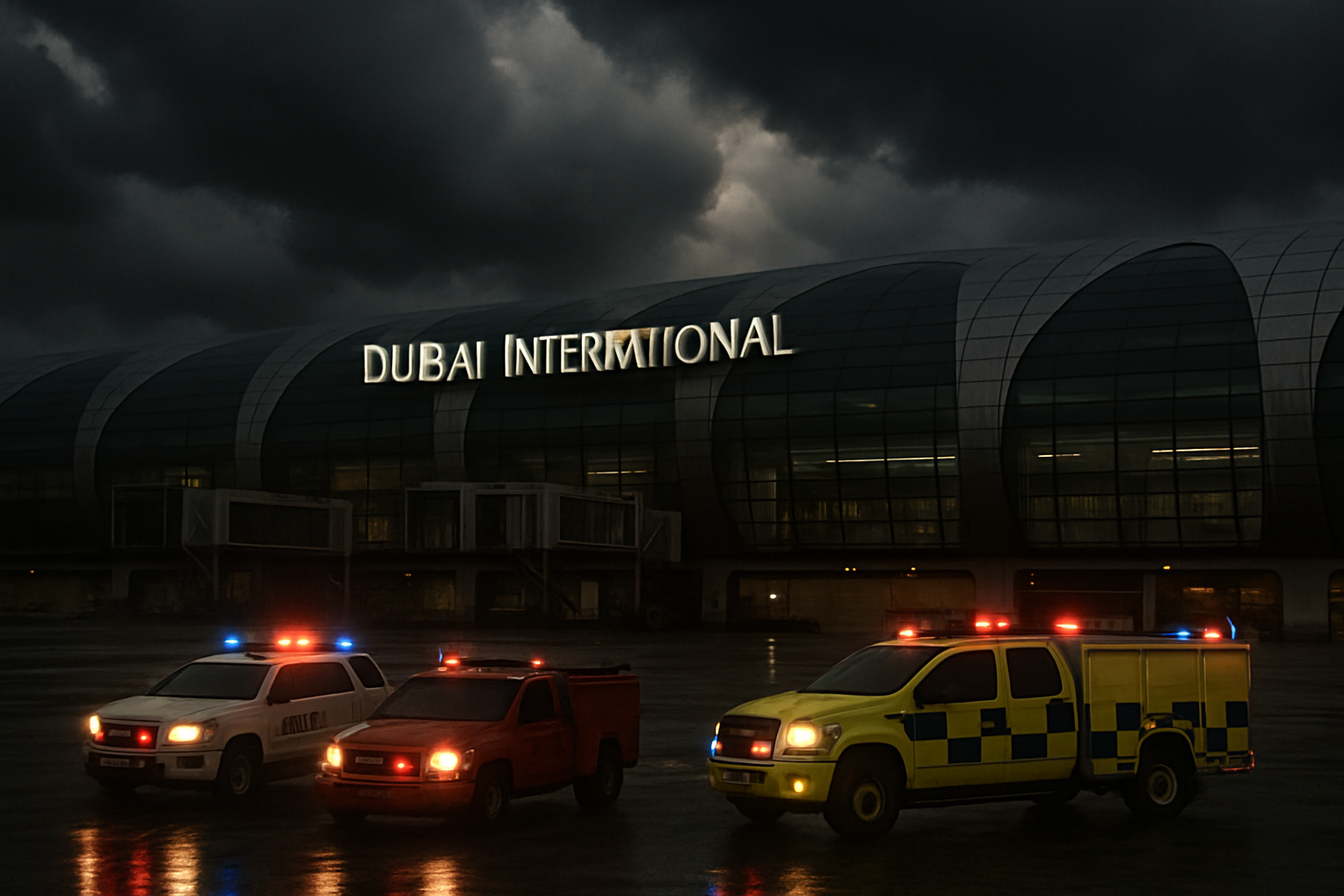
Dubai International Airport, the world's busiest aviation hub handling over 86 million passengers annually, continues operations suspension after sustaining missile damage during Iran's massive retaliatory strikes against regional targets following the US-Israeli "Operation Epic Fury."
The closure of Dubai International has created cascading global aviation effects, with over 18,000 flights cancelled worldwide since March 1, 2026 - marking the most extensive aviation disruption since the COVID-19 pandemic. Emirates and Etihad Airways face operational crisis as the critical Europe-Asia transit hub remains severed from international networks.
Airport Struck During Regional Escalation
The airport shutdown began March 1 following Iran's "Operation True Promise 4," which Iranian Revolutionary Guard forces launched declaring "no red lines remain" in response to the coordinated US-Israeli strikes that killed Supreme Leader Ali Khamenei. Dubai International sustained direct missile damage, injuring four airport workers and forcing complete evacuation of all terminals.
According to multiple international sources, Iranian forces targeted Dubai as part of systematic attacks across Gulf states including Kuwait, Qatar, Bahrain, and the UAE. The strikes represented the largest regional military escalation since the Cold War, with Iran effectively closing the Strait of Hormuz - a critical chokepoint handling 40% of global oil transit.
"The decision to close airspace comes at a critical moment when tens of thousands of people are trying to evacuate through Dubai ahead of the escalating conflict in Iran."
— Slovakia Aviation Authority Statement
Global Aviation Crisis Unfolds
Eight Middle Eastern countries simultaneously closed civilian airspace including Iran, Iraq, Israel, UAE, Qatar, Syria, Kuwait, and Bahrain - creating the most comprehensive regional aviation shutdown in modern history. Major airlines including Air France-KLM, Wizz Air, Bulgaria Air, and British Airways suspended operations affecting hundreds of thousands of passengers globally.
The crisis has forced airlines to implement complex alternative routing strategies, with dramatically increased costs and extended flight times. Caribbean stopovers and trans-Pacific routes have become necessary as Russian and Ukrainian airspace remain closed, creating unprecedented logistical challenges for international aviation.
Swedish traveler Emily Grosser paid 6,000 SEK ($560) for alternative routing from Paris to Australia, exemplifying the extreme passenger costs during the crisis. West Indies and Zimbabwe cricket teams remain stranded in India following the T20 World Cup due to airspace closures.
Mass International Evacuations
The Dubai Airport closure has complicated what has become the largest coordinated international evacuation since the Arab Spring of 2011. Australia faces the challenge of extracting 115,000 nationals, while Germany works to evacuate 30,000 stranded tourists. Cyprus activated its national ESTIA evacuation plan for the first time in history.
Emirates flight EK414 successfully departed with over 200 Australian citizens bound for Sydney, marking one of the first evacuation flights after the initial closure. Cyprus Airways completed a Dubai-Larnaca repatriation flight carrying 180 citizens, but such operations remain limited due to ongoing security concerns.
Multiple European nations including Sweden, Serbia, Estonia, and Norway have ordered immediate evacuations from Iran and surrounding conflict zones, citing "extremely uncertain" security conditions.
Energy Security Crisis
The regional conflict has created the most severe global energy security threat in decades. Oil prices have surged 10% to over $80 per barrel as Iran declared the Strait of Hormuz "unsafe for shipping," effectively blocking the passage that handles 40% of global seaborne oil transit.
Major shipping companies Maersk and MSC have suspended Persian Gulf operations, leaving over 150 oil and LNG tankers stranded in the region representing billions in cargo value. Natural gas prices have jumped 24% in Europe and 78% in the United States, while Qatar has halted LNG production at key facilities.
The energy crisis extends beyond oil, affecting global supply chains from consumer goods to industrial materials that depend on Middle Eastern logistics networks. Strategic petroleum reserves provide only temporary buffer against sustained disruptions.
Diplomatic Breakdown Context
The current crisis stems from the complete collapse of US-Iran nuclear negotiations despite what officials called "broad agreement on guiding principles" - the most progress since the 2018 JCPOA collapse. Fundamental disagreements persisted over scope, with Iran excluding ballistic missiles and proxies as "red lines" while the US demanded comprehensive deals including missiles, armed groups, and human rights.
The diplomatic failure led to "Operation Epic Fury," described as the largest coordinated US-Israeli military operation since the 2003 Iraq invasion, using dual-carrier deployment of USS Gerald Ford and Abraham Lincoln representing approximately one-third of the active US Navy fleet.
"This is a historic moment for the entire region, but the human cost cannot be ignored as civilian infrastructure becomes collateral damage."
— International Aviation Safety Expert
Regional Coalition Under Strain
An unprecedented coalition of Saudi Arabia, UAE, Qatar, and Egypt that had supported diplomatic solutions now faces severe strain as Iranian retaliation directly targets member territories. Egyptian President Sisi condemned attacks on "sisterly Arab countries," warning of "comprehensive chaos" across the region.
The UAE reported one civilian killed in Abu Dhabi from missile debris, while Kuwait Airport sustained drone strikes causing employee injuries. Qatar successfully intercepted 65 missiles and 12 drones using Patriot systems but reported eight people injured from falling debris.
Economic and Market Impact
Global financial markets have experienced their worst disruption in years. Pakistan's KSE-100 index crashed over 16,000 points (-8.97%) in its largest single-day decline in history. South Korean markets plunged over 7%, while Dow futures dropped 400-570 points.
PayPal postponed its $1.1 billion US IPO due to market volatility, highlighting how regional conflicts now instantly create global economic consequences. Central banks are coordinating emergency liquidity provision to prevent broader financial contagion.
Recovery Timeline Uncertain
Unlike weather-related aviation disruptions with predictable recovery timelines, the current crisis depends entirely on military operations resolution and diplomatic tensions normalization. Airlines conduct daily operational reviews but cannot make long-term scheduling decisions while airspace remains closed.
Even when flights resume, industry experts estimate weeks will be required to clear passenger backlogs and normalize operations. The crisis has exposed fundamental vulnerabilities in global transportation networks' dependency on Middle Eastern hubs for Europe-Asia connectivity.
Nuclear Governance Crisis Context
The crisis occurs amid broader nuclear governance breakdown, with the New START treaty having expired February 5 - marking the first time in over 50 years without US-Russia nuclear constraints. Combined with China's nuclear expansion and Iran's continued 60% uranium enrichment approaching weapons-grade levels, UN Secretary-General Guterres warns nuclear risks are at their "highest in decades."
This represents a template-setting moment for 21st-century diplomacy versus military confrontation approaches, with global implications affecting energy security, nuclear proliferation precedents, and international law credibility.
Looking Ahead
The Dubai Airport closure symbolizes how rapidly regional conflicts can create global disruptions in an interconnected world. The aviation industry now faces fundamental questions about route planning, risk assessment, and contingency protocols for managing geopolitical volatility in strategic regions.
As the crisis enters its second week, the international community faces its greatest test of multilateral cooperation and crisis management in the modern era. Success in containing the regional confrontation could provide frameworks for future nuclear crisis resolution, while failure may accelerate military solutions reshaping Middle Eastern geopolitics for decades.
The stakes extend far beyond aviation, encompassing regional war prevention, global energy security, nuclear governance credibility, and international law enforcement mechanisms that have governed the post-World War II order. Coming decisions will determine whether this remains a contained regional crisis or expands into broader Middle Eastern warfare with worldwide implications extending decades beyond current events.