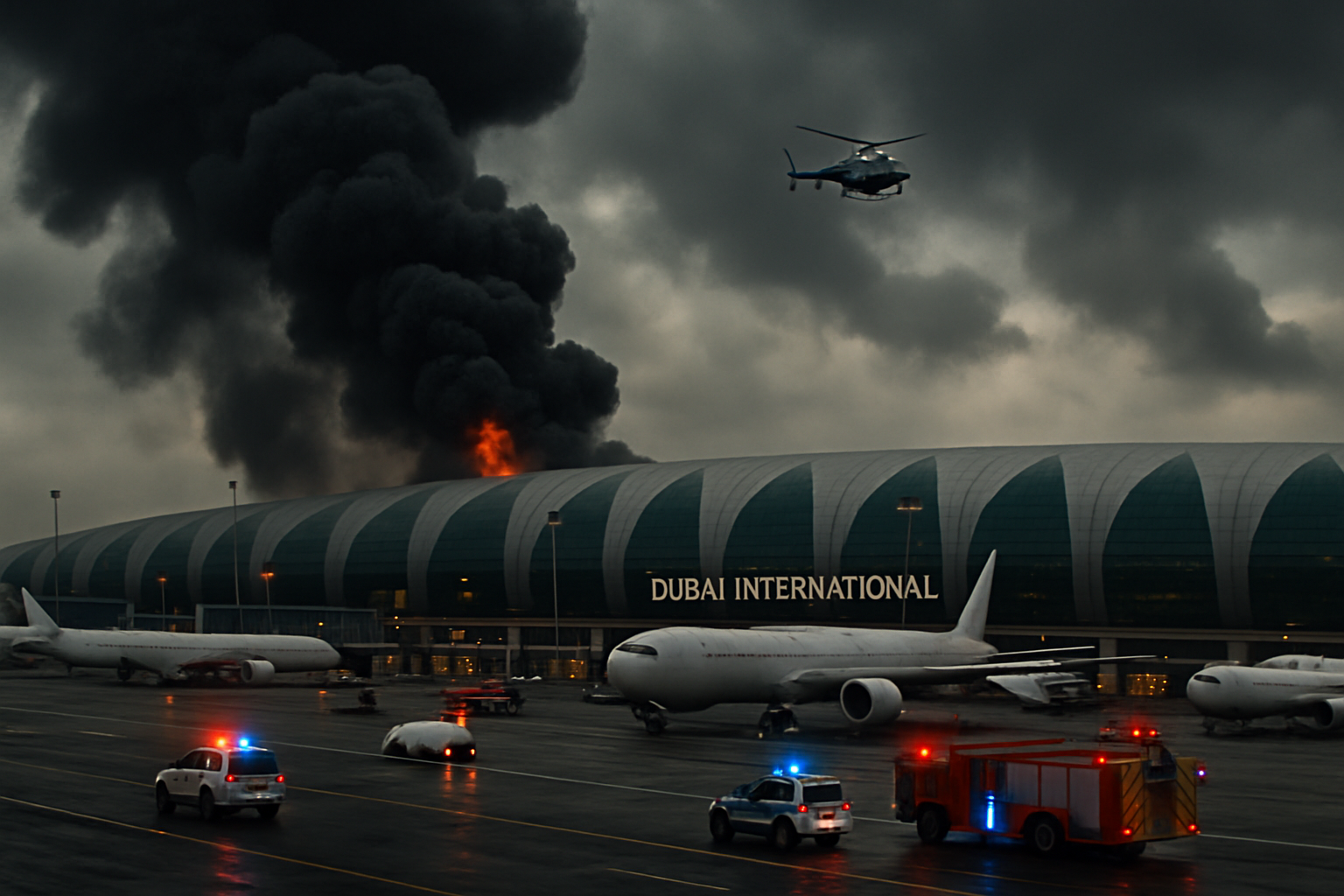
Dubai International Airport, the world's busiest for international passenger traffic, suspended all flight operations Monday morning after Iranian drone strikes hit fuel storage facilities near the airport, causing massive fires as part of Tehran's "Operation True Promise 4" systematic campaign against Gulf states.
The attacks occurred as part of Iran's escalating retaliation against Gulf nations supporting U.S.-Israeli military operations, with Iranian Revolutionary Guard officials declaring "no red lines remain" in their systematic targeting campaign. The fuel tank strikes triggered significant fires that were successfully contained, though no casualties have been reported at the airport facility itself.
Critical Aviation Hub Paralyzed
Dubai International Airport, which handles over 86 million passengers annually and serves as the critical Europe-Asia transit hub, announced the complete suspension of operations as a precautionary measure following the fuel facility attack. The closure compounds an already unprecedented global aviation crisis that has seen over 18,000 flights cancelled worldwide—the most extensive disruption since the COVID-19 pandemic.
Emirates and other major carriers have suspended operations indefinitely, affecting hundreds of thousands of passengers globally. Air France-KLM, Wizz Air, and Bulgaria Air have also cancelled Middle Eastern routes, with industry experts warning the closures could last for weeks depending on the security situation.
"This represents the most comprehensive regional airspace closure in modern history," said aviation analyst Samuel Morrison. "With eight countries simultaneously closing their airspace and Dubai—a critical global hub—completely shut down, we're seeing disruption on a scale that exceeds even the 1991 Gulf War."
Regional Coalition Under Assault
The Dubai airport attack is part of Iran's broader "Operation True Promise 4" campaign that has systematically targeted Gulf coalition members supporting U.S.-Israeli operations against Iran. The strikes have severely strained the unprecedented Saudi/UAE/Qatar/Egypt consensus that had been supporting diplomatic solutions to the nuclear crisis.
Regional casualties from Iranian retaliation now include: one civilian killed in Abu Dhabi from missile debris, 32 injured at Kuwait International Airport from drone strikes, and eight wounded in Qatar despite Patriot missile systems intercepting 65 missiles and 12 drones. Most dramatically, Iranian drones struck RAF Akrotiri in Cyprus—marking the first attack on European territory since World War II.
Egyptian President Abdel Fattah el-Sisi condemned the attacks on "sisterly Arab countries," warning of "comprehensive chaos across the region" if escalations continue. The targeting of coalition territories threatens to collapse the diplomatic framework that Gulf leaders had hoped would prevent broader regional war.
Global Energy Crisis Deepens
The aviation crisis parallels an unprecedented global energy emergency as Iran maintains its blockade of the Strait of Hormuz, affecting 40% of global oil transit. Oil prices have surged past $100 per barrel for the first time since 2022, with Brent crude peaking at $119.50 and WTI jumping a record 18.98% to $108.15.
The International Energy Agency announced the largest strategic petroleum reserve release in its 50-year history—400 million barrels from 32 countries—more than double the 2022 Ukraine crisis response. Japan is releasing 80 million barrels starting March 16, the first deployment since the 2011 Fukushima disaster, reflecting the severity of the supply disruption.
Natural gas prices have exploded by 24% in Europe and 78% in the United States, reaching €47.32/MWh—the highest levels since February 2025. Qatar has halted LNG production at its Ras Laffan and Mesaid facilities, threatening 20% of global LNG exports and forcing European governments to implement emergency energy measures.
Nuclear Diplomacy Breakdown
The current crisis stems from the complete breakdown of U.S.-Iran nuclear negotiations despite achieving what diplomats described as "broad agreement on guiding principles"—the most progress since the 2018 JCPOA collapse. However, fundamental disagreements proved insurmountable, with Iran excluding ballistic missiles and proxy forces as "red lines" while the United States demanded comprehensive talks including missiles, armed groups, and human rights issues.
This diplomatic failure led directly to "Operation Epic Fury," the largest U.S.-Israeli coordinated military operation since 2003, which resulted in the death of Supreme Leader Ali Khamenei on March 1. Iran has since appointed his son, Mojtaba Khamenei, in the first hereditary succession in the Islamic Republic's 47-year history, with CIA assessments suggesting unprecedented Revolutionary Guards control over governance.
The nuclear governance crisis has been compounded by the expiration of New START on February 5—the first time in over 50 years that the United States and Russia operate without nuclear constraints. Iran continues uranium enrichment at 60% purity with over 400 kilograms of weapons-grade material, sufficient for multiple nuclear weapons if weaponized.
International Evacuation Crisis
The aviation and security crisis has triggered the largest coordinated international evacuation since the Arab Spring of 2011, with Australia reporting 115,000 nationals trapped and Germany evacuating 30,000 stranded tourists. The European Union activated its ESTIA evacuation plan for Cyprus for the first time in the bloc's history following the RAF Akrotiri attack.
Multiple governments have ordered immediate evacuations from Iran, with Sweden and Serbia citing "extremely uncertain" security conditions. The United States has closed its embassy in Kuwait indefinitely and evacuated non-essential personnel from 15 Middle Eastern countries, underscoring the regional nature of the crisis.
Economic and Financial Impact
Global financial markets have crashed in response to the crisis, with Pakistan's KSE-100 index recording its largest single-day decline in history at -8.97%. South Korea's KOSPI plunged 12%, triggering circuit breakers, while the Korean won hit a 17-year low as foreign capital fled. PayPal postponed its $1.1 billion IPO indefinitely due to market volatility.
Central banks, including the European Central Bank and Bank of Japan, are coordinating emergency liquidity measures to prevent broader financial contagion. Traditional monetary policy tools have proven limited in addressing structural geopolitical disruptions to energy and transportation networks.
Consumer impacts are being felt globally, with Sweden predicting electricity increases of 10-20 öre and gasoline rises of 1-2 kronor, while Ireland faces heating oil approaching €2 per liter. Bangladesh has implemented fuel rationing for 170 million people, and Pakistan has imposed wartime austerity measures including four-day government work weeks.
European Security Implications
The Iranian drone strike on RAF Akrotiri represents a watershed moment for European security, prompting an unprecedented naval coalition response. HMS Dragon, Spanish frigates, and vessels from Italy, France, the Netherlands, and Greece are now protecting European waters—the most significant coordinated European military response to Middle Eastern threats in decades.
The attack has forced European leaders to confront the reality that Middle Eastern conflicts can directly threaten European territory, fundamentally altering security calculations and defense cooperation frameworks within NATO and EU structures.
Template-Setting Crisis Management
UN Secretary-General António Guterres has described the situation as "the greatest test of multilateral cooperation in crisis management in the modern era." The rapid transition from diplomatic breakthrough to military confrontation demonstrates the fragility of crisis management mechanisms in the multipolar world order.
The crisis affects multiple critical systems simultaneously: regional war prevention, global energy security, nuclear governance credibility, and international law enforcement. Success in containing the escalation could provide a framework for nuclear crisis resolution, while failure may accelerate military solutions and encourage nuclear proliferation globally, undermining diplomatic credibility for decades.
Uncertain Recovery Timeline
Unlike weather-related disruptions that follow predictable patterns, recovery from this crisis depends entirely on military operations resolution and diplomatic normalization. Aviation industry officials cannot make long-term scheduling decisions with multiple airspaces closed indefinitely, while energy markets remain volatile with critical transit routes blocked.
The Persian Gulf serves as a critical trade hub beyond energy, affecting consumer goods and industrial materials worldwide. The 21-mile Strait of Hormuz represents a single-point failure in modern logistics with no realistic alternatives, exposing dangerous over-dependence on strategic chokepoints.
As the crisis enters its third week, the stakes continue to rise. The international community faces its most consequential test since the Cold War's end, with implications extending decades beyond current events. The decisions made in coming days will establish precedents for 21st-century conflict resolution, energy security architecture, and the sustainability of the post-World War II international order.