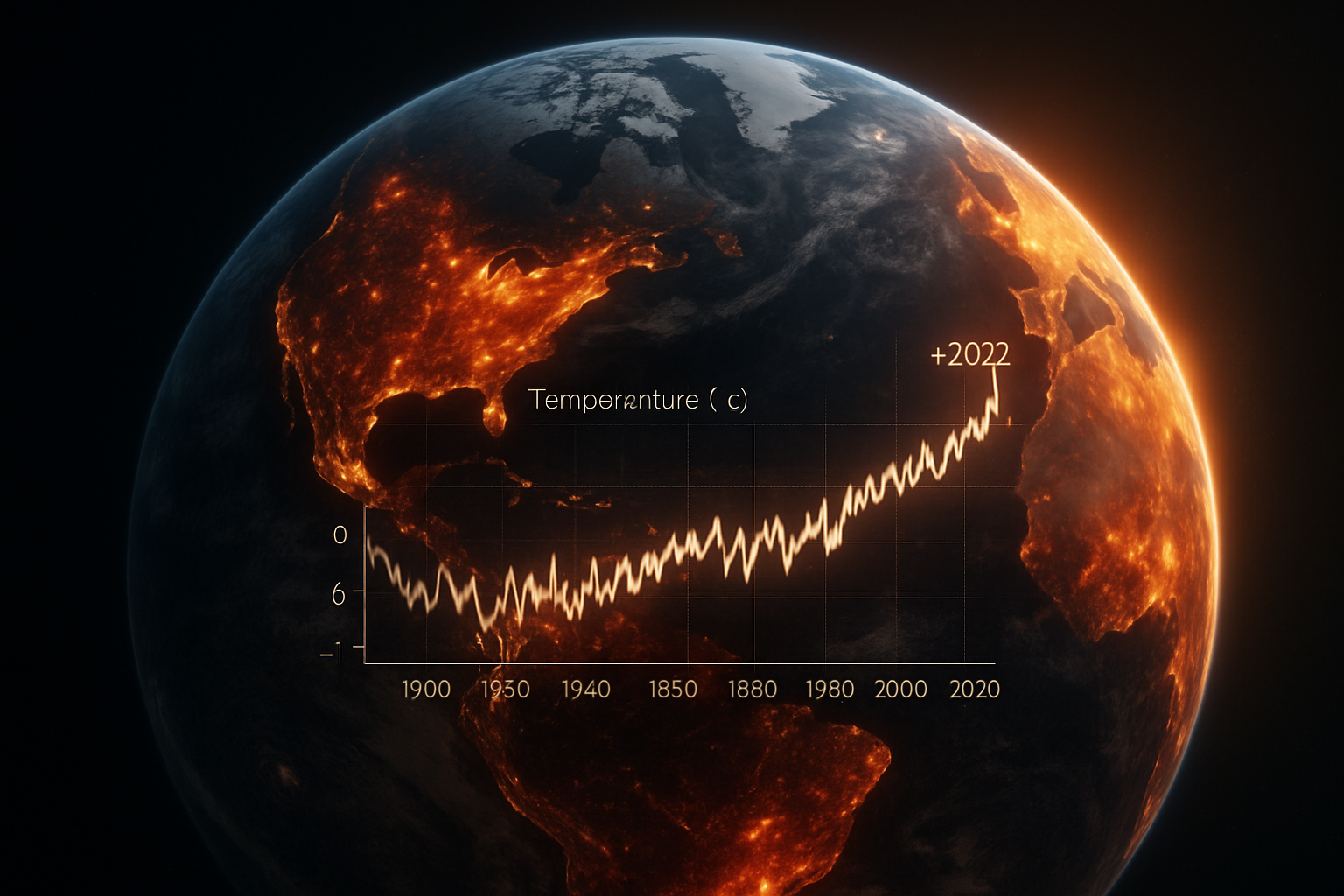
Earth's heat-trapping capacity reached record levels in 2025, with the United Nations warning Monday that the consequences of this unprecedented energy imbalance could persist for thousands of years, marking the most alarming climate milestone in recorded history.
The World Meteorological Organisation (WMO) confirmed that 2025 ranks as either the second or third hottest year on record, with global temperatures averaging 1.43°C above the 1850-1900 baseline. Most critically, the 11 warmest years ever recorded have all occurred between 2015 and 2025, representing an unprecedented concentration of extreme heat in modern climate data.
Historic Energy Imbalance Reaches Critical Threshold
For the first time, the WMO's flagship State of the Global Climate report includes measurements of Earth's energy imbalance—the rate at which energy enters Earth's atmosphere versus the amount released back to space. This fundamental metric reveals that human-made greenhouse gas concentrations have severely reduced the planet's ability to release heat, creating a dangerous accumulation of thermal energy.
"The global climate is in a state of emergency. Planet Earth is being pushed beyond its limits. Every key climate indicator is flashing red," declared UN Secretary-General Antonio Guterres during the report's release. "Humanity has just endured the 11 hottest years on record. When history repeats itself 11 times, it is no longer a coincidence. It is a call to act."
Unprecedented Atmospheric Conditions
The concentration of carbon dioxide in Earth's atmosphere has reached levels not seen in over two million years, according to complementary research from Swedish climate institutions. This represents a fundamental shift in planetary atmospheric composition that extends far beyond natural climate variability.
The energy imbalance documented in 2025 demonstrates that Earth is now absorbing significantly more solar radiation than it radiates back to space. This excess energy accumulation drives not only surface warming but also ocean heating, ice sheet melting, and increasingly volatile weather patterns worldwide.
"These are not temporary fluctuations but indicators of long-term planetary changes that will shape Earth's climate for millennia to come."
— Dr. Elena Manaenkova, WMO Deputy Secretary-General
Global Climate System Transformation
The 2025 climate data reveals that human-induced warming has now completely overridden natural climate cycles, including La Niña cooling effects that historically moderated global temperatures. This represents a fundamental alteration of Earth's atmospheric systems beyond their natural recovery mechanisms.
Scientists report that the "climate volatility paradox" now enables both record global heat and severe regional weather extremes simultaneously. Disrupted polar vortex patterns and altered Atlantic circulation create compound environmental effects that challenge traditional weather prediction models and emergency response frameworks.
Regional impacts documented in 2025 include unprecedented Arctic warming, with Greenland experiencing positive temperatures during traditional winter months—a phenomenon that accelerates ice sheet destabilization and global sea level rise projections.
Economic and Social Consequences
The record heat accumulation has triggered cascading economic impacts across multiple sectors. Agricultural systems worldwide face mounting adaptation challenges as traditional seasonal patterns become unreliable guides for planting and harvesting cycles.
Insurance industry data reveals climate-related claims reaching unprecedented levels, with infrastructure designed for historical climate conditions repeatedly failing under current extreme weather patterns. Recovery timelines for weather-related damage have shifted from weeks to months or years, fundamentally altering economic planning assumptions.
Public health systems report increased strain from heat-related illnesses and vector-borne diseases expanding into previously temperate regions as warming temperatures create suitable habitats for tropical disease carriers across broader geographic areas.
Emergency Response at Breaking Point
Emergency services globally report operating at or beyond capacity limits as extreme weather events occur simultaneously across multiple continents rather than following historical sequential patterns. Traditional mutual aid mechanisms, designed for regional disasters, prove inadequate when multiple nations face concurrent climate emergencies.
The European Union's Civil Protection Mechanism has been repeatedly activated throughout 2025 and early 2026, with assistance programs reaching record levels. The largest coordinated European weather response to date involved €246 million in Sweden-Denmark assistance, demonstrating both international cooperation capabilities and the insufficient scale relative to current climate challenges.
Scientific Projections and Tipping Points
Climate scientists warn that current conditions provide a preview of routine circumstances expected in the 2030s without immediate, transformative climate adaptation investments. Research indicates that several critical climate thresholds are approaching faster than previously projected.
Antarctic ice loss data reveals annual retreat equivalent to the area of Vienna, with total ice reduction of 12,820 square kilometers documented since 1996. Marine ecosystem studies show that every 0.1°C of ocean warming reduces fish populations by 7.2%, creating compound effects on global food security for billions dependent on marine protein sources.
The World Meteorological Organization projects a 50-60% probability of El Niño development by July-September 2026, which could drive global temperatures to unprecedented levels by combining baseline warming with natural cycle amplification during an already record-breaking warming streak.
Adaptation and International Cooperation
Despite the alarming trends, the climate report also documents emerging adaptation innovations that integrate cutting-edge technology with traditional ecological knowledge. Successful examples include Estonia's achievement of 88% renewable electricity generation and operation of continental Europe's largest battery storage facility.
However, implementation faces significant challenges, particularly regarding supply chain vulnerabilities. European Union auditors warn that climate goals remain threatened by critical materials dependencies, with China controlling 60% of global production and 90% of refining capacity for lithium, cobalt, and rare earth elements essential for renewable energy infrastructure.
Critical Decision Point
The WMO report positions 2025 as a watershed year that demands a fundamental shift from reactive crisis management to proactive climate resilience building. Current global warming represents the longest sustained extreme warming period in recorded human history, with January 2026 confirmed as the hottest month ever documented.
"Building back better" climate-resilient infrastructure has evolved from an optional enhancement to an essential survival strategy for communities worldwide. Traditional seasonal patterns that guided human activities for millennia are no longer reliable frameworks for infrastructure design, agricultural planning, or emergency preparedness.
The window for effective climate action continues to narrow as ecological systems approach critical thresholds that could trigger irreversible changes affecting global food security, climate stability, and human settlements. The tools, knowledge, and cooperation frameworks exist for comprehensive environmental protection, but success depends on unprecedented speed and coordination in implementation.
As the international community faces Earth's most environmentally challenging period in recorded history, the choices made in the coming months and years will prove decisive for global climate resilience strategies affecting generations to come.