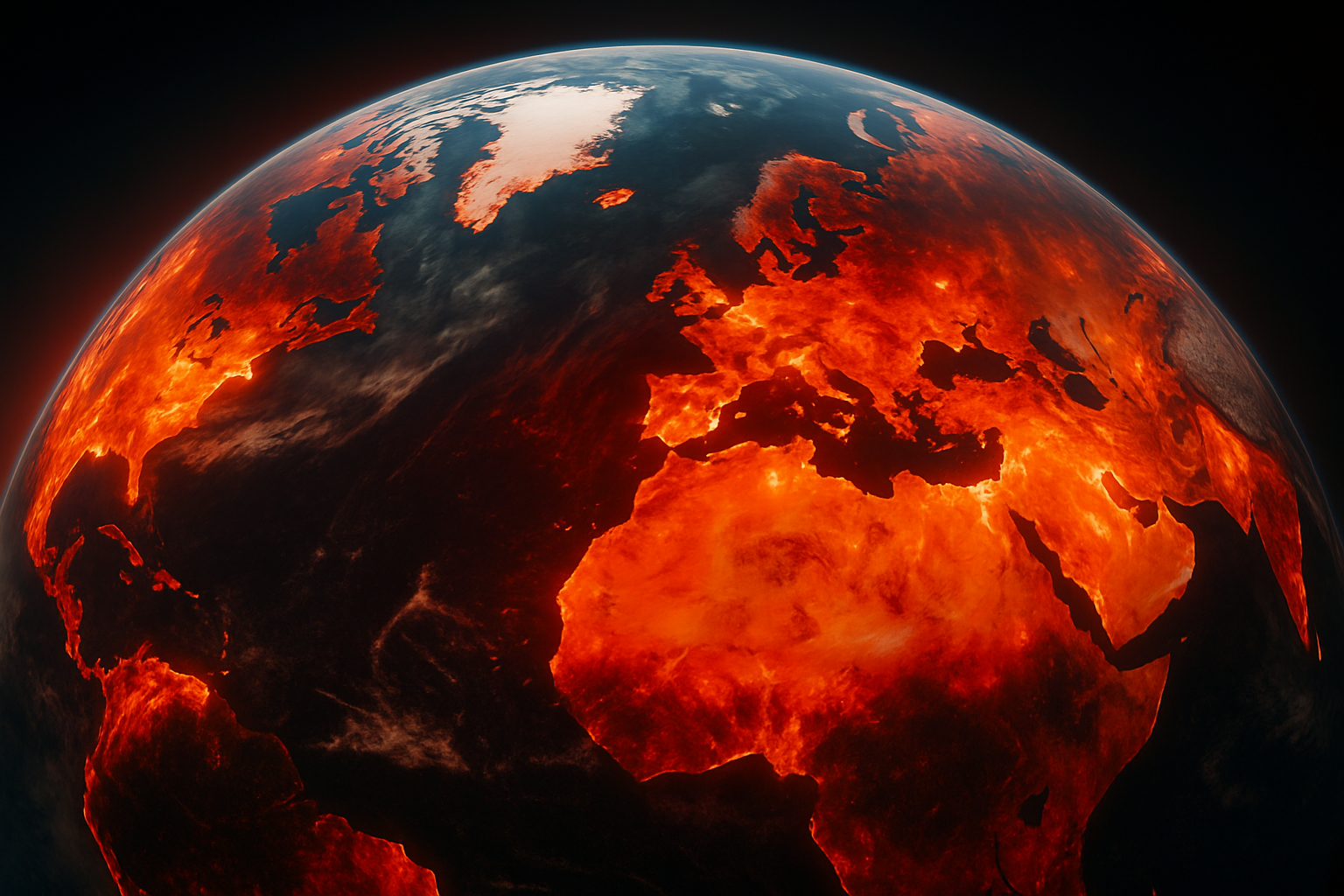
Earth's climate system is accelerating beyond scientific predictions, with new research revealing the planet has warmed 0.35°C in just the past decade—75% faster than the previous average—as March 2026 extends an unprecedented streak of global temperature records to 20 consecutive months above critical thresholds.
The shocking acceleration, documented in Bulgarian research published in Geophysical Research Letters and confirmed by Romanian scientists from the National Museum of Natural Sciences, demonstrates that global warming has not only continued but dramatically intensified since 2015. Where climate scientists previously measured average warming of 0.2°C per decade between 1970-2015, the Earth has heated at an alarming 0.35°C rate over the last ten years.
Unprecedented Temperature Streak Shatters Records
January 2026 marked the hottest month in recorded history, extending what climatologists now recognize as the longest sustained temperature anomaly in human records. For 20 consecutive months, global average temperatures have exceeded 1.5°C above pre-industrial levels—the threshold scientists identified as critical for preventing catastrophic climate impacts.
This sustained warming has fundamentally altered Earth's atmospheric systems, overriding natural climate variability that would typically moderate global temperatures. Even La Niña cooling cycles, which historically reduced global temperatures, have proven powerless against human-induced warming.
"This is the first statistically compelling evidence that global warming is no longer simply continuing—it's accelerating at an unprecedented rate that challenges our fundamental understanding of the climate system."
— Climate Research Team, Geophysical Research Letters
Human-Induced Changes Override Natural Systems
The research reveals a disturbing new reality: human activities have so fundamentally altered Earth's atmospheric composition that natural climate regulation mechanisms are failing. The sustained 20-month temperature streak demonstrates that greenhouse gas concentrations have reached levels where natural cooling cycles can no longer provide the regulatory effects they have for millennia.
Marine ecosystem studies from Spanish institutions have documented cascading effects throughout ocean systems, with fish populations declining 7.2% for every 0.1°C of ocean warming per decade. This research, analyzing 33,990 fish populations across the Mediterranean, North Atlantic, and Northeast Pacific from 1993-2021, shows a devastating 20% annual decline in fish biomass as ocean temperatures rise.
Compound Environmental Effects
The accelerated warming is creating compound environmental crises across multiple systems simultaneously. Finland faces near-total bird population collapses across vast regions as extreme winter conditions push even hardy species beyond survival limits. Nordic countries experience historically weak water conditions, straining hydroelectric systems that power much of the regional economy.
In Antarctica, University of California Irvine glaciologists report that vulnerable ice sections are losing mass equivalent to the area of Vienna every year. Since 1996, total ice retreat has reached 12,820 square kilometers, with West Antarctic ice sheets particularly vulnerable to complete melting that would contribute significantly to global sea level rise.
Infrastructure and Emergency Systems Overwhelmed
Traditional emergency response systems designed for sequential disasters are proving inadequate as multiple continents face simultaneous extreme weather events. Recent weeks have seen unprecedented coordination requirements:
- EU Civil Protection Mechanism repeatedly activated with Sweden-Denmark providing €246 million in the largest coordinated European climate response
- Australia's Katherine Hospital evacuated due to the worst Northern Territory flooding in decades
- Latvia experiencing potentially its strongest blizzard of the season with 62cm snow accumulation
- Portugal deploying 26,500 emergency personnel in its largest peacetime operation
Transportation networks, power grids, and communication systems are operating beyond their design parameters, which were based on historical climate patterns that no longer exist. Recovery timelines have shifted from weeks to months or years, fundamentally changing disaster response approaches worldwide.
Economic Cascade Effects Mount
The climate acceleration is creating massive economic disruptions across sectors. Agricultural systems are mounting billions in losses from destroyed crops and disrupted supply chains. Tourism industries face extended cancellations and infrastructure damage during what should be peak seasons.
Energy markets reflect the crisis, with natural gas prices surging 24% in Europe and 78% in the US as extreme weather disrupts production and increases heating demands. Traditional regional compensation mechanisms are breaking down as disasters become simultaneous and global rather than isolated events.
"We're seeing the preview of routine 2030s conditions if current warming trends continue. The infrastructure, economic systems, and emergency responses we've built for historical climate patterns are proving inadequate for this new reality."
— International Climate Adaptation Research Consortium
Scientific Warnings Turn Dire
Climate scientists are issuing increasingly urgent warnings about Earth entering a climate phase potentially incompatible with human civilization as we know it. Research by Hans Joachim Schellnhuber published in "One Earth" journal demonstrates that humanity has pushed planetary systems closer to irreversible tipping points than previously understood.
Finland's climate research confirms that dangerous tipping points are increasingly probable—once triggered, stopping climate warming becomes exponentially more difficult. The current acceleration suggests several critical thresholds may be approaching simultaneously, creating potential cascade effects that could lock in centuries of environmental change.
Technology and Traditional Knowledge Integration
Successful climate adaptation is requiring sophisticated integration of cutting-edge technology with traditional ecological knowledge and community-based management. From Estonia's agricultural wisdom combined with climate monitoring to Australia's Indigenous fire management enhanced with meteorological forecasting, hybrid approaches are proving most effective.
Advanced monitoring systems using satellite imagery, environmental DNA sampling, and AI analysis provide unprecedented ecosystem tracking capabilities while traditional stewardship methods offer time-tested approaches for managing environmental stress.
International Cooperation at Breaking Point
The simultaneous nature of current climate crises is testing international cooperation mechanisms designed for sequential rather than parallel disasters. Traditional mutual aid frameworks prove inadequate when multiple regions require emergency assistance simultaneously, straining both resources and coordination capabilities.
Environmental systems cross political boundaries, making unilateral adaptation efforts insufficient. Ocean currents carry pollution across continents, atmospheric systems transport effects globally, and climate impacts affect infrastructure regardless of borders. Success requires unprecedented coordination across policy frameworks, shared monitoring systems, and collaborative response protocols.
Critical Action Window Rapidly Closing
March 2026 represents what scientists characterize as a critical juncture in global climate response—a choice between reactive crisis management and proactive ecosystem service management that could determine whether conservation efforts can keep pace with accelerating environmental change.
The environmental action window is narrowing rapidly as ecological systems approach critical thresholds that could trigger irreversible changes. However, tools, knowledge, and cooperation frameworks exist for comprehensive protection, requiring immediate scaling through sustained international cooperation and enhanced coordination.
The current 20-month temperature streak demonstrates that climate change has moved beyond abstract future threat to present reality affecting ecosystems worldwide. The choices made in coming months may prove decisive for global environmental protection trajectory for decades ahead, making coordinated international responses more critical than ever before during this unprecedented period of planetary change.