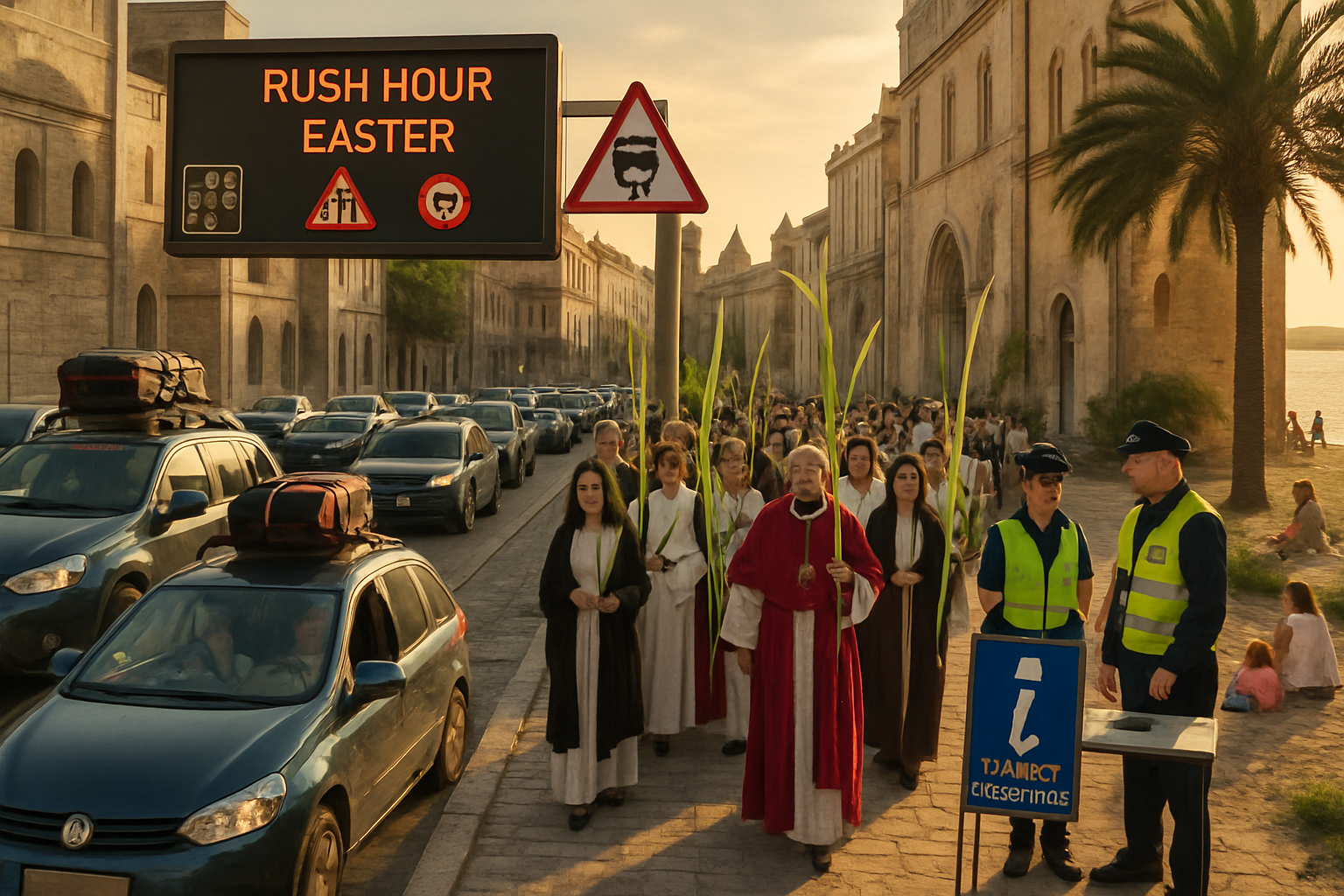
Countries across the globe are implementing extraordinary safety measures and traffic management systems as millions prepare for Easter weekend travel, combining centuries-old religious traditions with modern logistical challenges during one of Christianity's most significant celebrations.
From Australia's fuel-price-dampened holiday traffic to Germany's anticipated highway congestion, nations are balancing the spiritual significance of Holy Week with the practical realities of mass population movement during the Easter period. The convergence of religious observance, family travel, and tourism represents one of the most complex logistical operations of the year.
Religious Processions and Spiritual Preparations
The Easter celebrations are unfolding against the backdrop of significant religious developments worldwide. Pope Leo XIV is preparing to celebrate his first Easter as pontiff, one year after the death of his predecessor Francisco, while tensions in the Middle East cast a shadow over Christian celebrations globally.
In Bolivia, preparations for Easter have taken on added significance as Rome prepares to receive tens of thousands of faithful for Easter celebrations, described as "the most important feast of the Christian calendar that commemorates the death and Resurrection of Christ." The Latin Patriarch of Jerusalem faced unprecedented restrictions, highlighting the complex security environment affecting religious observances worldwide.
Nicaragua has demonstrated comprehensive religious coordination, with the Catholic Church celebrating the Misa Crismal at the Metropolitan Cathedral of Managua, emphasizing priestly renewal and the blessing of holy oils during Holy Week. These preparations showcase the deep spiritual infrastructure supporting Easter celebrations across Latin America.
Papua New Guinea has emerged as a focal point for passionate religious observance, with hundreds gathering in Hohola for the 2026 Stations of the Cross procession. The processions reached significant milestone locations, demonstrating the community commitment to traditional Easter observances despite global uncertainties.
Traffic Management and Transportation Challenges
Germany is bracing for what authorities describe as potentially massive traffic congestion, with travelers heading "to the sea, to the mountains, to relatives" during the Easter period. Early travelers were already experiencing traffic jams, and officials warn that Easter Monday is expected to bring particularly heavy traffic volumes.
"On German roads, it's expected to be busy again at Easter. The first travelers were already stuck in traffic and Easter Monday is also expected to see heavy traffic."
— German Transportation Authorities
Australia presents a contrasting picture, where roads are expected to be less busy than typical public holidays due to fuel prices constraining holiday travel. This represents a significant shift in traditional travel patterns, with economic factors directly impacting Easter travel volumes.
Peru is experiencing comprehensive traffic management challenges in the south, with authorities monitoring conditions closely as part of live Easter Week coverage that includes church tours, masses, and traffic updates. The country has enabled 21 churches in Lima's Historic Center for religious festivities, following technical inspections and enhanced security measures.
South Africa is preparing for heavy traffic on national routes as the country enters the Easter long weekend, with authorities reporting a significant decrease in road accidents despite this being typically "one of the busiest" and "high-risk periods on the roads."
Security Deployments and Safety Measures
Nicaragua has launched one of the most comprehensive security operations in the region, deploying over 1,500 military personnel in coordination with Civil Defense across beach resorts and tourist destinations. This Easter security plan aims to guarantee protection and assistance to families during the summer season throughout the country.
The security measures extend beyond simple crowd control to comprehensive emergency management. Nicaragua's Health Ministry has deployed 348 medical posts and 57 mobile clinics across recreational centers, representing the largest temporary health infrastructure deployment in recent Nicaraguan history.
Peru has taken a multi-faceted approach to Easter safety, combining religious accommodation with practical security measures. Lima authorities have enabled access to 21 churches in the Historic Center while reinforcing security throughout the area, balancing spiritual needs with public safety concerns.
International Tourism and Economic Impact
The Easter period represents a significant economic opportunity for countries worldwide, with coordinated tourism campaigns replacing individual competition through regional cooperation. Countries are implementing quality-focused strategies that emphasize authentic cultural experiences while managing increased visitor volumes.
Algeria is preparing for a high-profile papal visit, with Culture and Arts Minister Malika Ben Douda conducting inspection visits to the province of Annaba to assess the readiness of major archaeological sites, including the archaeological site of "Hippo" and its museum. These preparations highlight the intersection of religious tourism with cultural heritage preservation.
Malta faced unexpected challenges with the cancellation of the traditional Good Friday Walk due to bad weather, prompting Prime Minister Robert Abela to announce a €50,000 government donation to Puttinu Cares. This demonstrates the adaptive measures countries are taking to maintain the spirit of Easter celebrations despite logistical challenges.
New Zealand is preparing for weather-related travel complications, with MetService forecasting heavy rain for the South Island and mixed conditions for the North Island, adding another layer of complexity to Easter weekend planning.
Regional Variations and Cultural Adaptations
The global nature of Easter celebrations is evident in the diverse approaches countries are taking to manage the holiday period. Each nation is adapting traditional observances to contemporary realities while maintaining the essential spiritual character of the season.
Venezuela demonstrates this balance through diplomatic engagement, with the U.S. Ambassador to Venezuela celebrating her first Easter in Caracas with a message of "faith and peace" for the country, showing how Easter serves as a bridge for international cooperation even in complex political environments.
The economic multiplier effects of Easter celebrations extend far beyond traditional hospitality sectors, supporting infrastructure improvements, cultural industry development, artisan networks, and year-round employment creation. This comprehensive economic impact underscores Easter's role as both spiritual observance and economic catalyst.
Technology and Traditional Synthesis
Modern Easter celebrations demonstrate successful integration of technological innovation with traditional spiritual practices. Countries are employing advanced traffic monitoring systems, digital emergency response platforms, and real-time communication networks to manage the complex logistical challenges of the holiday period.
This technological enhancement serves to preserve rather than replace authentic cultural practices, enabling better crowd management, emergency response, and communication while maintaining the essential spiritual character of Easter observances.
Looking Forward: Sustainable Easter Celebrations
The Easter 2026 celebrations represent a template for sustainable holiday management that balances spiritual significance with practical considerations. Countries are demonstrating that ancient traditions can adapt to contemporary challenges while maintaining their essential character and meaning.
Success factors emerging from this year's preparations include cultural authenticity preservation, enhanced visitor experiences through strategic infrastructure, meaningful community involvement, international cooperation, and adaptive management responding to changing circumstances.
As millions of people prepare to celebrate Easter across the globe, the coordination between religious institutions, government agencies, transportation authorities, and tourism organizations demonstrates the sophisticated planning required to serve both spiritual needs and practical considerations during one of the year's most significant celebrations.
The convergence of faith, family, and mobility during Easter 2026 showcases humanity's enduring capacity to maintain meaningful traditions while adapting to contemporary realities, creating celebrations that honor the past while embracing the future.