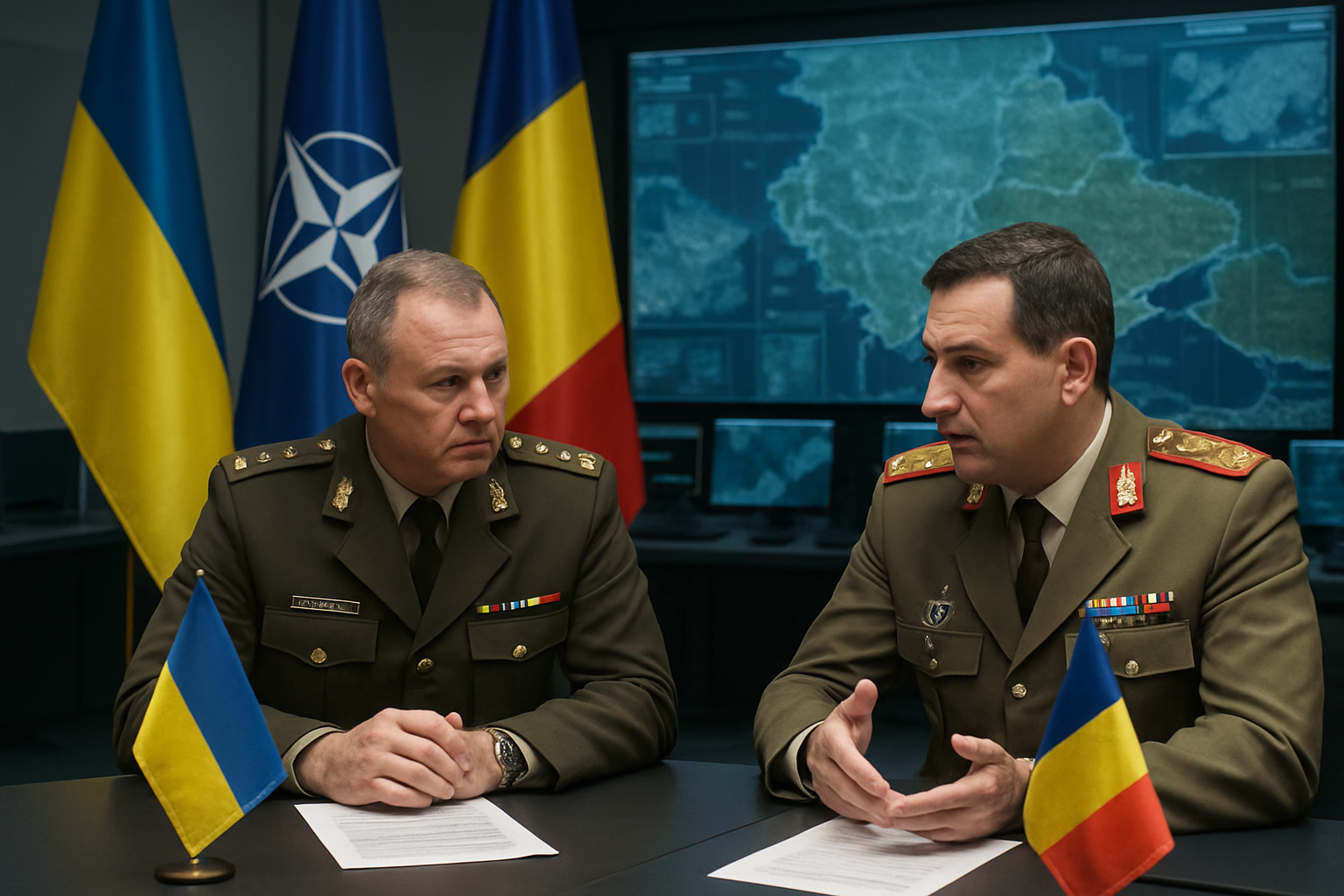
Ukrainian President Volodymyr Zelensky conducted critical security consultations with Romanian Defense Minister Radu Miruță at the strategic Borcea Air Base, marking a significant expansion of Eastern European defense cooperation as regional security challenges intensify and diplomatic initiatives face unprecedented setbacks.
The March 12, 2026 meeting at the 86th Air Base "Lieutenant Aviator Gheorghe Mociorniță" in Călărași County represents the highest-level Ukrainian-Romanian military consultation since Russia's full-scale invasion began nearly four years ago. The discussions, which followed Zelensky's meetings with Romanian President Nicușor Dan and Prime Minister Ilie Bolojan, focused on strengthening support for Ukraine and reinforcing defense capabilities along NATO's Eastern Flank.
Strategic Military Cooperation Expansion
The Borcea meeting carries particular significance as it centers around Ukraine's F-16 training programs, with Romanian personnel and Ukrainian trainees participating in advanced pilot preparation. This collaboration represents a crucial evolution in international military cooperation, as Ukraine works to integrate Western fighter aircraft into its defense architecture while facing continued Russian aerial assault.
According to official statements from Romania's Ministry of National Defense, the discussions addressed comprehensive defense cooperation mechanisms, including training protocols, logistical support systems, and operational readiness standards for Ukrainian pilots operating Western aircraft systems.
"The strengthening of support for Ukraine and the reinforcement of defense capabilities on NATO's Eastern Flank remain our absolute priority."
— Romanian Ministry of National Defense Official Statement
Regional Security Deterioration
The high-level consultations occur against a backdrop of dramatically escalating regional violence. Russian forces launched over 50 attacks on Ukraine's Dnipropetrovsk region within hours of the meeting, resulting in four civilian casualties and demonstrating the continued intensity of Moscow's campaign against Ukrainian territory.
In the Nikopol, Kryvyi Rih, and Synelnykivskyi districts alone, Russian forces deployed drones and artillery in systematic attacks that injured four civilians and caused extensive infrastructure damage. These strikes represent part of a broader pattern of Russian escalation that has seen significant tactical shifts in recent weeks.
Ukrainian military intelligence reports indicate Russia is rapidly expanding its unmanned systems forces, with plans to increase personnel in drone units to 101,000 troops by April 1, 2026. This represents a fundamental shift in Russian military doctrine, reflecting what Ukrainian Commander-in-Chief Oleksandr Syrskyi describes as the war "entering a new stage."
Defensive Achievements and Technological Warfare
Despite the intensifying attacks, Ukrainian forces demonstrated continued operational effectiveness with successful counterstrike operations. In the Huliaipole area of Zaporizhzhia region, Ukrainian unmanned systems destroyed two expensive Russian Merlin-VR reconnaissance drones, highlighting the increasingly sophisticated nature of electronic warfare along the front lines.
The destruction of these advanced reconnaissance platforms, valued at millions of dollars each, represents both tactical success and strategic intelligence gathering, as Ukrainian forces continue to adapt to Russian technological improvements in drone warfare.
International Defense Partnerships Under Pressure
The Ukrainian-Romanian cooperation discussions come as broader international security coordination faces significant challenges. Peace negotiations between Ukraine, Russia, and the United States have been postponed indefinitely due to the escalating Middle East crisis, according to President Zelensky's March 12 statement.
"Due to the situation around Iran, there are still no necessary signals for trilateral meeting," Zelensky explained, acknowledging that talks will resume "as soon as the security situation and general political context allow."
This postponement represents a significant setback to diplomatic momentum that had achieved unprecedented breakthroughs in early 2026, including the largest prisoner exchange in five months and the restoration of US-Russia military communications after a four-year suspension.
Strategic Pivot to Middle East Security
In response to the diplomatic delays, Ukraine has announced a strategic expansion of military cooperation with Middle Eastern nations, including the UAE, Qatar, Jordan, Bahrain, and Kuwait. This initiative will see Ukrainian military experts share battlefield experience in combating Iranian "Shahed" drone attacks—the same weapons systems that have devastated Ukrainian infrastructure for months.
This pivot represents Ukraine's evolution from aid recipient to security provider, leveraging its extensive experience in countering Russian-Iranian drone technology to build strategic partnerships across multiple regions.
Technological Innovation in Defense
The security cooperation discussions also highlighted significant developments in European defense technology. An Estonian-Ukrainian defense technology firm recently secured $400,000 in funding from Swedish investors Front Ventures and Hede Capital to accelerate production of the SHADOX drone, specifically designed for indoor and trench warfare applications.
This investment represents growing international confidence in Eastern European defense innovation, with battlefield-tested Ukrainian expertise attracting significant private sector investment in next-generation military technology.
Nuclear Governance Crisis Context
The security consultations occur amid an unprecedented nuclear governance crisis, with the New START treaty having expired on February 5, 2026—the first time in over 50 years without US-Russia nuclear constraints. This vacuum adds extraordinary urgency to regional security cooperation, as both superpowers control approximately 80% of global nuclear weapons without bilateral limitations.
UN Secretary-General António Guterres has described this as a "grave turning point," warning that nuclear risks are at their "highest in decades." The restored military communications between Washington and Moscow represent the only remaining formal diplomatic channel between the nuclear superpowers.
Humanitarian and Operational Impact
The security challenges continue to exact a devastating toll on civilian populations. The systematic targeting of energy infrastructure during harsh winter conditions has left over 1.7 million Ukrainians still requiring winter support programs, with critical infrastructure attacks representing what international observers describe as "energy terrorism."
Recent attacks have killed multiple civilians, including children, in systematic strikes on residential areas. The pattern of civilian targeting during extreme winter conditions represents clear violations of international humanitarian law, according to multiple international legal assessments.
Regional Alliance Strengthening
Despite the challenges, the Ukrainian-Romanian defense cooperation represents broader trends in Eastern European security coordination. NATO allies are establishing increasingly sophisticated forward support infrastructure in conflict zones, with the UK recently acknowledging four operational maintenance, repair, and overhaul (MRO) facilities in Ukraine servicing Western-supplied equipment.
This infrastructure investment demonstrates long-term commitment to Ukrainian military modernization beyond the current conflict, establishing templates for future international military cooperation in active conflict zones while maintaining clear distinctions between support roles and direct combat involvement.
Strategic Implications and Future Outlook
The March 12 consultations between Zelensky and Romanian defense leadership represent more than bilateral cooperation—they exemplify the broader transformation of Eastern European security architecture under pressure from sustained military conflict and diplomatic uncertainty.
With peace negotiations suspended and regional security threats escalating, the strengthening of military partnerships between Ukraine and NATO allies becomes increasingly critical. The integration of Ukrainian pilots into NATO training programs, combined with expanding technological cooperation and strategic intelligence sharing, creates a more resilient defense framework capable of addressing evolving threats.
As the conflict approaches its fourth anniversary, the success of these security partnerships will likely determine not only Ukraine's defensive capabilities but also the broader stability of Eastern Europe's security architecture. The ongoing cooperation between Kyiv and Bucharest represents a crucial element in maintaining regional deterrence while diplomatic solutions remain elusive.
The stakes extend beyond immediate military considerations, affecting European security architecture redefinition, international law enforcement credibility, and territorial sovereignty principles that will shape 21st-century conflict resolution approaches. As military cooperation deepens and threats evolve, Eastern European nations continue adapting their security postures to address the most significant regional crisis since the Cold War.