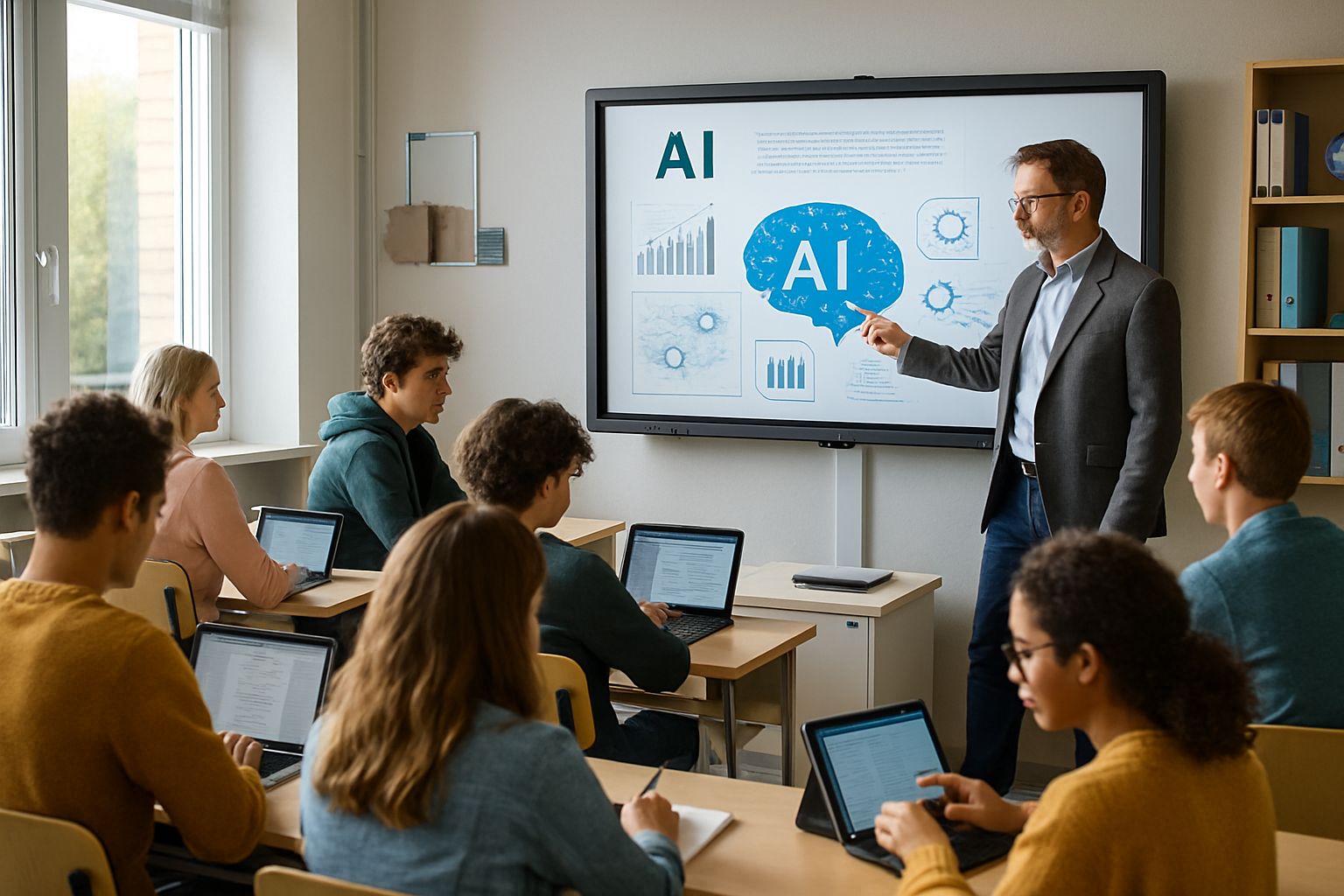
Universities across three continents are pioneering the next frontier of educational technology, with Canadian educators integrating AI-powered teaching assistants into classrooms, while the University of the South Pacific launches revolutionary language preservation programs that harness technology to safeguard indigenous Pacific cultures.
The global educational technology landscape is experiencing unprecedented transformation as institutions balance cutting-edge artificial intelligence with cultural preservation efforts, creating a unique synthesis of innovation and heritage protection that is reshaping how knowledge is transmitted and preserved in the digital age.
AI Integration in Canadian Higher Education
Canadian universities are leading a paradigm shift in higher education by systematically integrating artificial intelligence into classroom instruction. Professors at major institutions including the University of Quebec at Montreal (UQAM), Concordia University, the University of Toronto, and the University of Lethbridge are pioneering responsible AI adoption that enhances rather than replaces human instruction.
At UQAM, accounting professor Antonello Callimaci has implemented AI-powered teaching assistants that provide 24/7 student support while maintaining rigorous academic standards. Meanwhile, Concordia University's professional writing program coordinator Maggie McDonnell emphasizes the importance of teaching students to use AI tools with a critical eye, ensuring they develop both technological fluency and analytical thinking skills.
"We're not replacing human judgment with artificial intelligence," McDonnell explains. "Instead, we're teaching students how to leverage these powerful tools while maintaining their critical thinking abilities."
— Maggie McDonnell, Concordia University
The University of Toronto's vice-president international and political science professor Joseph Wong has focused on incorporating AI into international studies curricula, preparing students for a globally connected world where technological literacy is essential. Similarly, Sidney Shapiro at the University of Lethbridge brings expertise in business analytics and computer science to create interdisciplinary approaches that bridge technology and traditional academic disciplines.
Pacific Language Technology Revolution
While North American institutions integrate AI for enhanced learning experiences, the University of the South Pacific (USP) has launched an equally revolutionary initiative targeting cultural preservation. The newly introduced Bachelor of Language Technology represents a groundbreaking approach to protecting the region's indigenous languages through digital innovation.
The program addresses a critical challenge facing Pacific communities: the rapid disappearance of indigenous languages as technology advances faster than traditional culture can adapt. With nearly 100 indigenous languages spoken across Pacific island nations, many facing extinction within a generation, USP's initiative provides both urgent intervention and long-term sustainability strategies.
Rajendra Prasad, Teaching Assistant for Linguistics at USP, emphasizes the program's transformative potential: "The program shifts Pacific students from simply using technology to creating it themselves, based on their own languages and values, ensuring cultural knowledge is not lost with each generation."
Technology as Cultural Bridge
The Bachelor of Language Technology focuses on training students to use advanced technology for documenting, translating, and developing Pacific languages. Students learn to create digital archives, develop translation software, and build educational applications that serve their communities while preserving linguistic heritage.
This approach represents a significant departure from traditional language preservation methods, which often relied on academic documentation by external researchers. Instead, USP empowers indigenous speakers to become technology creators, ensuring that digital tools reflect authentic cultural perspectives and community needs.
The program responds to a growing need across the Pacific region, where globalization and technological advancement have accelerated language loss. By training local technologists, USP creates sustainable mechanisms for ongoing language development and preservation that extend far beyond university boundaries.
Flexible Learning Models Emerge
Argentina's educational landscape demonstrates another dimension of contemporary educational innovation through expanded access models. Universities are increasingly offering both traditional in-person instruction and distance learning options, particularly for programs like psychology that can accommodate diverse learning preferences and life circumstances.
This flexibility reflects broader global trends toward personalized education that recognizes students' varying needs, geographic constraints, and career goals. The expansion of distance learning options, accelerated by pandemic-era innovations, now represents a permanent feature of higher education rather than an emergency adaptation.
Global Context and Implications
These developments occur within the broader "2026 Educational Technology Renaissance" that includes Singapore's WonderBot 2.0 conversational learning system, Malaysia's AI-integrated Islamic schools, and comprehensive digital reform initiatives across multiple continents. The pattern reveals coordinated global recognition that educational institutions must fundamentally reimagine their approaches to remain relevant and effective.
The convergence of AI integration and cultural preservation efforts demonstrates that educational technology advancement need not come at the expense of traditional knowledge systems. Instead, thoughtful implementation can enhance both technological capabilities and cultural continuity.
"Technology should serve human purposes, not replace human values. Our approach ensures that innovation strengthens rather than undermines the communities we serve."
— Rajendra Prasad, University of the South Pacific
Challenges and Considerations
Despite promising developments, educational technology implementation faces significant challenges. Infrastructure limitations, particularly in Pacific island regions, require creative solutions for reliable internet connectivity and device access. Faculty training represents another critical need, as educators must develop both technological competency and pedagogical strategies for effective integration.
The global AI memory crisis, with semiconductor prices increasing sixfold, creates additional constraints for institutions seeking to implement advanced technological solutions. Universities must balance innovation ambitions with realistic budget considerations and sustainable implementation strategies.
Privacy and data security concerns also require careful attention, particularly when working with indigenous languages and cultural knowledge that may have specific protection requirements under traditional protocols.
Future Directions
The educational innovations documented across Canada, Fiji, and Argentina suggest several emerging trends that will likely influence global higher education development. First, successful technology integration requires careful attention to human-centered design principles that enhance rather than replace traditional teaching relationships.
Second, cultural preservation and technological advancement can work synergistically when communities have agency in determining how technology serves their specific needs and values. This approach offers models for other regions facing similar challenges between modernization and heritage protection.
Third, flexible delivery models will likely become standard across disciplines, requiring institutions to develop sophisticated capabilities for both in-person and distance education that maintain quality standards regardless of format.
Long-term Impact
The 2026 educational technology developments represent more than incremental improvements to existing systems. Instead, they suggest fundamental shifts in how educational institutions understand their roles in preserving knowledge, serving communities, and preparing students for rapidly changing global circumstances.
Universities implementing these innovations are positioning themselves as bridges between traditional knowledge systems and emerging technological capabilities. Their success will likely influence educational policy decisions worldwide, particularly in regions facing similar challenges around cultural preservation, technological integration, and educational access.
As these programs mature and demonstrate their effectiveness, they may provide templates for educational institutions worldwide seeking to balance innovation with cultural responsibility, technological advancement with human-centered learning, and global connectivity with local community needs.