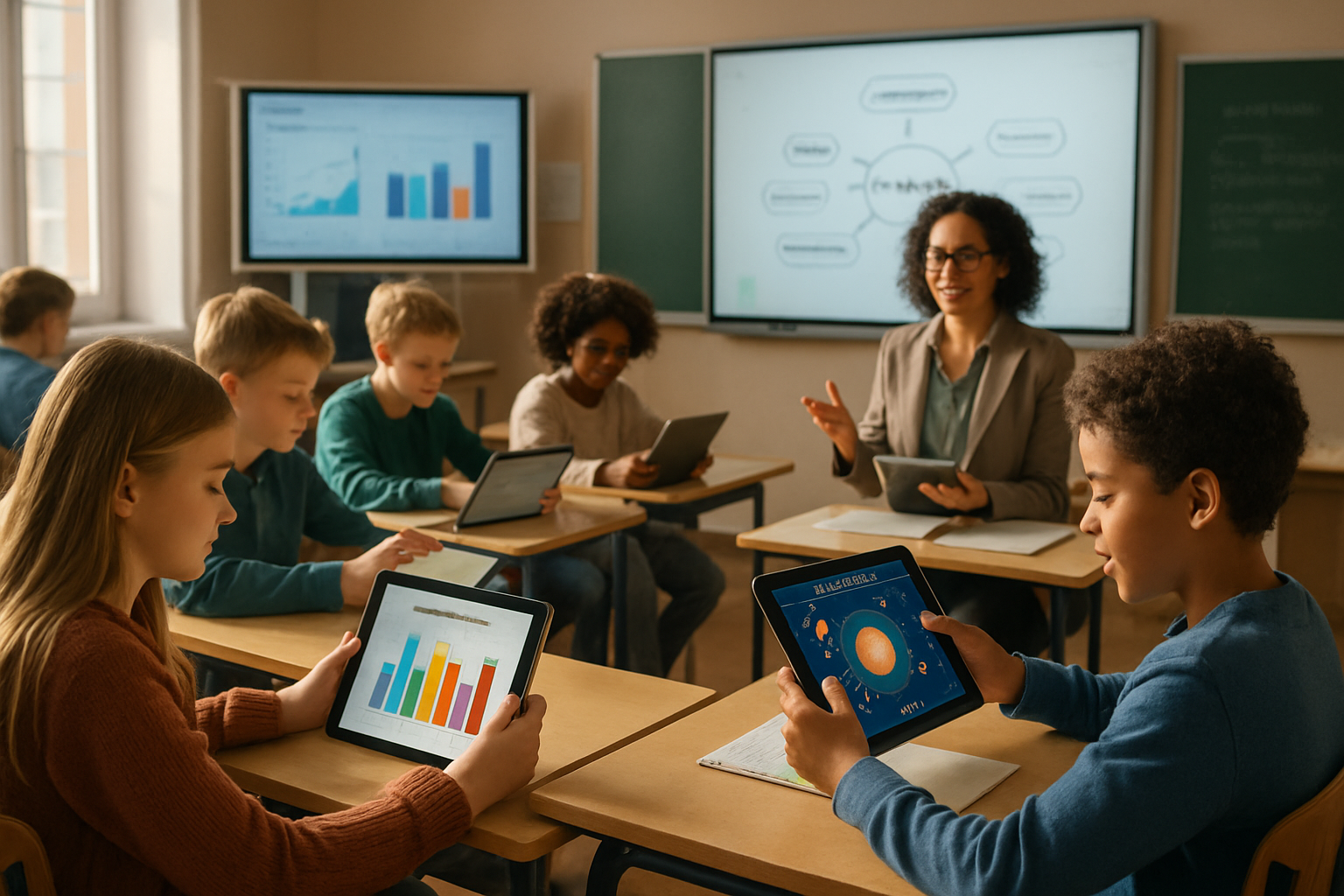
Educational systems worldwide are experiencing unprecedented transformation as Azerbaijan launches groundbreaking social-emotional learning programs for vulnerable children while simultaneously hosting the nation's premier English Olympiad, marking a pivotal moment in what experts call the "2026 Educational Technology Renaissance."
At the forefront of this global movement, Azerbaijan has implemented two distinctive educational initiatives that exemplify the modern approach to comprehensive student development. Under the leadership of Leyla Aliyeva, Vice-President of the Heydar Aliyev Foundation and founder of the IDEA Public Union, a pioneering social-emotional learning program has been launched for children living in residential social service institutions across the country.
This innovative program represents a fundamental shift from traditional academic-only approaches to education, recognizing the critical importance of emotional intelligence and psychological wellbeing in student success. The initiative focuses on developing children's ability to understand and manage emotions, establish positive relationships, and make responsible decisions—skills that research has shown to be equally important as academic achievement for long-term life success.
Academic Excellence Through Global Competition
Simultaneously, Azerbaijan is demonstrating its commitment to academic excellence through the 8th English Olympiad for Academic Purposes, launched by ADA University with support from the Ministry of Science and Education. This prestigious competition, conducted in partnership with the Baku Education Information Center and Ultra Technologies, brings together students from across the nation to showcase their academic skills in English language proficiency.
The Olympiad represents more than a simple language competition—it serves as a platform for identifying and nurturing academic talent while promoting international communication skills essential for success in today's globalized economy. Students participating in the competition demonstrate not only linguistic competency but also critical thinking abilities and cultural awareness that prepare them for higher education and professional careers on the global stage.
This dual approach—combining emotional development with academic rigor—positions Azerbaijan at the forefront of what educational experts describe as the most significant transformation in learning since the post-World War II educational expansion. The initiative reflects a sophisticated understanding that modern education must address the complete spectrum of human development to prepare students for an increasingly complex world.
Global Context of Educational Innovation
Azerbaijan's initiatives occur within the broader context of the "2026 Educational Technology Renaissance," a coordinated international movement toward thoughtful integration of digital tools with traditional educational values. This global phenomenon emphasizes human-centered approaches that enhance rather than replace fundamental teacher-student relationships, representing a crucial evolution from technology-for-efficiency models to outcome-oriented enhancement of learning effectiveness.
Leading examples of this transformation include Malaysia's remarkable achievement of a 97.82% teacher placement rate alongside the world's first AI-integrated Islamic school, which successfully combines artificial intelligence with traditional religious and academic learning. Singapore's WonderBot 2.0 conversational AI heritage education system and Canada's responsible AI teaching assistants that maintain critical thinking standards provide complementary models demonstrating how technology can serve educational goals without replacing essential human connections.
The success of these diverse international approaches underscores a fundamental principle emerging from the 2026 educational transformation: effective modernization requires thoughtful adaptation of technological tools to serve specific cultural, economic, and social needs rather than adopting standardized solutions that ignore local contexts and values.
Addressing Digital Age Challenges
The timing of Azerbaijan's social-emotional learning initiative is particularly significant given mounting evidence of digital age challenges affecting young people globally. Recent research by Dr. Ran Barzilay at the University of Pennsylvania reveals that 96% of children aged 10-15 use social media, with 70% experiencing harmful content exposure and over 50% facing cyberbullying.
These statistics highlight the urgent need for educational programs that develop emotional resilience and social skills necessary to navigate an increasingly complex digital landscape. Early smartphone exposure before age 5 has been linked to persistent sleep disorders, cognitive decline, and weight problems extending into adulthood, while children spending four or more hours daily on screens face a 61% increased risk of depression.
Azerbaijan's social-emotional learning program directly addresses these challenges by providing children with tools to understand their emotional responses, develop healthy coping mechanisms, and build supportive relationships—skills that serve as protective factors against the negative impacts of excessive technology use and social media exposure.
The Danish Learning Innovation Model
While Azerbaijan demonstrates the integration of emotional learning with academic excellence, Denmark's educational initiatives showcase another dimension of the global transformation. Danish schools have pioneered innovative approaches to learning that emphasize critical thinking, creativity, and collaborative problem-solving—skills increasingly recognized as essential for success in an AI-integrated economy.
Denmark's focus on developing uniquely human capabilities that complement rather than compete with artificial intelligence represents a strategic response to employment transformation predictions. Microsoft's Suleyman forecasts that the majority of office workers could be replaced within two years, making the development of creativity, emotional intelligence, and complex critical thinking more valuable than ever.
Economic and Social Implications
The global shift toward comprehensive educational approaches carries significant economic implications. Countries implementing prevention-first educational strategies report superior outcomes through reduced crisis intervention costs, decreased unemployment rates, and improved workforce productivity. Educational investments are increasingly viewed as strategic 21st-century infrastructure that creates self-reinforcing cycles where educational excellence supports economic development, enabling further investment in human capital.
The prevention-first approach exemplified by Azerbaijan's social-emotional learning program demonstrates measurable benefits that extend far beyond immediate educational outcomes. Programs that address students' emotional and psychological needs early prevent more costly interventions later, including reduced requirements for crisis mental health services, lower rates of academic failure, and decreased involvement with juvenile justice systems.
This economic framework positions education as a strategic investment rather than a cost center, generating multiplier effects that benefit entire communities through enhanced resilience, reduced social service demands, and improved public health outcomes. Countries like Finland, which have maintained their position as the world's happiest nation for nine consecutive years through educational reforms that balance academic achievement with psychological wellbeing, demonstrate the long-term value of comprehensive educational approaches.
International Cooperation and Knowledge Sharing
The success of diverse educational initiatives worldwide has been facilitated by unprecedented levels of international cooperation and knowledge sharing. Unlike traditional models focused primarily on financial assistance, contemporary educational cooperation emphasizes comprehensive support including cultural integration, language acquisition, and ongoing development systems.
Regional frameworks are emerging that enable smaller nations to access expertise while contributing innovations to global knowledge bases. Bilateral partnerships and peer-to-peer knowledge sharing networks have proven more resilient than traditional multilateral approaches, allowing for flexible, culturally responsive strategies while maintaining evidence-based standards.
Azerbaijan's initiatives benefit from this global knowledge exchange while contributing unique insights about implementing social-emotional learning in institutional settings and organizing large-scale academic competitions. The country's experience provides valuable templates for other nations seeking to balance emotional development with academic excellence while respecting local cultural values and traditions.
Challenges and Implementation Factors
Despite significant progress, the global educational transformation faces substantial challenges that require sustained attention and resources. The worldwide semiconductor crisis has driven memory chip prices up sixfold, creating infrastructure bottlenecks for technology-dependent programs that are expected to persist until 2027 when new manufacturing facilities come online.
This crisis has paradoxically driven innovation toward more efficient and sustainable technology integration approaches, emphasizing educational enhancement over wholesale replacement of traditional methods. Educational systems are learning that effective technology integration requires sustained political commitment, comprehensive stakeholder engagement, and careful balance between innovation and tradition.
Success factors identified across multiple countries include sustained political commitment that survives electoral cycles, comprehensive stakeholder engagement involving educators, students, families, and communities, and innovation-tradition balance that preserves cultural authenticity while embracing technological advancement. Additionally, adequate resource allocation for long-term sustainability and international cooperation through knowledge sharing and technical assistance have proven essential for successful implementation.
Future Implications and Global Significance
The educational initiatives emerging in 2026 represent a critical juncture that will determine educational trajectories for the coming decade and significantly affect global capacity to address climate change, technological disruption, and social cohesion through quality educational systems serving as strategic infrastructure for 21st-century prosperity.
The stakes are particularly high as educational systems must prepare students for an AI-integrated global economy while preserving human creativity, critical thinking, and cultural knowledge that define authentic educational excellence. The window for effective coordinated action is narrowing as technological change accelerates and global challenges intensify, requiring unprecedented coordination between governments, educational institutions, private sector partners, and international organizations.
Azerbaijan's dual approach—combining social-emotional learning with academic competitions—provides a compelling template for educational modernization that maintains human-centered values while embracing necessary technological advancement. The success of this approach, along with similar initiatives worldwide, suggests that the future belongs to educational systems that successfully integrate advanced technologies while preserving fundamental human relationships, critical thinking skills, and cultural authenticity that make education meaningful and culturally relevant.
Building Sustainable Educational Ecosystems
As the "2026 Educational Technology Renaissance" continues to evolve, the focus increasingly shifts toward building sustainable educational ecosystems that can adapt to rapid change while maintaining core educational values. This requires moving beyond simple technology adoption to comprehensive transformation that addresses the complete spectrum of student development needs.
The evidence from Azerbaijan, Denmark, and other leading educational innovators demonstrates that successful transformation requires thoughtful adaptation to specific cultural, economic, and social contexts rather than wholesale adoption of external models. Countries that balance technological advancement with human development, global competencies with local identity, and innovation with cultural authenticity are positioning themselves most advantageously for sustained prosperity.
The global educational transformation of 2026 represents more than policy adjustment—it reflects a fundamental reimagining of education's role in human development. Success will be measured not only by academic achievement but by the development of resilience, creativity, and collaborative capacity necessary to address the complex challenges of the coming decades. The stakes include ensuring that education fulfills its promise as the foundation for human flourishing in an increasingly complex world that requires both technological sophistication and deep human wisdom.