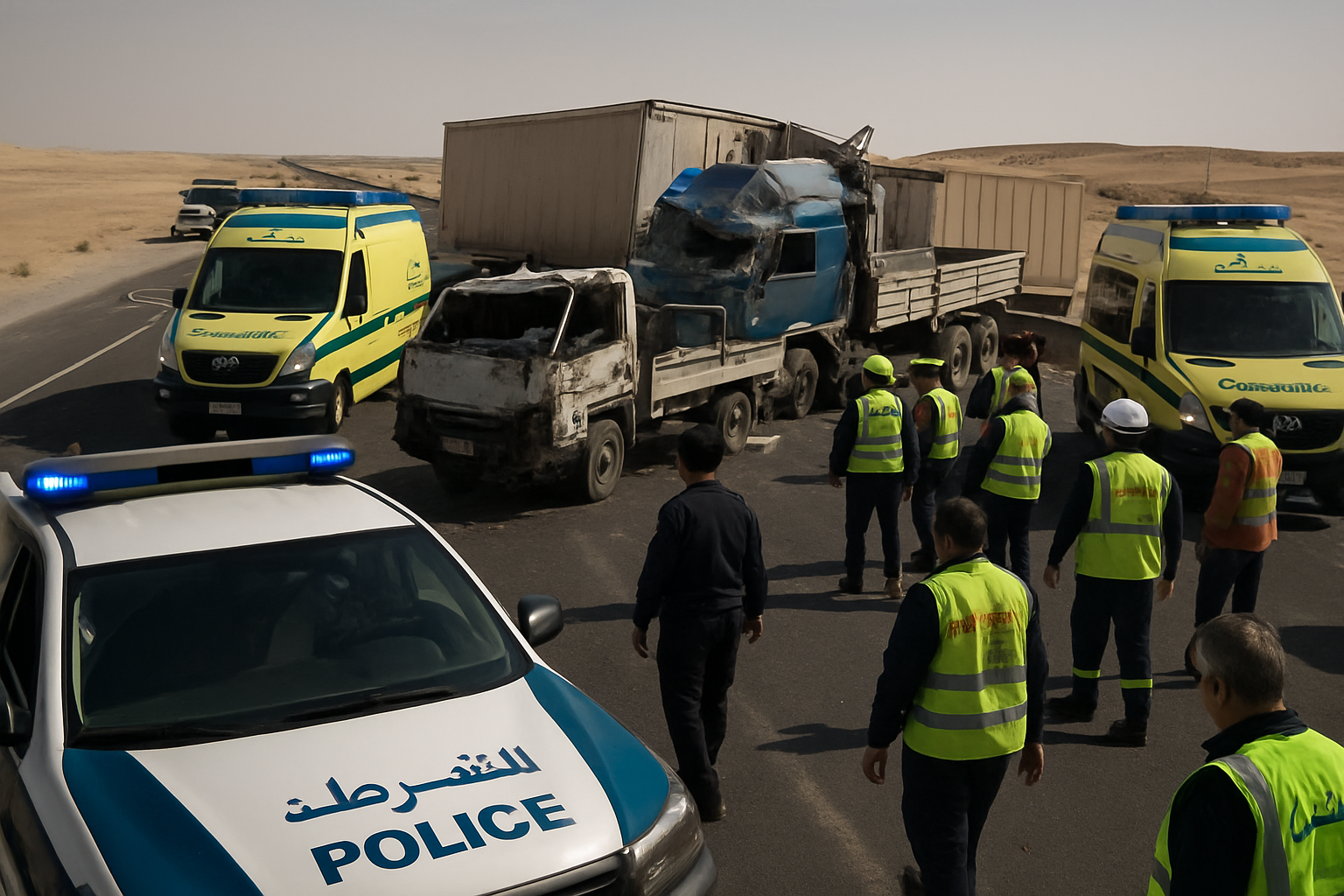
A catastrophic multi-vehicle collision on a major highway south of Port Said, Egypt, has claimed the lives of 18 people and left three others injured, according to local authorities and international news reports. The tragic incident occurred on Thursday afternoon when two large trucks collided with a pickup truck carrying fishermen to work.
The collision took place on a highway in northeastern Egypt, with the pickup truck becoming fatally trapped between two heavy commercial vehicles. According to Bulgaria's BTA news agency, which cited Associated Press reporting, the victims were fishermen being transported to their work at a fish farm in the Port Said area.
Devastating Impact and Immediate Response
Images released by local authorities captured the horrific aftermath of the crash, showing the pickup truck completely crushed between the two massive cargo trucks. The force of the impact left the smaller vehicle unrecognizable, underlining the severe nature of the collision that occurred on one of Egypt's busy commercial highways.
Emergency responders rushed to the scene to extract victims from the wreckage and provide medical assistance to the three survivors. The incident has drawn attention to the dangers faced by Egypt's working population, particularly those who rely on shared transportation to reach remote work sites.
The Ministry of Labor confirmed that the deceased were fishermen, highlighting how this tragedy has impacted Egypt's vital fishing industry. The workers were being transported in the pickup truck as part of their daily commute to fish farming operations in the Port Said region, an area crucial to Egypt's aquaculture sector.
Egypt's Ongoing Road Safety Crisis
This latest tragedy underscores a persistent and deadly pattern across Egypt's road network. According to Al Jazeera's reporting, road accidents in Egypt are frequently linked to speeding and claim thousands of lives each year, making traffic safety one of the country's most pressing public health challenges.
The incident occurs within a broader context of transportation safety concerns that have plagued Egypt and the broader Middle East region. Historical data from our news monitoring shows that Egypt has experienced recurring traffic safety incidents, often involving commercial vehicles and workers being transported to job sites.
"Road accidents, often linked to speeding, claim thousands of lives each year in Egypt."
— Al Jazeera Report
The causes of Thursday's specific collision remain under investigation, with authorities yet to determine whether speed, mechanical failure, or other factors contributed to the deadly crash. However, the incident fits a troubling pattern of accidents involving heavy commercial vehicles on Egypt's highway system.
Vulnerable Workers at Risk
The fact that all 18 victims were fishermen traveling to work highlights the particular vulnerability of Egypt's working population, especially those in industries like fishing and agriculture who often depend on shared transportation to reach remote work locations. These workers frequently travel in vehicles that may lack adequate safety features or proper maintenance.
Egypt's fishing industry employs hundreds of thousands of workers, many of whom must travel significant distances to reach coastal fish farms, processing facilities, and fishing ports. The Port Said region, where this tragedy occurred, is a critical hub for Egypt's maritime industries, including both commercial fishing and the operations of the Suez Canal.
The incident raises questions about workplace safety protocols and whether adequate protections exist for workers during their commutes to job sites. The use of pickup trucks to transport multiple workers, while common practice, can expose passengers to significant risks in the event of collisions with much larger vehicles.
Regional Transportation Challenges
This collision comes amid a broader pattern of transportation safety challenges across the Middle East and North Africa region. Recent investigations have documented similar concerns about road safety infrastructure, vehicle maintenance standards, and enforcement of traffic regulations.
Egypt's road network carries heavy traffic loads, including substantial commercial vehicle traffic serving the country's agricultural and industrial sectors. The mixing of heavy trucks, passenger vehicles, and work-related transportation creates complex safety challenges that require comprehensive solutions.
The Port Said area, due to its strategic location near the Suez Canal and its importance as a commercial hub, experiences particularly heavy traffic volumes. This includes not only local commuter traffic but also international commercial vehicles and industrial transportation serving Egypt's export industries.
Investigation and Safety Measures
Local authorities have launched an investigation into the circumstances surrounding the collision, though specific details about the cause remain limited. The investigation will likely examine factors including vehicle speeds, mechanical conditions, road conditions, and whether any traffic violations contributed to the tragedy.
The incident has prompted renewed calls for enhanced road safety measures throughout Egypt. These might include improved highway design, better separation of commercial and passenger traffic, enhanced vehicle safety inspections, and stricter enforcement of speed limits and other traffic regulations.
For Egypt's fishing industry and other sectors that rely on worker transportation, the tragedy highlights the need for improved safety protocols. This could involve requirements for safer vehicles, better insurance coverage for workers, and alternative transportation arrangements that reduce risks.
Broader Implications
Thursday's deadly collision represents more than just a single tragic incident—it reflects systemic challenges that Egypt and other developing nations face in balancing rapid economic development with public safety infrastructure. The pressure to move workers efficiently to job sites must be weighed against the fundamental obligation to protect their safety.
The international attention drawn by this incident, reported across multiple countries and news agencies, underscores the global concern about road safety in rapidly developing economies. Egypt's experience offers lessons for other nations grappling with similar challenges in transportation safety and worker protection.
As Egypt continues its economic development and infrastructure modernization efforts, incidents like this tragic collision serve as stark reminders of the human cost of inadequate safety measures. The 18 lives lost represent not just statistics, but individuals with families and communities who depended on them.
The path forward requires comprehensive approaches that address vehicle safety standards, road infrastructure improvements, enforcement mechanisms, and protection for Egypt's most vulnerable workers. Only through sustained commitment to these improvements can similar tragedies be prevented in the future.