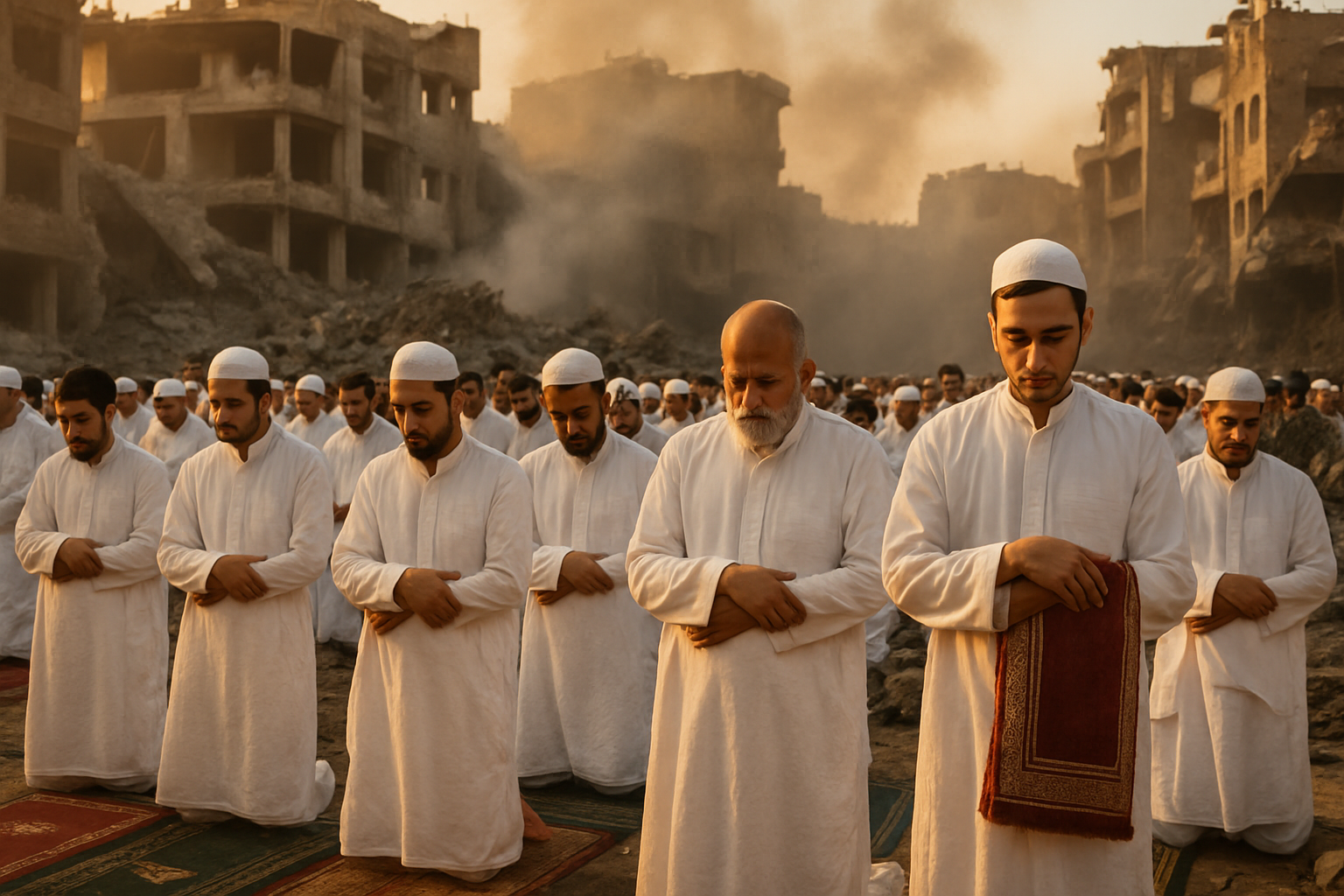
Nearly 2 billion Muslims worldwide celebrated Eid al-Fitr on March 20, 2026, marking the conclusion of what has been described as "the most internationally coordinated Ramadan in modern Islamic history," yet the joyous festival unfolded under the shadow of ongoing conflicts and unprecedented restrictions at Islam's third holiest site.
From Algeria's presidential prayers at the Grand Mosque to Gaza's resilient worshippers gathering among rubble, this year's Eid al-Fitr celebrations demonstrated both the unifying power of faith and the harsh realities of a world still grappling with conflict. The festival, which celebrates the end of the holy month of Ramadan, took place amid the most serious Middle East crisis since the Cold War, with Muslims in conflict zones showing remarkable resilience in maintaining their spiritual traditions.
A Tale of Two Realities: Celebration and Conflict
The stark contrasts of Eid 2026 were evident across the Muslim world. In Algeria, President Abdelmadjid Tebboune arrived at the Grand Mosque to perform Eid prayers alongside senior government officials, foreign diplomats, and thousands of worshippers in scenes of traditional celebration. Meanwhile, in neighboring Libya and across conflict zones, Muslims faced severe challenges in observing their holiest festival.
The most poignant symbol of these contrasts emerged from Gaza, where Palestinians performed Eid prayers among the ruins of destroyed mosques and in temporary shelters near refugee camps. Tens of thousands gathered in makeshift prayer areas, their voices rising in traditional Eid chants despite the devastation surrounding them—a testament to the enduring power of faith amid adversity.
In Azerbaijan's recently liberated Karabakh region, Eid prayers were held at the newly reopened Aghdam Juma Mosque, marking a significant moment in the revival of religious life in territories that had been inaccessible for decades. The ceremony at this historic mosque represented not just religious observance but the restoration of cultural identity to a region scarred by conflict.
Al-Aqsa Mosque: Unprecedented Restrictions
Perhaps nowhere were the tensions of celebrating Eid amid conflict more apparent than in Jerusalem, where Israeli forces imposed severe restrictions on access to the Al-Aqsa Mosque compound. For the 17th consecutive day, the mosque remained effectively closed to most Muslim worshippers—an unprecedented situation that marked the first time since 1967 that Israeli authorities had completely prevented regular Muslim prayers at Islam's third holiest site.
Palestinian sources reported that Israeli forces used tear gas against Palestinians attempting to reach the mosque for Eid prayers, forcing many to pray in the streets around the Old City. The restrictions, implemented during the most volatile period in decades, represented a significant escalation in the control of religious sites during sensitive periods.
The closure of Al-Aqsa during Eid carried profound symbolic weight for Muslims worldwide, as the mosque has historically served as a focal point for major Islamic celebrations. Videos circulated on social media showing Palestinians praying in narrow alleyways and on rooftops, their determination to observe Eid undiminished despite the obstacles.
Global Diplomatic Tensions
The geopolitical backdrop to Eid 2026 was dominated by the ongoing crisis following the death of Iran's Supreme Leader Ali Khamenei on March 1, which triggered the most dangerous international crisis since the Cold War. This regional instability cast a shadow over celebrations across the Middle East and beyond.
In Jordan, King Abdullah II performed Eid prayers at the Royal Guard Mosque in Aqaba, while the kingdom's officials maintained diplomatic efforts to de-escalate regional tensions. The Hashemite Kingdom, as custodian of Islamic holy sites in Jerusalem, found itself in a particularly delicate position, balancing its peace treaty with Israel with its responsibilities to the Muslim world.
Even in countries far from the immediate conflict zones, the global Muslim community felt the weight of these tensions. In Bosnia and Herzegovina, religious leaders used their Eid sermons to pray for peace in the Middle East, while community leaders emphasized the festival's themes of unity and reconciliation.
Resilience Through Faith
Despite the challenging circumstances, the essential character of Eid al-Fitr—celebration, charity, and community unity—persevered across diverse settings. In Pakistan, millions gathered for prayers after the Central Ruet-i-Hilal Committee confirmed the moon sighting, with special security arrangements ensuring peaceful celebrations across the country.
The festival's emphasis on charitable giving, known as Zakat al-Fitr, took on added significance this year as Muslim communities worldwide organized unprecedented relief efforts for those affected by conflicts. Saudi Arabia's massive international coordination during Ramadan—which included distributing 2.2 million Quran copies to 120 countries and deploying 91 imams to 49 nations—continued into Eid with extensive humanitarian programs.
In the Gulf states, despite regional tensions, Eid celebrations proceeded with appropriate security measures. Kuwait's leadership exchanged congratulations with Arab and Islamic leaders, while maintaining diplomatic efforts toward regional stability. The UAE and Qatar similarly balanced celebration with cautious diplomacy.
Technology Bridging Distances
One of the remarkable aspects of Eid 2026 was the role of technology in connecting separated communities. Mobile applications for prayer times, Quranic recitation, and charitable giving enabled global diaspora participation across time zones, while social media platforms facilitated virtual family gatherings for those unable to travel due to ongoing conflicts or restrictions.
This technological integration represented a synthesis of ancient spiritual traditions with contemporary communication capabilities, allowing Muslims in conflict zones to participate in global Eid celebrations despite physical barriers. Virtual Eid gatherings became particularly important for Syrian refugees, Rohingya communities, and other displaced populations.
International Recognition and Interfaith Dialogue
The global significance of Eid al-Fitr was acknowledged by leaders and institutions worldwide, even amid ongoing tensions. Non-Muslim leaders across Europe, North America, and other regions extended congratulations to Muslim communities, reflecting growing global awareness and respect for Islamic traditions.
This interfaith recognition took on added importance given the current global climate, with many seeing respectful acknowledgment of religious festivals as crucial for maintaining social cohesion in increasingly diverse societies. Educational institutions in non-Muslim countries increasingly accommodated Muslim students and staff, reflecting evolving cultural inclusivity.
Looking Forward: Lessons of Resilience
Eid al-Fitr 2026 concluded what religious scholars described as the most internationally coordinated Ramadan in modern Islamic history, despite unprecedented challenges. The festival demonstrated that spiritual traditions can maintain their essential character even under the most difficult circumstances, providing hope and unity when they are most needed.
The celebrations also highlighted the complex relationship between religion and geopolitics in the contemporary world. While conflicts may restrict access to holy sites or complicate traditional observances, they cannot diminish the fundamental human capacity for faith, community, and hope.
For the nearly 2 billion Muslims who observed Eid al-Fitr in 2026, the festival served as both a celebration of spiritual achievement and a reminder of the resilience required to maintain religious traditions in an uncertain world. From the grand mosques of peaceful nations to the makeshift prayer areas of conflict zones, the essential message remained unchanged: faith endures, community perseveres, and hope survives even in the darkest times.
As the Islamic calendar moves forward, the lessons of Eid 2026—about resilience, international cooperation, technological adaptation, and the enduring power of spiritual community—will likely influence how religious festivals are observed and understood in an increasingly interconnected yet conflicted world.