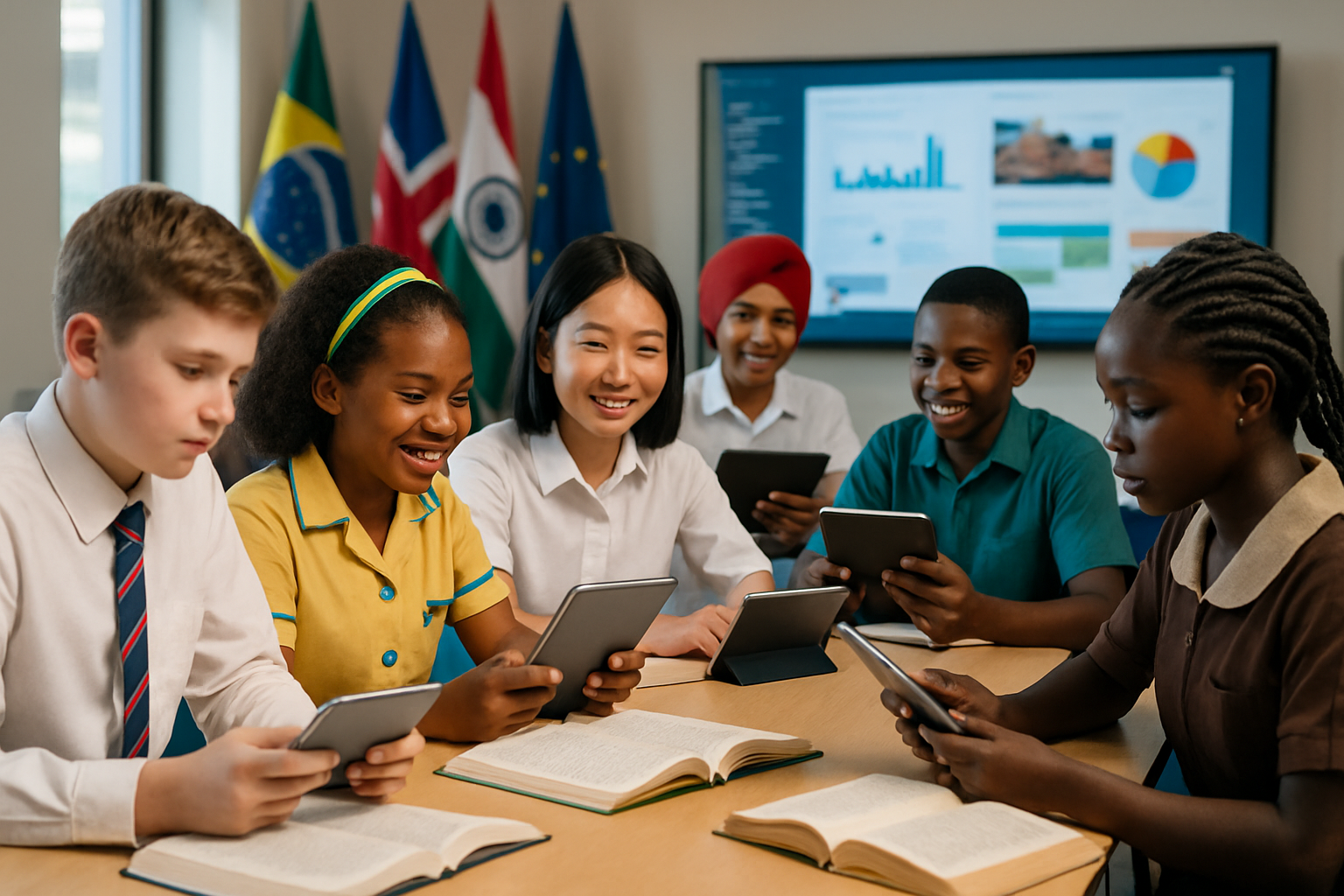
A comprehensive investigation across eight nations reveals unprecedented coordination in global educational transformation, with countries from Central America to Northern Europe implementing innovative policies that balance technological advancement with human-centered learning approaches.
From El Salvador's systematic school renovation program to Kenya's groundbreaking competency-based curriculum rollout, the March 2026 educational landscape demonstrates what experts are calling the "2026 Educational Technology Renaissance" - a coordinated international movement toward accessible, technologically integrated learning systems that address local needs while maintaining global competitiveness.
Central America Leads Infrastructure Revolution
El Salvador continues to set the standard for educational infrastructure investment through its ambitious "#DosEscuelasXDía" program, which has now reached 586 school interventions nationwide. The latest renovation at Centro Escolar Profesor Raúl Flores Moreno in Conchagua demonstrates the government's commitment to providing dignified learning environments across all regions.
The comprehensive support packages distributed under President Nayib Bukele's administration benefit 1.2 million students nationally, including cutting-edge technology devices adapted to academic levels - tablets for primary grades and laptops for higher education. This systematic approach to educational equity has garnered international attention as a model for developing nations seeking to bridge the digital divide.
"This program not only strengthens learning but also represents direct economic relief for families while ensuring students can advance through the academic year with improved conditions,"
— Educational authorities, El Salvador Ministry of Education
East Africa's Curriculum Revolution
Kenya's Ministry of Education has set a December 2026 deadline for the complete rollout of the Competency-Based Curriculum (CBC) across all universities nationwide. This transformative shift represents a fundamental departure from theory-comprehensive education toward hands-on, practical learning designed to prepare students for real-world job experiences.
The transition emphasizes developing practical skills alongside theoretical knowledge, addressing long-standing concerns about graduate employability in Kenya's evolving job market. This approach positions Kenya as a leader in African educational innovation, with other nations monitoring the implementation closely.
Peru's Academic Excellence Breakthrough
Students from the Juan Pablo Peregrino school in Lima Norte achieved unprecedented success in university entrance examinations, with Eidan Arredondo and Jhamil Rondan securing places in Human Medicine at the prestigious Universidad Nacional Mayor de San Marcos. The institution's remarkable achievement of nearly 200 university admissions demonstrates the effectiveness of focused academic preparation programs.
This success story highlights Peru's educational transformation, where systematic investment in teacher training and curriculum development is producing measurable results in academic achievement and university access for students from diverse socioeconomic backgrounds.
Asia-Pacific Innovation Models
The Philippines' Department of Education has approved the implementation of a revolutionary trimester school calendar through the Economy and Development Council, representing a significant shift from traditional semester-based systems. This innovation aims to improve learning outcomes through longer continuous learning periods and more effective curriculum pacing.
Meanwhile, Saint Vincent and the Grenadines Community College students have launched an innovative "Tea-Tiime" campaign, creating locally processed herbal teas that demonstrate practical application of food science education while supporting community health initiatives.
Nordic Educational Resilience
Sweden faces significant challenges as multiple educational institutions confront closure due to economic pressures. The Karolina preschool in Solna announced sudden closure with only two weeks' notice, leaving families scrambling for alternatives. Similarly, the Mälardalen International School in Västerås may close following Northvolt's bankruptcy, which has significantly impacted student enrollment.
These developments highlight the vulnerability of educational institutions to economic fluctuations and the importance of sustainable funding models in maintaining educational continuity.
Finland's Strategic Consolidation
Finland's National Archives (Kansallisarkisto) has begun planning the closure of four regional locations as part of a strategic consolidation effort to centralize archival storage and improve operational efficiency. This decision reflects broader trends in Nordic countries toward optimizing educational and cultural infrastructure for long-term sustainability.
Global Context: The 2026 Educational Technology Renaissance
These developments occur within what educational experts identify as the most significant transformation since post-World War II educational expansion. The 2026 Educational Technology Renaissance is characterized by thoughtful digital tool integration with traditional educational values, emphasizing human-centered approaches that enhance rather than replace fundamental teacher-student relationships.
Success stories from Malaysia's AI-integrated Islamic schools achieving 97.82% teacher placement rates, Singapore's WonderBot 2.0 heritage education system, and Canada's AI teaching assistants demonstrate that technological advancement can coexist with cultural preservation and critical thinking development.
Implementation Challenges and Solutions
The global semiconductor crisis has driven memory chip prices up sixfold, creating infrastructure bottlenecks for technology-dependent programs until 2027 when new manufacturing facilities come online. This challenge has paradoxically driven innovation toward more efficient, sustainable technology integration approaches.
Countries implementing comprehensive, prevention-focused educational approaches report superior economic outcomes through reduced crisis intervention costs, decreased unemployment, and improved workforce productivity. Educational investments are increasingly viewed as strategic 21st-century infrastructure rather than mere cost centers.
International Cooperation Evolution
Educational cooperation is evolving beyond traditional financial assistance toward comprehensive support including cultural integration, language acquisition, and ongoing development systems. Regional frameworks are enabling smaller nations to access expertise while contributing innovations to global knowledge bases.
Bilateral partnerships and peer-to-peer knowledge sharing networks are proving more resilient than traditional multilateral approaches, allowing for flexible, culturally responsive strategies while maintaining evidence-based standards.
Success Factors and Future Implications
Analysis across all eight nations reveals consistent success factors: sustained political commitment beyond electoral cycles, comprehensive stakeholder engagement, adequate resource allocation for long-term sustainability, and balance between innovation and tradition that preserves cultural authenticity while embracing necessary technological advancement.
The most promising initiatives prioritize human-centered approaches that treat technology as enhancement tools serving educational goals rather than replacing fundamental relationships that define authentic education.
March 2026: A Critical Juncture
Educational policy experts identify March 2026 as a critical juncture in global educational policy development, where the success or failure of current reform initiatives will determine educational trajectories for the coming decade. These decisions will significantly affect global capacity for addressing climate change, technological disruption, and social cohesion through quality educational systems.
The stakes include preparing students for an AI-integrated global economy while preserving human creativity, critical thinking, and cultural knowledge that define authentic educational excellence. The window for effective coordinated action is narrowing as technological change accelerates and global challenges intensify.
As these eight nations continue their educational transformations, their experiences provide valuable templates for worldwide implementation, demonstrating that effective modernization requires thoughtful technological tool adaptation serving specific cultural, economic, and social needs rather than standardized solutions. The future belongs to educational systems that successfully integrate advanced technologies while preserving the fundamental human relationships, critical thinking skills, and cultural authenticity that contribute to meaningful education and human flourishing.