The death of Nemesio Oseguera Cervantes, known as "El Mencho," leader of the Jalisco New Generation Cartel (CJNG), has plunged Mexico into a security crisis just months before hosting the 2026 World Cup, with violent retaliation spreading across 20 states following his killing during a military operation in Jalisco.
Mexican Defense Secretary Ricardo Trevilla confirmed Monday that the 59-year-old cartel boss was killed Sunday during a coordinated operation in the mountain resort town of Tapalpa, Jalisco state. The operation, which involved tracking one of El Mencho's romantic partners to his luxury hideout, ended the reign of one of the world's most wanted criminals who carried a $15 million U.S. Drug Enforcement Administration bounty.
The Operation: From Intelligence to Elimination
The successful operation against El Mencho was the result of sophisticated intelligence cooperation between Mexican and U.S. authorities. According to Defense Secretary Trevilla, intelligence agencies tracked a woman close to El Mencho's romantic partner to the Tapalpa Country Club, an exclusive residential complex in a forested mountain area.
"Intelligence agents identified a person close to 'El Mencho's' partner before the coordinated Sunday assault," Trevilla explained during a press conference at the National Palace. "Through this tracking, intelligence officers discovered the woman was sent to Tapalpa, a mountain tourist area in Jalisco, where the cartel boss and his men were hiding."
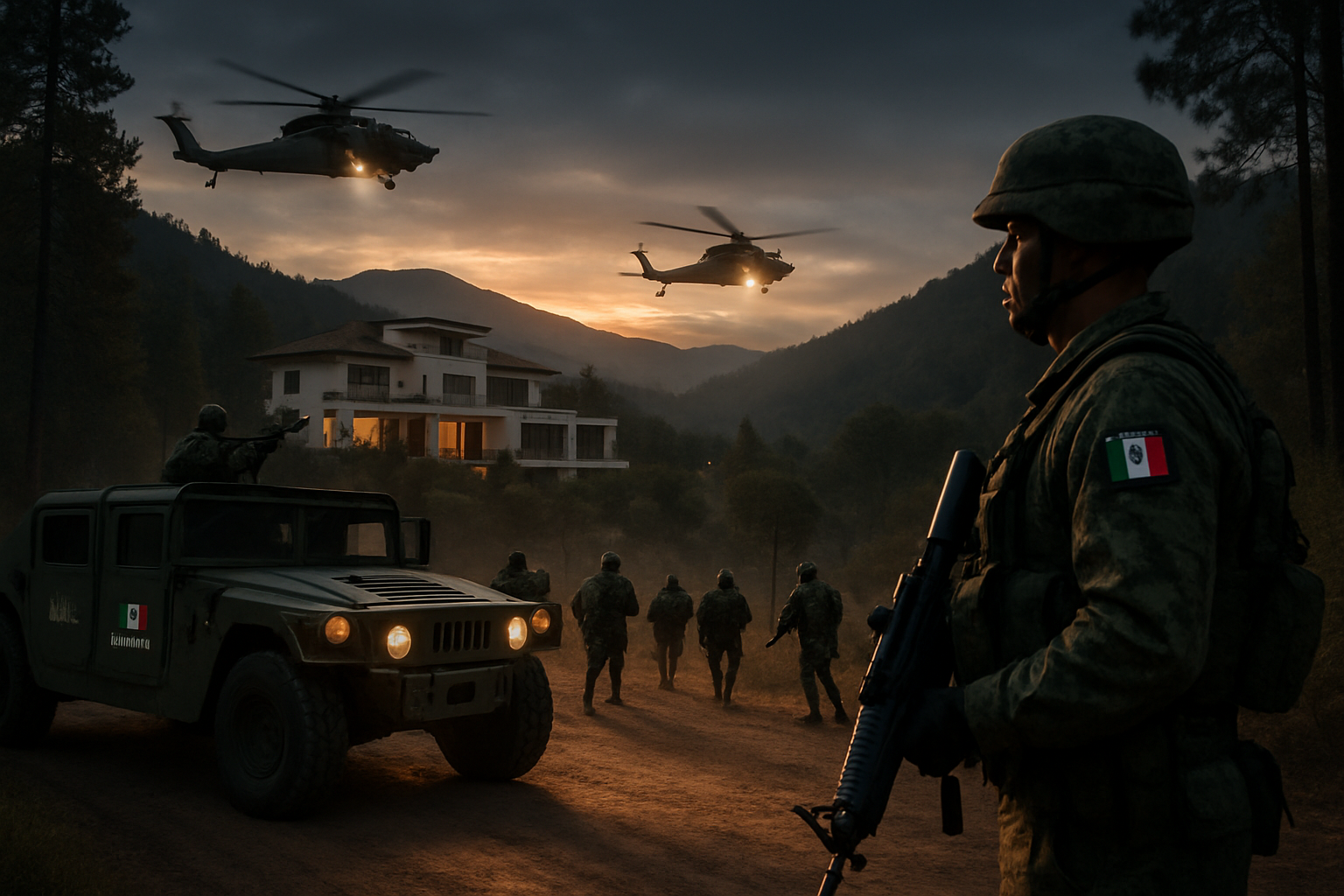
The operation involved air and ground forces, with Mexican special forces launching coordinated attacks that resulted in two major firefights. El Mencho was mortally wounded during the confrontation and died while being transported by helicopter to Mexico City. Six of his bodyguards were also killed in the operation, while three Mexican military personnel were injured.
Inside El Mencho's Final Hideout
Investigators who searched El Mencho's luxury accommodations at the Tapalpa Country Club discovered telling details about the cartel leader's final days. His room contained a Catholic altar with images of the Virgin Mary, fine chocolates, and kidney medications, painting a picture of a man grappling with both his mortality and his faith.
A handwritten card featuring Psalm 91, often called the "soldier's prayer," was found among his possessions, suggesting the cartel boss may have sensed his end was near. The psalm, which speaks of divine protection in times of danger, has become a talisman for those in high-risk professions, including military personnel and criminals alike.
Unprecedented Retaliation Campaign
The CJNG's response to their leader's death has been swift and devastating. Members of the organization launched a coordinated campaign of violence across 20 Mexican states, demonstrating the cartel's vast reach and organizational capacity even without its supreme leader.
The retaliation has claimed significant casualties among Mexican security forces. At least 25 members of the National Guard military police have been killed in retaliatory attacks, along with one police officer and one judicial employee. Approximately 70 CJNG members have also been eliminated during ongoing operations.
In Guadalajara, Mexico's second-largest city and a designated host city for the 2026 World Cup, cartel members have erected burning blockades, attacked businesses, and targeted government infrastructure. The violence has extended to popular tourist destinations, with a Costco store in Puerto Vallarta set ablaze and multiple branches of Banco del Bienestar attacked.
FIFA and World Cup Security Concerns
The timing of El Mencho's death has raised serious concerns about Mexico's ability to provide security for the 2026 World Cup, which it will co-host with the United States and Canada. FIFA has requested detailed security reports from the Mexican government following the outbreak of violence in Guadalajara, one of the tournament's host cities.
President Claudia Sheinbaum attempted to reassure the international community during her Monday press conference, announcing that all commercial flights were expected to resume normal operations after widespread cancellations during the weekend violence. However, many tourists in affected areas have reported flight cancellations and official warnings to remain indoors.
"We couldn't leave. The situation was incredibly tense, and we were advised to stay at our hotel until further notice."
— U.S. Tourist in Jalisco
The Criminal Empire Left Behind
El Mencho's death leaves behind a multi-billion-dollar criminal empire that extends far beyond Mexico's borders. Under his leadership since 2011, the CJNG evolved from the remnants of the Milenio Cartel into Mexico's most sophisticated criminal organization, known for its military-style tactics and advanced weaponry.
The cartel gained international notoriety in 2015 when it shot down a Mexican military helicopter using rocket-propelled grenades, demonstrating capabilities that rivaled state forces. The organization has been identified as a primary supplier of fentanyl to the United States and maintains criminal networks across Latin America and Asia.
Hugo, known as "El Tuli," the cartel's main logistical and financial operator, was killed alongside El Mencho during the operation. His elimination represents a significant blow to the organization's operational capacity, as he had been offering rewards of 20,000 pesos for the assassination of Mexican soldiers.
Succession Battle and Future Violence
Security analysts are warning of a potential succession battle within the CJNG that could lead to increased violence as various factions compete for control. El Mencho's son, Rubén "El Menchito" Oseguera, remains in U.S. custody, leaving a leadership vacuum that regional commanders are likely to contest.
Victor Manuel Sánchez Valdés, a security analyst, warned that while El Mencho's death represents "a historic blow against organized crime," it does not guarantee the cartel's defeat. "The territorial magnitude, financial resources, and lack of clear succession could result in internal disputes and episodes of focused violence," he explained.
Historical patterns suggest that the elimination of cartel leaders often leads to organizational splintering rather than decreased violence, as competing factions battle for control of lucrative territories and trafficking routes.
International Implications
The operation has drawn international attention and praise from the United States. U.S. President Donald Trump praised the successful bilateral cooperation on his Truth Social platform, emphasizing that Mexico must "increase efforts against cartels and drugs."
The success of the operation demonstrates the effectiveness of U.S.-Mexico intelligence cooperation, with American agencies providing crucial support through established frameworks. This collaboration has become increasingly important as Mexican cartels have evolved into transnational criminal organizations with capabilities that exceed traditional law enforcement capacity.
Canada and Australia have issued travel advisories for affected regions in Mexico, while the tourism industry faces significant disruption. The violence has led to the suspension of transportation systems and the authorization of court closures for safety reasons in several affected areas.
Government Response and Security Deployment
In response to the crisis, Mexico has deployed approximately 10,000 troops across western regions, representing one of the largest security deployments in recent years. President Sheinbaum maintained real-time communication with her Security Cabinet during the operation and its aftermath while traveling in Coahuila state.
Jalisco Governor Pablo Lemus declared a "red code" emergency, suspending schools in eight states on Monday as authorities worked to contain the violence. The massive military response demonstrates the Mexican government's recognition of the threat posed by the CJNG's retaliation campaign.
A New Chapter in Mexico's Drug War
The death of El Mencho represents the most significant cartel leadership elimination since the capture of Joaquín "El Chapo" Guzmán in 2016. However, the violent aftermath serves as a stark reminder of the challenges facing Mexico's security forces as criminal organizations have evolved into sophisticated entities with state-like capabilities.
The operation tests Mexico's ability to manage major criminal organizations while minimizing civilian impact, particularly as the country prepares to host one of the world's largest sporting events. The success in eliminating El Mencho demonstrates tactical victory, but the long-term strategic implications remain to be determined as Mexico grapples with the complex challenge of dismantling criminal networks that have become integral to certain regional economies.
As Mexico continues its efforts to restore stability in affected regions, the international community watches closely to see whether this tactical success will translate into lasting security improvements or merely trigger a new phase of violence as criminal organizations adapt and reorganize in the wake of their leader's death.