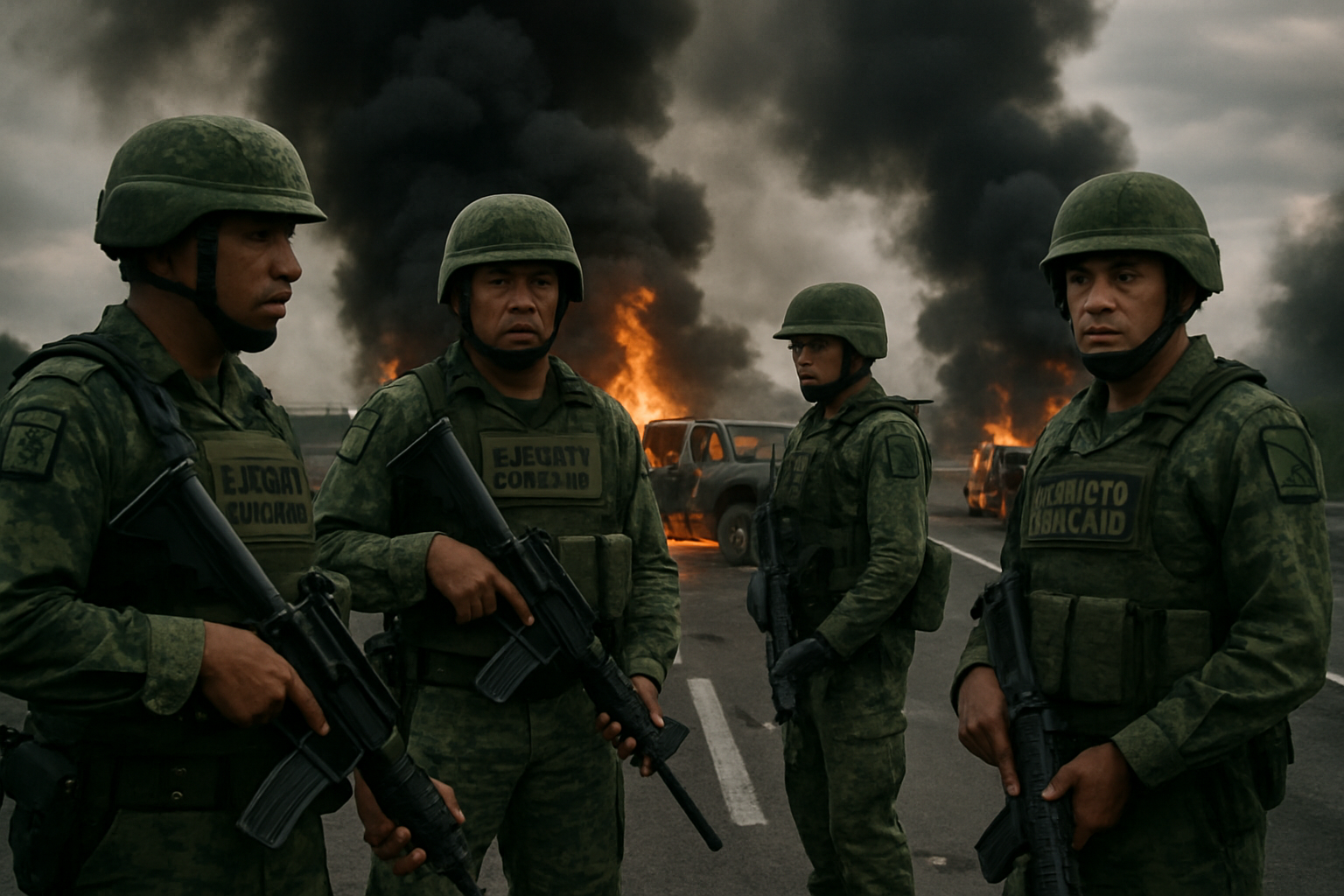
Mexico has deployed 10,000 military personnel across western regions following the death of Nemesio Oseguera Cervantes, known as "El Mencho," the feared leader of the Jalisco New Generation Cartel (CJNG), whose killing by special forces triggered an unprecedented wave of retaliatory violence across the country.
The 59-year-old cartel kingpin, who carried a $15 million U.S. bounty on his head, was killed Sunday during a military operation in Tapalpa, Jalisco state, approximately 130 kilometers south of Guadalajara. Mexican Defense Secretary Ricardo Trevilla revealed that intelligence agencies located Oseguera by tracking one of his romantic partners who visited his hideout.
President Claudia Sheinbaum confirmed that the Security Cabinet kept her informed in real-time of the operation while she was conducting a work tour in Coahuila, hundreds of kilometers from the action. "Very early in the morning, the general secretary called me," Sheinbaum said, emphasizing that "Mexico is at peace" despite the violence that followed.
Coordinated Nationwide Retaliation
The cartel's response was swift and devastating. Within hours of Oseguera's death, CJNG members launched coordinated attacks across 20 Mexican states, demonstrating the organization's reach and sophisticated communication networks. Security Secretary Omar García Harfuch reported that at least 25 National Guard members, along with one police officer and one judicial employee, were killed in retaliatory attacks.
The violence was particularly severe in Jalisco, where the cartel blocked highways with burning vehicles, attacked businesses, banks, and government buildings. Guadalajara's international airport implemented security protocols as flames from burning vehicles were visible from the terminals. In Puerto Vallarta, attackers targeted a Costco store and multiple Banco del Bienestar branches.
Jalisco Governor Pablo Lemus declared a "red code" emergency alert and suspended classes in all educational systems on Monday. Public transportation was also halted as authorities worked to restore order.
The Fall of Mexico's Most Wanted
Oseguera had been Mexico's most sought-after criminal, leading the CJNG since approximately 2011 after it emerged from the remnants of the Milenio Cartel. Under his leadership, the organization became known for its military-style tactics, including the 2015 downing of a Mexican military helicopter using rocket-propelled grenades.
The operation that led to his death involved sophisticated intelligence work. Defense officials revealed that authorities had been tracking Hugo 'H', alias 'El Tuli', identified as one of Oseguera's main logistical and financial operators. 'El Tuli' was also killed during the operation and had reportedly offered 20,000 pesos for killing soldiers.
The military engagement was fierce, resulting in approximately 70 CJNG members killed alongside the security force casualties. Oseguera was wounded during the firefight and died while being transported by helicopter to Mexico City for medical treatment.
International Ramifications
The death of "El Mencho" and the subsequent violence have drawn international attention and concern. U.S. President Donald Trump praised the operation on his Truth Social platform, stating that "Mexico must increase its efforts against cartels and drugs." The White House confirmed that U.S. intelligence agencies provided crucial support in locating the cartel leader.
Multiple countries, including Canada and Australia, issued travel advisories for Mexico following the violence. The tourism industry, particularly in popular destinations like Puerto Vallarta and Guadalajara, faced immediate disruptions as authorities implemented emergency protocols.
Succession Battle Looms
Security analysts warn that Oseguera's death may not bring peace but could instead trigger a violent succession battle within the CJNG. At least five potential successors are reportedly vying for control of the organization, including his son Rubén "El Menchito" Oseguera, who is currently imprisoned in the United States.
The fragmentation of the cartel could lead to increased violence as different factions fight for territory and control of lucrative drug trafficking routes. Historical precedent suggests that the elimination of major cartel leaders often results in organizational splintering and escalated conflict rather than the collapse of criminal enterprises.
Massive Security Response
In response to the crisis, Mexico has implemented its largest security deployment in years. The 10,000 troops deployed to western Mexico represent a significant show of force aimed at preventing further cartel retaliation and maintaining public order.
The deployment spans multiple states, with particular focus on Jalisco, where the CJNG maintained its strongest presence. Additional National Guard and military personnel have been positioned at strategic locations, including airports, government buildings, and commercial centers.
Courts in affected regions have been authorized to close for safety reasons, while schools in eight states suspended classes on Monday as a precautionary measure. The economic impact is already being felt, with concerns about the upcoming FIFA World Cup 2026, which includes Guadalajara as a host city.
CJNG's Criminal Empire
Under Oseguera's leadership, the CJNG became one of Mexico's most powerful and sophisticated criminal organizations, with operations spanning drug trafficking, kidnapping, extortion, and money laundering. The cartel was particularly known for its role in fentanyl trafficking to the United States, making it a priority target for U.S. law enforcement.
The organization's military-style structure and advanced weaponry set it apart from traditional cartels. Its members were known to use drones for surveillance, encrypted communications, and sophisticated logistics networks that rivaled those of legitimate businesses.
The cartel's influence extended beyond Mexico, with connections to criminal networks throughout Latin America and operations in the United States, Europe, and Asia. This international reach explains why Oseguera's death has implications far beyond Mexico's borders.
Looking Ahead
While Mexican authorities celebrate the elimination of one of the country's most dangerous criminals, security experts caution that the challenge is far from over. The sophisticated nature of modern cartels means that organizational structures can survive the loss of individual leaders.
The coming weeks will be crucial in determining whether Mexico can maintain stability or whether the succession battle within the CJNG will lead to increased violence. The deployment of 10,000 troops represents a significant commitment to maintaining order, but the test will be whether this show of force can prevent the further fragmentation and violence that has historically followed such high-profile eliminations.
The death of "El Mencho" marks the end of an era in Mexico's war against organized crime, but it may also signal the beginning of a new and potentially more chaotic chapter as various factions vie for control of the criminal empire he built.