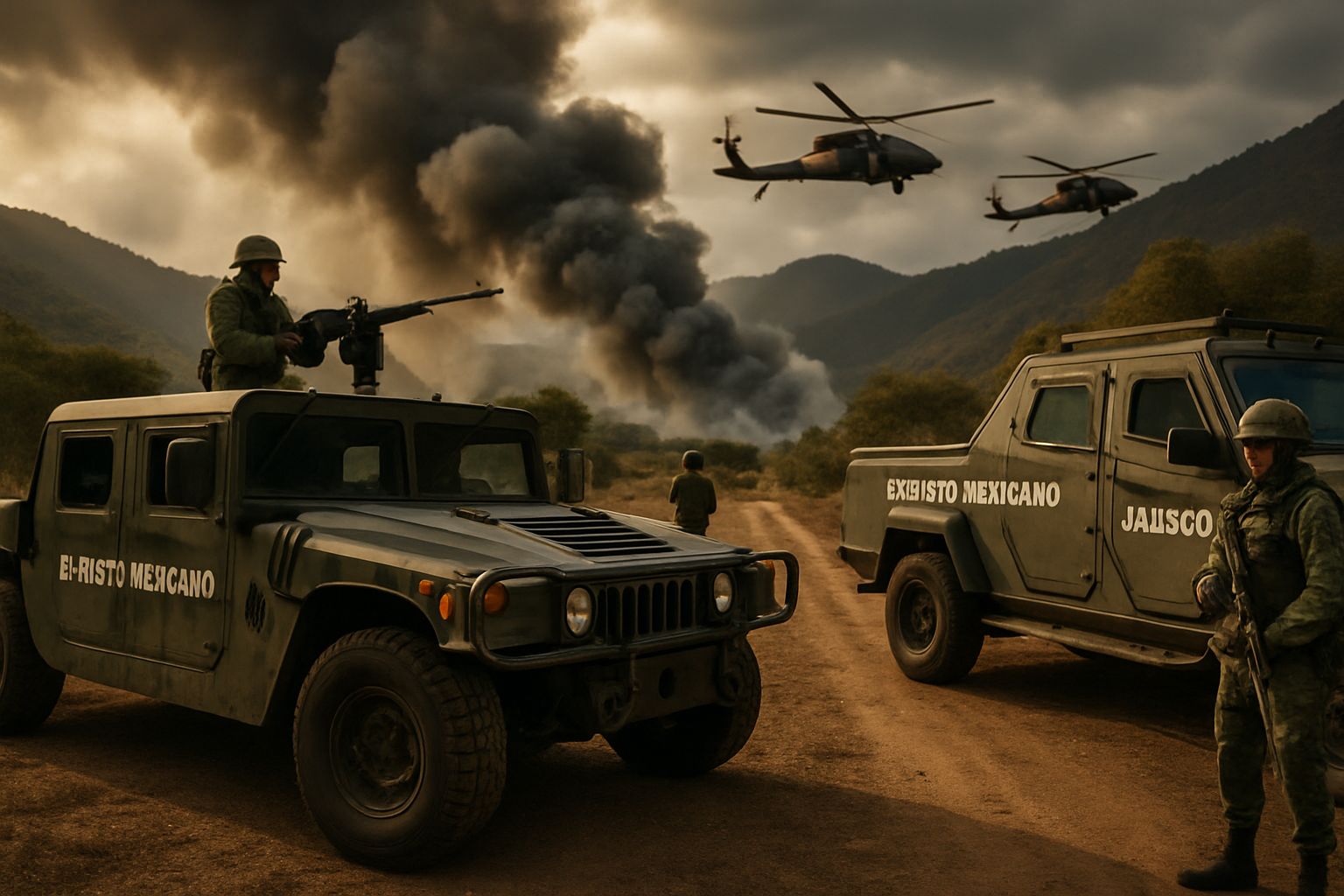
The death of Mexico's most wanted drug lord, Nemesio Oseguera Cervantes, alias "El Mencho," has unleashed a wave of coordinated violence across multiple Mexican states as the powerful Jalisco New Generation Cartel (CJNG) retaliates against the military operation that killed their leader.
Mexican federal forces confirmed Sunday evening that Oseguera, 59, was killed during a special military operation in Tapalpa, Jalisco state. The leader of one of the world's most dangerous criminal organizations died from wounds sustained in a firefight with federal troops, succumbing to his injuries during aerial transport to Mexico City.
Military Operation Eliminates Top Fugitive
The operation, conducted by multiple branches of Mexico's armed forces with intelligence cooperation from the United States, targeted Oseguera at a compound in the mountainous region of western Jalisco. According to Mexico's Ministry of Defense (Sedena), the military was attacked upon arrival, leading to a violent confrontation that left seven CJNG members dead, including their supreme leader.
"The operation was executed based on military intelligence work and complementary information provided by the United States," stated the official government communique. Four cartel members were killed immediately in the firefight, while three others, including Oseguera, died from their wounds during medical evacuation.
The United States had placed a $15 million bounty on Oseguera's capture, reflecting his status as one of the most dangerous criminals in the Western Hemisphere. Christopher Landau, U.S. Deputy Secretary of State, confirmed on social media that Mexican security forces had "killed 'El Mencho,' one of the bloodiest drug lords."
Immediate Retaliation Engulfs Multiple States
Within hours of the operation's conclusion, CJNG members launched coordinated attacks across at least seven Mexican states: Jalisco, Michoacán, Tamaulipas, Colima, Guanajuato, and others. The retaliation campaign included systematic vehicle burnings, highway blockades, and attacks on commercial establishments.
In Puerto Vallarta, one of Mexico's premier tourist destinations, cartel members set fire to a Costco store and multiple vehicles. Videos circulating on social media showed burning buses and cars throughout Guadalajara, Mexico's second-largest city, while armed groups blocked major roadways with flaming barricades.
The violence prompted immediate travel advisories from international governments. Canada's Global Affairs ministry updated travel warnings for Puerto Vallarta and surrounding areas, urging citizens to avoid all travel to affected regions. Multiple airports, including Guadalajara's main terminal, experienced disruptions as authorities implemented enhanced security protocols.
Criminal Empire Built on Violence and Innovation
Oseguera transformed the CJNG from a regional criminal group into Mexico's most powerful cartel over the past decade. The organization became notorious for its brazen attacks on government forces, including a 2015 incident where the cartel used rocket-propelled grenades to down a Mexican military helicopter—an unprecedented display of firepower that demonstrated the group's military-grade capabilities.
Under Oseguera's leadership, the CJNG expanded operations beyond traditional drug trafficking to include kidnapping, extortion, human trafficking, and the production of synthetic drugs, particularly fentanyl destined for U.S. markets. The cartel's influence stretched across Mexico and into international markets, with operations documented in the United States, Europe, and South America.
U.S. Department of Justice indictments described Oseguera as leading "one of the most powerful and ruthless criminal organizations" operating in Mexico. The cartel's territorial control encompassed significant portions of Jalisco, Colima, Veracruz, and contested areas in other states, often maintaining control through extreme violence against rivals and civilians.
Government Response and Presidential Statement
Mexican President Claudia Sheinbaum praised the security forces involved in the operation while calling for calm amid the ongoing violence. "My recognition to the Mexican Army, National Guard, Armed Forces, and Security Cabinet. We work every day for peace, security, justice, and the welfare of Mexico," she posted on social media platform X.
Sheinbaum emphasized "absolute coordination" with state governments and urged citizens to "stay informed and remain calm" as authorities worked to restore order. The president's measured response reflected the delicate balance between celebrating a major security victory and managing the immediate consequences of cartel retaliation.
The operation occurred during heightened pressure from the Trump administration for Mexico to intensify efforts against fentanyl trafficking. The timing coincides with ongoing bilateral discussions about drug interdiction cooperation and border security measures.
Regional Impact and International Implications
The elimination of "El Mencho" represents one of the most significant victories against organized crime since the capture of Sinaloa Cartel leaders Joaquín "El Chapo" Guzmán and Ismael "Mayo" Zambada, both currently serving sentences in U.S. prisons. However, security analysts warn that Oseguera's death may trigger internal power struggles within the CJNG and potentially fragment the organization into smaller, more violent factions.
The immediate violence demonstrates the cartel's organizational depth and capacity for coordinated response across vast territories. The systematic nature of the retaliation—including attacks in tourist areas, commercial centers, and transportation hubs—suggests pre-planned contingency operations designed to maximize economic and psychological impact.
International mining companies operating in Mexico have heightened security protocols following recent attacks on foreign workers, including the January 2026 kidnapping and killing of Canadian mining employees in Sinaloa state. The current violence wave reinforces concerns about Mexico's security environment for international business operations.
Succession Questions and Future Instability
Security experts identify at least five potential successors within the CJNG leadership structure, including Oseguera's son Rubén "El Menchito" Oseguera, currently imprisoned in the United States, and various regional commanders who have maintained the organization's operations across different territories.
The succession battle could intensify violence as different factions compete for control of the cartel's lucrative territories and smuggling routes. Historical precedent suggests that eliminating top cartel leaders often leads to fragmentation rather than organizational collapse, potentially creating multiple smaller groups with reduced central control but maintained violence capacity.
Mexican authorities have declared enhanced security measures across affected states while international partners monitor developments. The situation represents a critical test for President Sheinbaum's security strategy and Mexico's ability to manage the consequences of major counternarcotics victories.
Tourism and Economic Concerns
The violence in Puerto Vallarta and other tourist destinations raises immediate concerns about Mexico's crucial tourism industry. Jalisco state is scheduled to host four matches during the 2026 FIFA World Cup, adding international attention to regional security conditions.
Flight cancellations and travel advisories issued by multiple countries could impact the winter tourism season, traditionally a peak period for international visitors to Mexico's Pacific coast destinations. Hotel and business operators in affected areas have implemented enhanced security measures while authorities work to restore normal operations.
The economic implications extend beyond tourism, affecting mining operations, manufacturing facilities, and cross-border trade relationships. International businesses operating in Mexico may reassess security protocols and investment decisions based on the current instability patterns.
As Mexico grapples with the immediate aftermath of "El Mencho's" death, the long-term implications for organized crime dynamics, bilateral security cooperation, and regional stability remain uncertain. The coordinated nature of the cartel's response demonstrates the continuing challenge of dismantling sophisticated criminal organizations while protecting civilian populations and economic interests from retaliation campaigns.