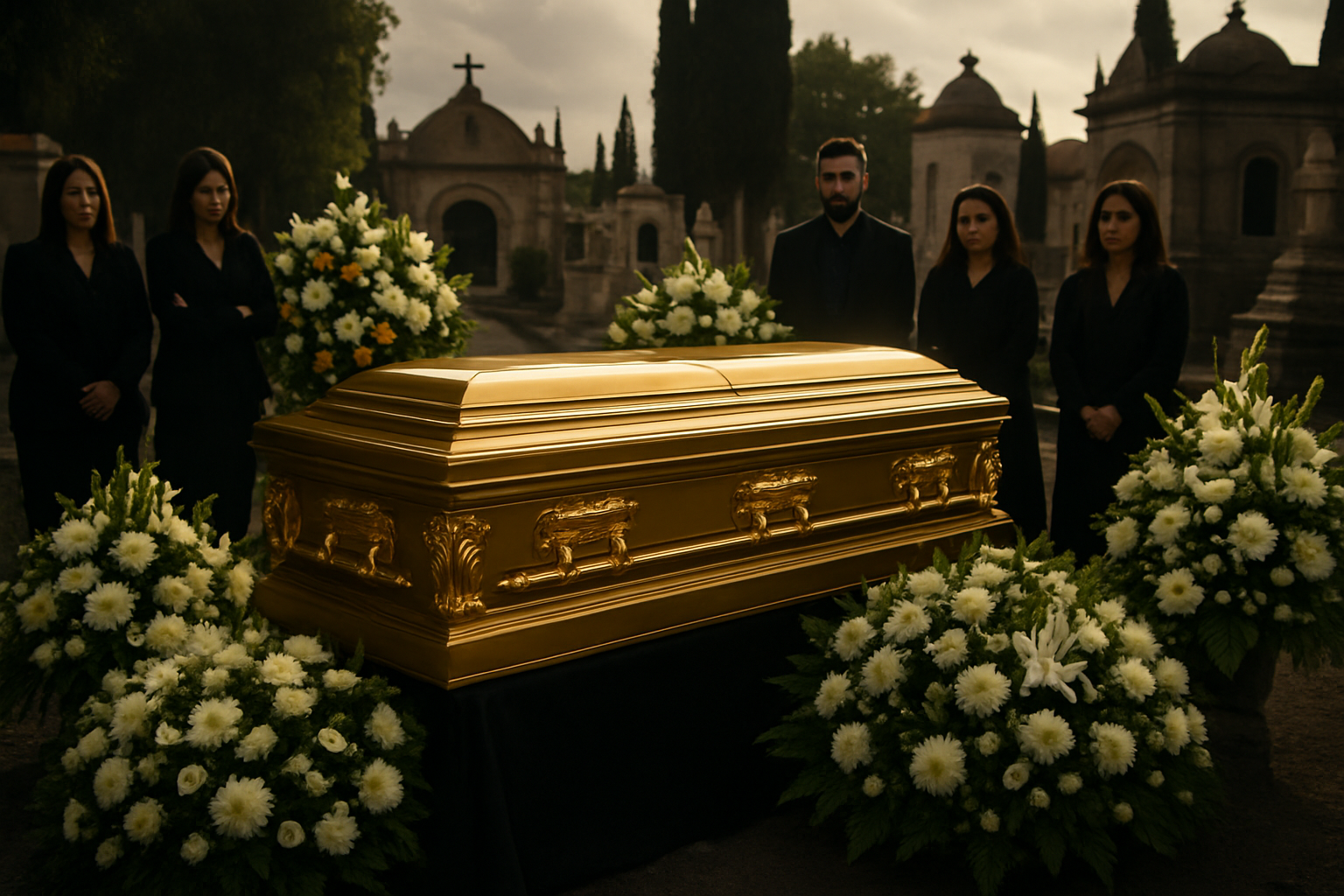
The funeral of Nemesio Oseguera Cervantes, known as "El Mencho," the feared leader of the Jalisco New Generation Cartel (CJNG), took place with elaborate ceremony in a golden coffin, marking a controversial end to one of Mexico's most wanted criminals just weeks after his death in a military operation.
People gathered beside the gold-colored coffin on March 2, 2026, at the Recinto de la Paz cemetery in Zapopan, following a wake at La Paz funeral home in San Andrés neighborhood, eastern Guadalajara. The funeral was conducted under massive military and police security operations, highlighting the complex dynamics between Mexican authorities and organized crime networks.
A Death That Shook Mexico
El Mencho was killed on February 22, 2026, during a military operation at the Tapalpa Country Club in Jalisco state. The 59-year-old cartel leader, who had a $15 million DEA bounty on his head as the world's most wanted drug criminal, died from gunshot wounds during helicopter transport to Mexico City after a fierce firefight that left six bodyguards dead and three Mexican military personnel injured.
The operation, conducted through U.S.-Mexico intelligence cooperation, located El Mencho through tracking of a romantic partner visiting his luxury mountain hideout. Defense Secretary Ricardo Trevilla confirmed it as a "sophisticated intelligence breakthrough" representing the most significant cartel leadership elimination since El Chapo's capture in 2016.
The Lavish Final Ceremony
The funeral proceedings revealed the extent of CJNG's influence and resources. Elaborate floral arrangements arrived without identification cards or condolence messages, including a distinctive rooster-shaped arrangement and multiple flower crowns bearing "CJNG" initials, clearly indicating cartel presence despite the heavy security.
"The body was transported from the funeral home to the cemetery with the same intensive security maintained throughout the proceedings."
— Local Security Official
Mourners attended with covered faces, reflecting both security concerns and the underground nature of the cartel's operations. The golden coffin itself became a symbol of the vast wealth accumulated through the CJNG's criminal enterprises, which had made it Mexico's most sophisticated criminal organization.
Unprecedented Retaliation and Government Response
Following El Mencho's death, the CJNG launched massive coordinated retaliation across 20 Mexican states with systematic violence including vehicle burning, highway blockades, and attacks on businesses and government infrastructure. The aftermath killed 25 National Guard members, one police officer, and one judicial employee, while Mexican forces eliminated approximately 70 CJNG members during operations.
President Claudia Sheinbaum's administration deployed 10,000 troops across western regions in the largest security deployment in years. Governor Pablo Lemus declared a "red code" emergency in Jalisco, with schools suspended across eight states. The violence particularly affected Guadalajara, a 2026 World Cup host city, raising international concerns about security preparations.
Questions of Security and Access
The elaborate funeral has raised serious questions about security protocols following El Mencho's death. President Sheinbaum asked the Attorney General's Office (FGR) to explain why the location where El Mencho was allegedly found was not properly secured after the February 22 military operation, allowing media access to the cabin where the cartel leader had been hiding.
She denied that the Jalisco State Attorney General's Office had any involvement in securing the area around the operation site, raising questions about coordination between federal and state authorities in handling such high-profile cases.
International Implications and FIFA Concerns
The cartel violence following El Mencho's death has had significant international repercussions. FIFA requested detailed security reports from the Mexican government following the violence in Guadalajara, one of the 2026 World Cup host cities. Multiple countries including Canada, Australia, and Belize issued travel advisories for Mexico.
The timing is particularly concerning as Mexico is set to co-host the 2026 FIFA World Cup with the United States and Canada, with tournament organizers now questioning security capabilities just months before the event begins in June 2026.
The Succession Battle
El Mencho's death has created a significant leadership vacuum within the CJNG. His son, Rubén "El Menchito" Oseguera, remains imprisoned in the United States, leaving regional commanders to compete for control of the organization's vast territorial holdings and financial resources.
Security analysts warn that this succession battle could create internal disputes and focused violence episodes, as historical patterns show that the elimination of cartel leaders typically causes organizational splintering rather than decreased violence. The funeral's CJNG symbolism demonstrated immediate organizational unity, but experts anticipate fragmentation in the coming months.
A Complex Legacy
Under El Mencho's leadership, the CJNG had evolved from remnants of the Milenio Cartel in 2011 to become Mexico's most sophisticated criminal organization. The group became notorious for military-style tactics, including the 2015 downing of a helicopter with RPGs, advanced weaponry, control of fentanyl trafficking to the United States, and international networks spanning Latin America and Asia.
The cartel's hideout revealed personal details about its leader: a Catholic altar with Virgin Mary images, a handwritten Psalm 91 "soldier's prayer" card, fine chocolates, and kidney medications indicating health issues that may have contributed to his operational limitations in recent years.
Broader Implications for Mexico
The lavish funeral and its aftermath represent more than the end of a criminal career—they highlight the ongoing challenges facing Mexican democracy in confronting sophisticated transnational criminal organizations. The event demonstrates how organized crime has achieved state-like capabilities requiring new security paradigms beyond traditional law enforcement scope.
The success of the operation against El Mencho represents effective U.S.-Mexico intelligence cooperation, with President Trump praising the bilateral operation while emphasizing that Mexico must "increase efforts against cartels and drugs." However, the violent retaliation and elaborate funeral proceedings show that eliminating leadership does not necessarily weaken these organizations' operational capabilities or cultural influence.
As Mexico continues to grapple with the aftermath of El Mencho's death and the power vacuum it has created, the golden coffin funeral serves as a stark reminder of the wealth, influence, and enduring challenges posed by organized crime in one of Latin America's largest democracies.