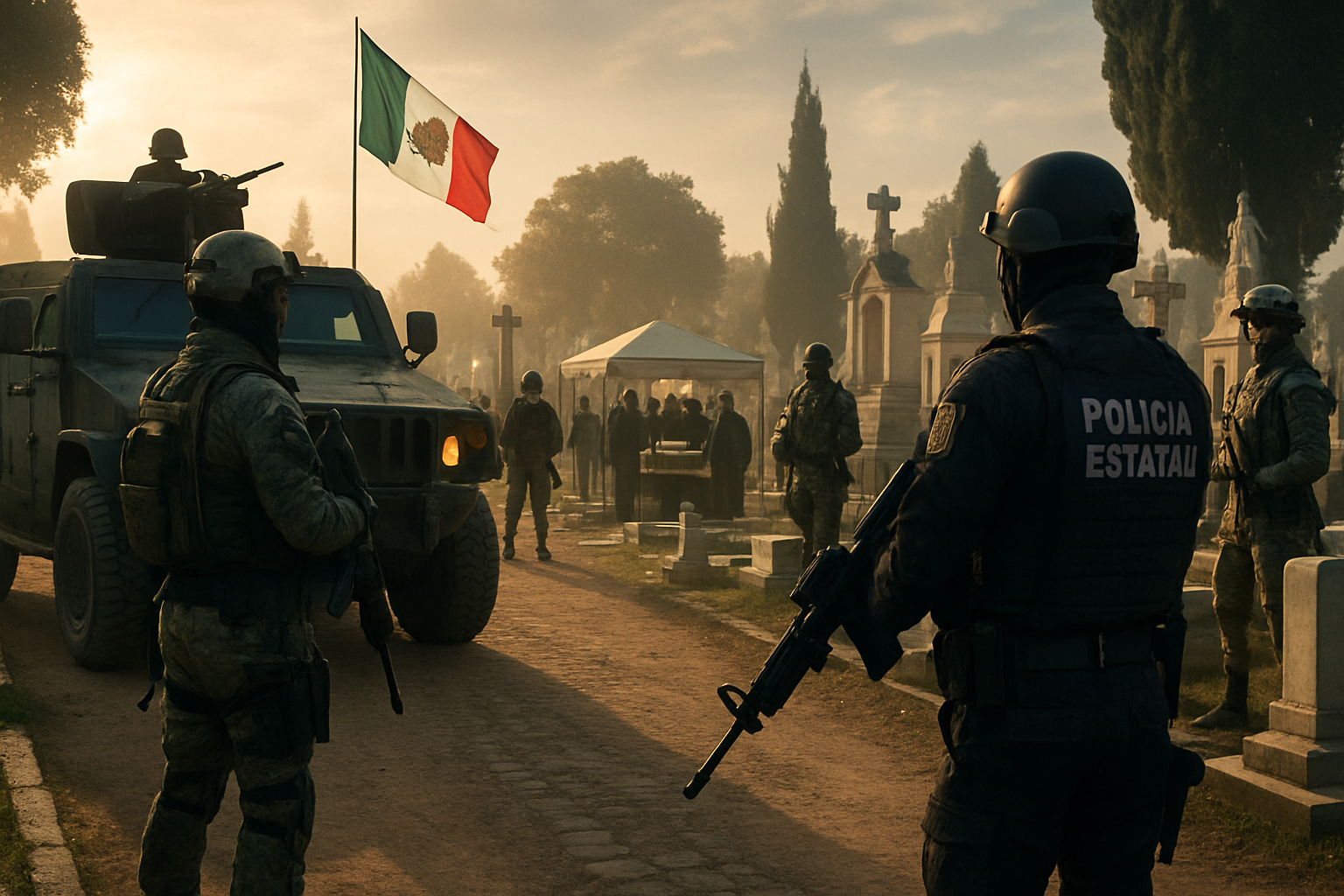
The funeral of Nemesio Oseguera Cervantes, alias "El Mencho," leader of the Jalisco New Generation Cartel (CJNG), was conducted Sunday under massive military security in Zapopan, marking the end of one of Mexico's most wanted criminals who was killed February 22 during a military operation in Tapalpa, Jalisco.
Heavy police and military presence surrounded the La Paz funeral home in the San Andrés neighborhood of eastern Guadalajara, as dozens of elaborate floral arrangements arrived without identification cards or condolence messages, signaling the clandestine nature of the proceedings.
Cartel Symbolism at Final Farewell
Despite the absence of signed condolence cards, several distinctive floral displays caught authorities' attention, including a rooster-shaped arrangement and multiple flower crowns bearing the initials "CJNG" - clear indicators of the cartel's presence at their fallen leader's funeral.
Mourners arrived with covered faces, reflecting both security concerns and the underground nature of Mexico's most powerful criminal organization paying its final respects. The funeral home's location in San Andrés became a focal point for what Mexican authorities described as an unprecedented security operation.
Following the wake, El Mencho's body was transported to the Recinto de la Paz cemetery in Zapopan for burial, where the same level of intensive security was maintained throughout the proceedings.
Aftermath of February Military Operation
El Mencho's death on February 22 marked the culmination of years of pursuit by Mexican and U.S. authorities. The 59-year-old cartel leader was eliminated during a coordinated operation at the Tapalpa Country Club, a luxury mountain hideout located through U.S.-Mexico intelligence cooperation tracking his romantic partner.
The military operation that ended El Mencho's reign revealed personal details about the cartel leader's final days, including a Catholic altar with Virgin Mary images, a handwritten Psalm 91 "soldier's prayer" card, fine chocolates, and kidney medications indicating ongoing health issues.
Hugo "El Tuli" Macías Ureña, the CJNG's main financial and logistical operator, was also killed alongside El Mencho. El Tuli had previously offered bounties of 20,000 pesos for the assassination of Mexican soldiers, demonstrating the organization's systematic targeting of security forces.
Security Response and Retaliation
Following El Mencho's death, the CJNG launched unprecedented retaliatory violence across 20 Mexican states, including systematic vehicle burning, highway blockades, and attacks on businesses and government infrastructure. The violence claimed the lives of 25 National Guard members, one police officer, and one judicial employee, while Mexican forces eliminated approximately 70 CJNG members during subsequent operations.
Mexico deployed 10,000 troops across western regions in what became the largest security operation in years. President Claudia Sheinbaum maintained real-time communication with the Security Cabinet during the crisis, while Jalisco Governor Pablo Lemus declared a "red code" emergency and suspended schools across eight states.
The violence particularly affected Guadalajara, a designated host city for the 2026 FIFA World Cup, raising international concerns about security just months before the tournament. Multiple countries issued travel advisories, with tourism industry facing its strongest threat since the pandemic.
International Implications
The successful operation represented a major victory for U.S.-Mexico intelligence cooperation, with American agencies providing crucial tracking support. U.S. President Trump praised the bilateral operation while emphasizing that Mexico must "increase efforts against cartels and drugs."
El Mencho's elimination represents the most significant cartel leadership takedown since El Chapo's capture in 2016. The CJNG under his leadership had become Mexico's most sophisticated criminal organization since 2011, notable for military-style tactics, advanced weaponry, and international networks spanning Latin America and Asia.
The cartel's evolution included the 2015 downing of a military helicopter with RPGs, control over fentanyl trafficking routes to the U.S., and demonstrated capabilities that required new security paradigms beyond traditional law enforcement scope.
Succession Battle and Future Implications
El Mencho's death creates a significant leadership vacuum within the world's most sophisticated criminal organization. His son, Rubén "El Menchito" Oseguera, remains imprisoned in U.S. custody, leaving regional commanders to compete for control of the vast criminal empire.
Security analysts warn that the territorial magnitude, financial resources, and lack of clear succession plan could create internal disputes and focused violence episodes as various factions vie for dominance. Historical patterns suggest that cartel leader eliminations typically cause organizational splintering rather than decreased violence.
The funeral's heavy security and symbolic CJNG presence indicate the organization remains unified in the immediate aftermath, but experts anticipate potential fragmentation as competing interests emerge within the cartel's hierarchy.
Broader Impact on Mexico's Security Landscape
The operation against El Mencho and the subsequent funeral proceedings demonstrate both the capabilities and limitations of Mexico's security apparatus. While the successful elimination of the $15 million DEA bounty target represents a tactical victory, the violent retaliation and continued cartel operations highlight the ongoing challenges facing Mexican authorities.
The timing proves particularly sensitive with the 2026 World Cup approaching, as Mexico must balance intensive security operations with preparations for hosting millions of international visitors. The crisis has already prompted FIFA to request detailed security reports from the Mexican government.
As Mexico grapples with the aftermath of El Mencho's death, the heavily secured funeral in Zapopan serves as a stark reminder of the continuing influence of organized crime and the complex security challenges facing the nation in its ongoing battle against sophisticated transnational criminal networks.