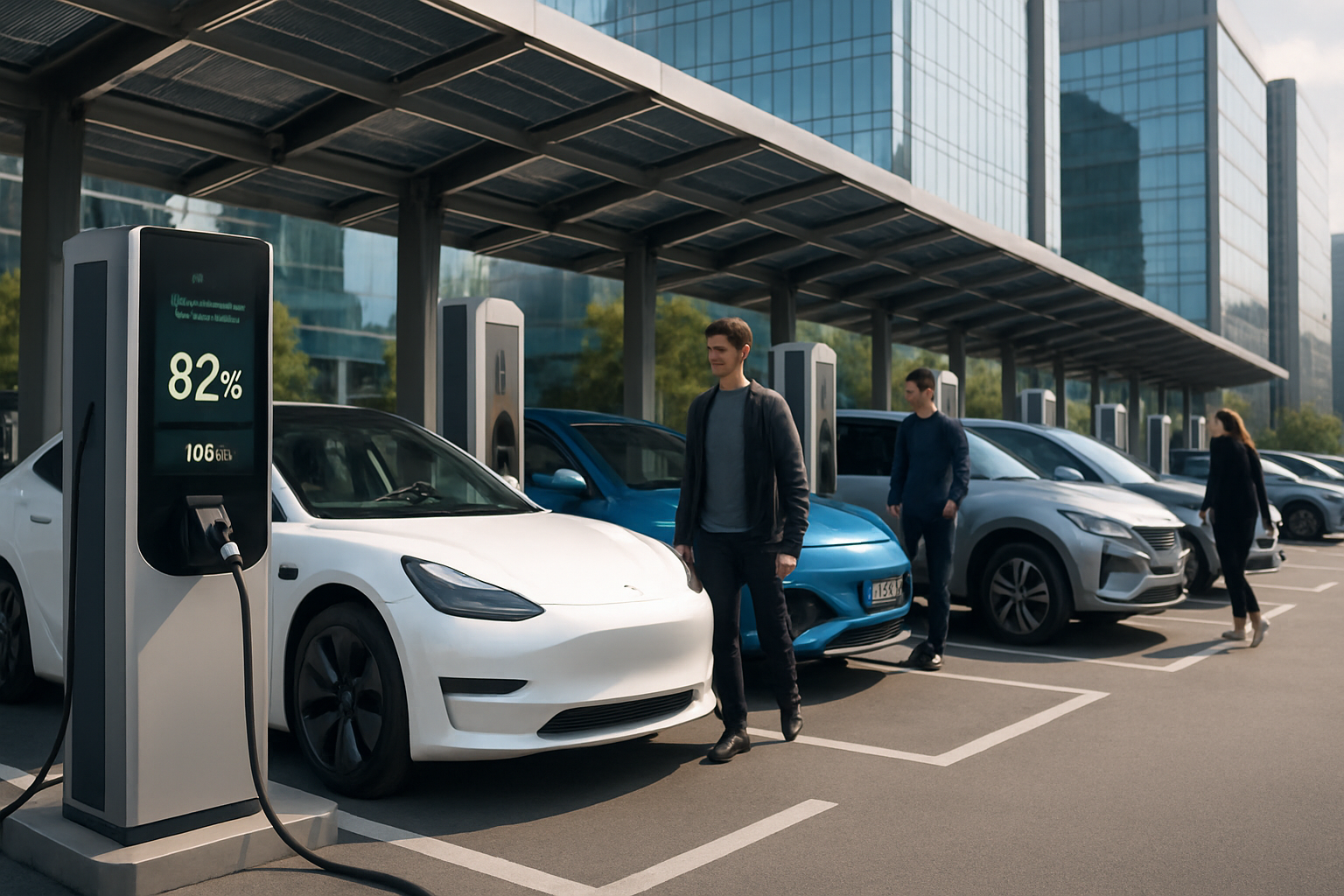
The global electric vehicle market is experiencing unprecedented acceleration as soaring oil prices and revolutionary technological breakthroughs converge to fundamentally reshape the automotive landscape, with manufacturers reporting record sales and infrastructure investments reaching historic levels.
Oil prices surging past $100 per barrel for the first time since 2022, with Brent crude peaking at $119.50 and WTI jumping a record 18.98% to $108.15, have created what energy analysts call a "game-changer" moment for electric vehicle adoption. The crisis, triggered by the closure of the Strait of Hormuz affecting 40% of global oil transit, has prompted consumers worldwide to reconsider their transportation choices as fuel costs approach $3 per liter in many markets.
Regional Success Stories Drive Global Momentum
Tesla's latest market entry in New Zealand demonstrates the growing appetite for electric vehicles, with the company's first 6-seater Model Y allocation selling out immediately despite premium pricing. The rapid sellout occurred amid boom conditions in EV interest across the Pacific region, reflecting broader consumer sentiment shifting toward electric mobility solutions.
China's dominance in the global EV supply chain continues to strengthen, with the country maintaining 60% of global critical materials production and 90% of refining capacity for lithium, cobalt, and rare earth elements. This strategic position has enabled Chinese manufacturers to achieve remarkable technological breakthroughs while scaling production to meet surging global demand.
Breakthrough Charging Technology Eliminates Key Barriers
BYD's revolutionary Megawatt Flash Charging system represents a quantum leap in EV technology, delivering 1,360 kW of power to enable vehicles to gain 400km of range in just 5 minutes. This breakthrough, combined with the company's Blade Battery 2.0 that functions effectively in temperatures down to -30°C, addresses two primary consumer concerns about electric vehicle adoption: charging time and cold weather performance.
"The closure of the Strait of Hormuz could be a game-changer for EVs," said David Brown, director of energy transition research at Wood Mackenzie. "The eye-watering 50 percent surge in global oil prices so far this month would further incentivise electric vehicle adoption."
— David Brown, Wood Mackenzie Energy Analyst
The technological advancement extends beyond charging speed to battery longevity, with comprehensive studies revealing that Tesla Model S vehicles from 2012-2014 with over 200,000 miles retain 85-92% of their original battery capacity. Similarly, Nissan Leaf vehicles from 2011-2013 demonstrate 75-85% capacity retention after a decade of operation, suggesting practical lifespans of 15-20 years that far exceed initial industry projections.
Infrastructure Investment Reaches Record Levels
Governments worldwide are responding to the EV revolution with unprecedented infrastructure commitments. Austria has doubled its EV charging capacity by adding 1,000 public charging stations, while Estonia maintains European leadership with 88% renewable electricity and the continent's largest battery storage system serving 90,000 households.
New Zealand announced a $50 million investment to double its public EV charging network through zero-interest loans to ChargeNet and Meridian Energy, deploying 2,574 new charging points in the most significant infrastructure expansion in the country's history. This coordinated approach demonstrates how governments are moving beyond incentives to create the foundational infrastructure necessary for mass EV adoption.
Supply Chain Challenges Create Strategic Dependencies
The rapid EV expansion occurs against a backdrop of significant supply chain challenges. Memory chip shortages continue to drive semiconductor prices up sixfold, affecting vehicle control systems across the industry until new fabrication facilities come online in 2027. These constraints highlight the complex technological ecosystem required for modern electric vehicles.
The US-EU-Japan Critical Minerals Partnership, now encompassing 55 countries and seven African suppliers, represents a coordinated effort to diversify supply chains away from Chinese dominance. However, experts acknowledge that this diversification will require massive investment and years of development time to meaningfully alter the current strategic dependencies.
Climate Urgency Drives Policy Acceleration
The transportation electrification momentum coincides with alarming climate data, as January 2026 marked the 18th consecutive month of global temperatures exceeding 1.5°C above pre-industrial levels. This unprecedented streak demonstrates human-induced climate change overriding natural climate variability, even during La Niña cooling periods.
Policy responses are accelerating accordingly. Canada returned EV consumer incentives under Prime Minister Mark Carney as part of a $9.7 billion national automotive strategy, while China implements comprehensive regulatory changes including a ban on hidden door handles effective January 2027, prioritizing functional safety over aesthetic design.
Commercial Vehicle Electrification Accelerates
Tesla's announcement of large-scale Semi truck production marks a significant milestone for commercial electric vehicle adoption after years of development since the 2017 unveiling. This breakthrough addresses the unique infrastructure demands of freight transportation, requiring high-capacity charging stations along major shipping corridors.
The convergence of passenger and commercial vehicle electrification creates opportunities for integrated transportation-energy ecosystems. Vehicle-to-grid (V2G) technology enables electric vehicles to function as distributed energy storage, charging during off-peak renewable generation periods and discharging during high demand, potentially stabilizing electrical grids while providing additional economic benefits to vehicle owners.
Urban-Rural Adoption Disparities Persist
Despite overall growth momentum, significant adoption disparities remain between urban and rural markets. Homeowners and rural residents maintain clear advantages through home charging access, while city apartment dwellers face infrastructure barriers despite higher interest levels in electric vehicles.
This challenge is driving innovation in workplace charging solutions and community-based charging networks. The success of programs in Estonia and Austria demonstrates that coordinated infrastructure investment can overcome geographical and housing-type barriers to create more equitable access to electric mobility.
Market Transformation Accelerates Amid Crisis
The current oil crisis represents what many analysts view as a watershed moment for global transportation electrification. Unlike previous energy price spikes, this crisis occurs when electric vehicle technology has matured to offer genuine alternatives to conventional vehicles in terms of performance, reliability, and increasingly, total cost of ownership.
Battery longevity improvements, ultra-fast charging capabilities, and expanding infrastructure networks have eliminated many early-adoption barriers. Combined with soaring fuel costs, these developments are pushing electric vehicles from environmental choice to economic necessity for many consumers.
The industry transformation requires unprecedented coordination across energy systems, infrastructure development, materials supply chains, and regulatory frameworks. Success depends on sustained international cooperation and financial commitments that recognize transportation electrification as essential infrastructure for planetary sustainability during the most environmentally challenging period in recorded human history.
As March 2026 demonstrates the convergence of crisis-driven demand and technological readiness, the electric vehicle market stands at an inflection point where adoption may accelerate beyond even the most optimistic projections. The window for effective climate action continues to narrow, but the technological innovation, economic incentives, and policy coordination evident in the current market surge offer genuine hope for maintaining planetary habitability through rapid transportation transformation.