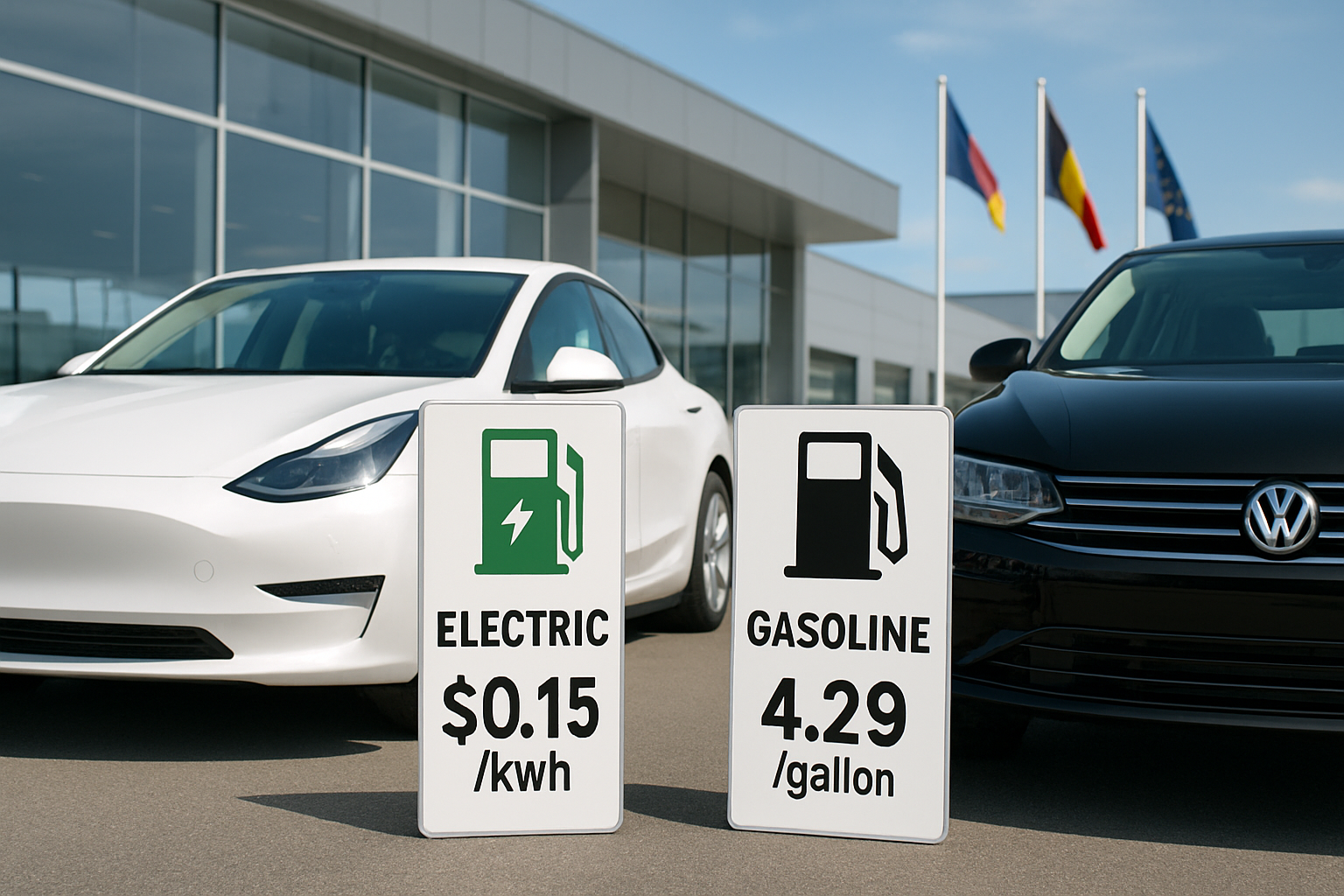
Electric vehicles have reached a historic economic tipping point, with used EVs now frequently cheaper than comparable gasoline and diesel vehicles across European markets, driven by skyrocketing fuel costs and rapidly maturing battery technology.
Swedish automotive data reveals that used electric vehicles are "often cheaper than gasoline and diesel cars," as reported by Svenska Dagbladet, representing a fundamental shift in transportation economics that experts say could accelerate the global transition away from fossil fuels.
The price reversal comes as European fuel costs have surged dramatically, with gasoline and diesel prices reaching levels that make electric vehicles the economically rational choice for many consumers. High fuel prices have increased interest in electric vehicles across the region, with growing numbers of drivers making the economic calculation in favor of electric mobility.
European Market Transformation
Slovakia's automotive sector demonstrates the broader European challenge facing traditional internal combustion engines. Chinese electric vehicle manufacturers are "flooding Europe" with competitively priced models, according to Slovak business publication Startitup, while domestic automakers struggle to respond to the rapid market transformation.
The crisis facing European manufacturers has reached unprecedented levels, with the continent now importing more vehicles from China than it exports. This represents a complete reversal of traditional automotive trade flows, as Chinese companies leverage their technological advantages in battery systems and manufacturing efficiency.
German automotive exports to China have declined significantly, reflecting the broader challenge facing traditional automakers as Chinese competitors gain market share through superior pricing and technological innovation in the electric vehicle segment.
Fuel Crisis Driving Adoption
The economic advantages of electric vehicles have been amplified by the ongoing global energy crisis. Oil prices breached $100 per barrel for the first time since 2022, with Brent crude reaching $119.50 and WTI hitting $108.15 following geopolitical disruptions in the Persian Gulf.
Iran's closure of the Strait of Hormuz, which handles 40% of global seaborne oil transit, has created supply shortages that pushed fuel prices to crisis levels across Europe. In response, multiple governments have implemented emergency measures including fuel rationing, price caps, and strategic petroleum reserve releases.
Bulgaria's automotive sector reflects the broader regional impact, with maintenance costs for internal combustion engine vehicles becoming increasingly burdensome as fuel prices remain elevated. The German automotive club ADAC's analysis of the 30 most cost-effective used vehicles highlights how operating expenses have fundamentally shifted the economic equation in favor of electric alternatives.
Battery Technology Breakthroughs
The electric vehicle market transformation has been accelerated by remarkable advances in battery technology. BYD's revolutionary Megawatt Flash Charging system delivers 1,360 kW of power, enabling vehicles to gain 400 kilometers of range in just five minutes - matching the convenience of traditional fuel stations.
The company's Blade Battery 2.0 operates effectively in temperatures as low as -30°C, addressing one of the primary concerns about electric vehicle performance in harsh climates. These technological leaps represent a quantum advancement in addressing the traditional barriers to EV adoption.
Long-term reliability studies have exceeded industry expectations. Tesla Model S vehicles from 2012-2014 with over 200,000 miles retain 85-92% of their battery capacity, while Nissan Leaf models from 2011-2013 maintain 75-85% capacity after a decade of operation. These findings suggest practical battery lifespans of 15-20 years, far exceeding initial manufacturer warranties and supporting robust used EV markets.
Infrastructure Investment Surge
European governments have accelerated infrastructure investment to support the electric transition. Austria doubled its EV charging capacity by adding 1,000 new stations, while Estonia maintains European leadership with 88% renewable electricity and continental Europe's largest battery storage network serving 90,000 households.
New Zealand announced a $50 million investment to double its public EV charging network through zero-interest loans to ChargeNet and Meridian Energy, deploying 2,574 new charging points nationwide. Canada returned EV incentives under Prime Minister Mark Carney as part of a $9.7 billion national automotive strategy.
Indonesia committed to installing 5,000 EV charging stations as part of its transportation electrification initiative, while multiple governments across Asia-Pacific and Europe coordinate infrastructure development to address urban-rural adoption disparities.
Supply Chain Challenges Persist
Despite the positive market trends, the industry faces significant supply chain constraints. China maintains control of 60% of global critical materials production and 90% of refining capacity for lithium, cobalt, and rare earth elements essential to battery manufacturing.
Memory chip shortages continue to drive semiconductor prices up sixfold, affecting vehicle control systems across the industry. These constraints are expected to persist until 2027 when new fabrication facilities come online.
The US-EU-Japan Critical Minerals Partnership, encompassing 55 countries and seven African suppliers, represents a coordinated effort to diversify supply chains. However, experts warn that reducing dependence on Chinese supply chains will require massive investment and years of development time.
Urban-Rural Adoption Patterns
Electric vehicle adoption shows distinct geographic patterns across Europe. Homeowners and rural residents maintain advantages through access to home charging infrastructure, while urban apartment dwellers face barriers despite higher environmental awareness in city centers.
Workplace charging programs are emerging as crucial solutions for urban adoption, while vehicle-to-grid technology enables EVs to function as mobile energy storage systems. This technology allows charging during off-peak renewable generation periods and discharging electricity during high-demand periods, providing additional economic benefits.
Regional governments are implementing targeted policies to address adoption disparities, including enhanced financial incentives for urban charging infrastructure and community-based charging networks serving apartment complexes and dense urban areas.
Climate Urgency Driving Policy
The transportation electrification trend occurs against a backdrop of climate urgency. January 2026 marked the 18th consecutive month of global temperatures exceeding 1.5°C above pre-industrial levels, demonstrating the persistence of human-induced climate change.
China's implementation of a hidden door handle ban effective January 2027, affecting Tesla, BYD, NIO, and XPeng, reflects evolving safety standards prioritizing functional access over aesthetic design. The regulation requires mechanical release systems independent of electrical power.
Commercial vehicle electrification is accelerating with Tesla's large-scale Semi truck production milestone and BMW's announcement of electric 3 Series production beginning August 2026 at its Munich facility, targeting mainstream market segments beyond premium offerings.
Economic Implications
The price parity achieved between electric and conventional vehicles represents a fundamental shift in automotive economics. Total cost of ownership calculations now favor EVs when considering extended battery life, lower maintenance requirements, and volatile fuel prices.
Insurance companies are adjusting policies based on improved EV reliability data, while government incentive programs are evolving from early-adopter support to mass-market acceleration policies. Used EV markets are strengthening as battery longevity data builds consumer confidence in second-hand electric vehicles.
Caribbean markets demonstrate the global applicability of EV economics, with electric vehicle owners saving $75 per $100 compared to gasoline costs despite electricity rate increases, according to regional automotive retailers.
Industry Transformation
The automotive industry is experiencing its most significant transformation in over a century. Traditional automakers face pressure from Chinese competitors who have achieved technological leadership through strategic industrial policy, supply chain control, and coordinated government support.
European automakers including Volkswagen and Stellantis are intensifying calls for Brussels to provide financial incentives supporting domestic EV manufacturing. The competitive pressure reflects fundamental changes in global automotive dynamics as Chinese manufacturers gain market share through pricing and innovation advantages.
Success in this transformation requires coordination across energy systems, infrastructure development, materials supply chains, and regulatory frameworks during what experts describe as the most significant industrial shift in modern history.
The convergence of economic necessity, technological readiness, and climate urgency has created what analysts describe as an inflection point for mass EV adoption. March 2026 represents a watershed moment where crisis-driven demand meets technological maturity, potentially accelerating the global transition to sustainable transportation beyond previous forecasts.