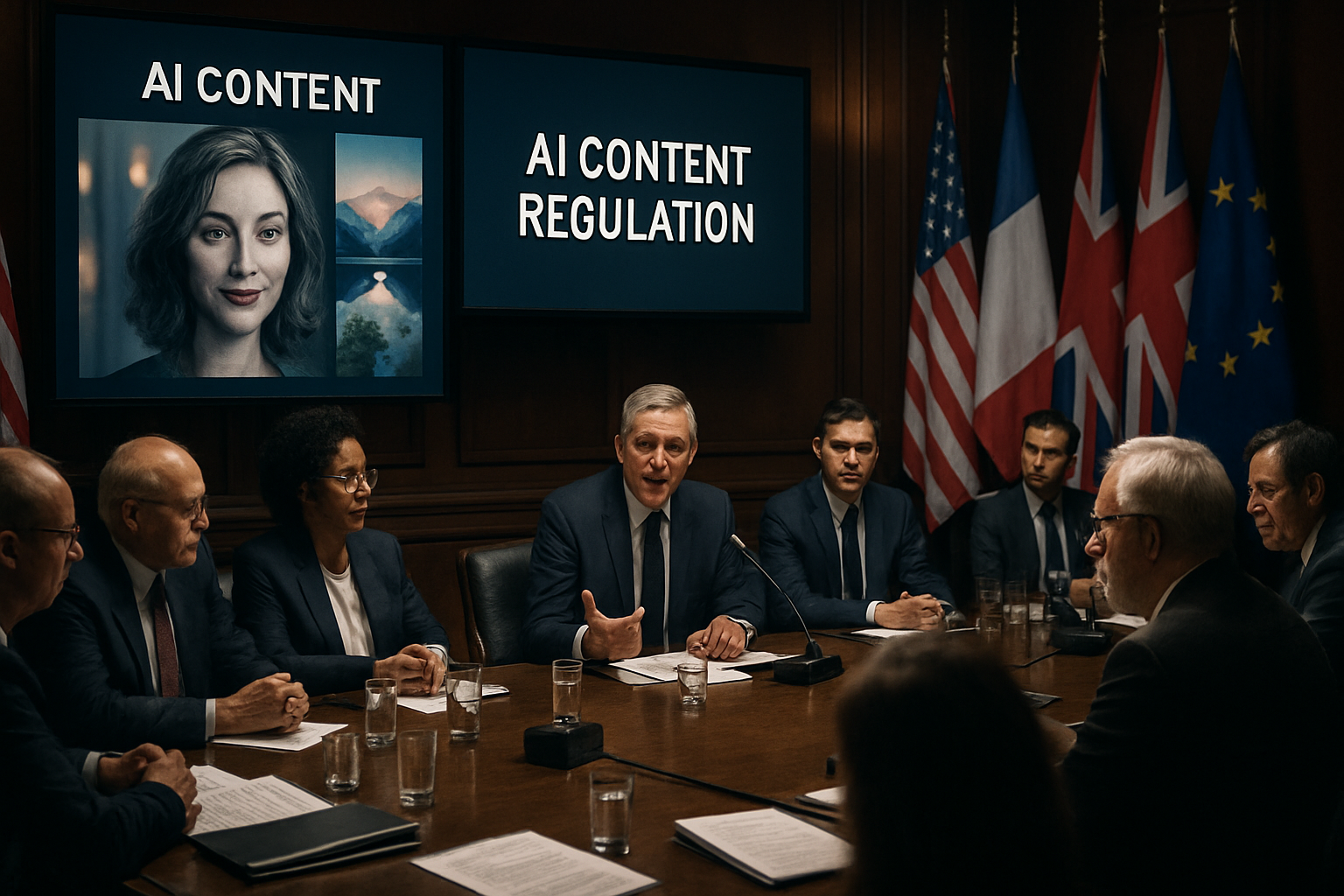
Countries across three continents are implementing unprecedented regulatory frameworks targeting AI-generated content, marking a pivotal moment in global efforts to address security threats and authenticity concerns posed by rapidly advancing artificial intelligence technologies.
The coordinated regulatory push spans from Austria's administrative AI oversight demands to Azerbaijan's criminal penalties for non-consensual intimate imagery, while Germany leads European Union initiatives to combat deepfake-enabled fraud through potential copyright law reforms.
Austria Demands Administrative AI Transparency
Austrian Green Party officials have escalated calls for comprehensive artificial intelligence regulation in government administration, warning of potential "AI chaos" without proper legal frameworks. Speaking through press releases, party representatives emphasized the urgent need for transparency measures that would prevent administrative systems from operating AI tools without adequate oversight mechanisms.
The Austrian initiative focuses specifically on government use of AI systems, demanding clear protocols for implementation, decision-making transparency, and public accountability measures. This represents a significant shift from purely private sector AI regulation toward comprehensive governmental AI governance frameworks.
Azerbaijan Criminalizes AI-Generated Sexual Content
Azerbaijan's Parliament has introduced groundbreaking legislation that would criminalize the creation of AI-generated sexually explicit content without consent, imposing penalties of up to seven years in prison for violations. The proposed law also mandates clear labeling requirements for all AI-generated content across photo, video, and audio formats.
"Such content must be clearly and conspicuously labeled to indicate that it was created using artificial intelligence."
— Parliamentary committee statement via APA news agency
The legislation establishes a two-tier enforcement system: criminal penalties for non-consensual intimate imagery creation, and administrative fines ranging from ₼80–₼150 ($50–$90) for failure to properly label AI-generated content before publication in media outlets.
Information Communication Technologies experts have praised the initiative as addressing critical gaps in existing legal frameworks that have struggled to keep pace with rapidly advancing AI content generation capabilities.
Germany Explores Copyright Solutions for Deepfake Fraud
German authorities are investigating potential applications of copyright law to combat the increasing use of deepfake technology in criminal enterprises. The approach represents a novel legal strategy that could leverage existing intellectual property protections to address AI-generated fraud schemes.
According to German media reports, deepfake-enabled fraud attempts have surged dramatically, with criminals using artificially generated images and videos of individuals for financial scams. The copyright approach would potentially allow victims to claim ownership over their digital likeness, providing legal recourse against unauthorized AI manipulation.
This development occurs within broader European Union initiatives to strengthen digital content governance, building on existing Digital Services Act frameworks that have already targeted major platforms for content moderation failures.
Global Regulatory Momentum Intensifies
The tri-national regulatory push reflects a broader global trend toward AI content governance that has gained unprecedented momentum throughout 2026. Historical context reveals this as part of the most significant technology regulation wave since the internet's commercialization.
Previous regulatory initiatives have included Spain's implementation of criminal executive liability for platform violations, France's cybercrime raids on AI companies over deepfake content, and the European Commission's investigation of TikTok for "addictive design" features that could face penalties reaching 6% of global revenue.
The United Nations has established an Independent Scientific Panel comprising 40 experts to provide the first comprehensive global assessment of AI impact, while multiple European nations coordinate age verification requirements for social media platforms to prevent jurisdictional arbitrage.
Technical Implementation Challenges
Despite regulatory enthusiasm, implementation faces significant technical hurdles. Industry experts note that effective AI content verification systems require substantial computational resources and sophisticated detection algorithms that can keep pace with rapidly improving generation technologies.
The global semiconductor shortage, which has driven memory chip prices up sixfold and is expected to constrain infrastructure until 2027, poses additional challenges for deploying comprehensive content verification systems. This "critical vulnerability window" may limit the immediate effectiveness of new regulatory frameworks.
Cross-border enforcement remains particularly complex, requiring unprecedented international cooperation mechanisms. The European approach of coordinated implementation aims to prevent regulatory arbitrage, but extends beyond traditional national jurisdictions into complex questions of digital sovereignty and platform accountability.
Industry Response and Resistance
Technology industry reactions have varied significantly across different regulatory approaches. While some companies have begun proactive compliance measures, others have characterized new requirements as overly restrictive or technically unfeasible.
The broader "SaaSpocalypse" – a term describing the elimination of hundreds of billions in traditional software market capitalization as AI systems demonstrate direct replacement capabilities – has created additional pressure on companies already facing substantial regulatory compliance costs.
Some platforms have begun reviewing design choices preemptively rather than waiting for formal enforcement, suggesting that regulatory momentum may influence industry practices even before final implementation.
Implications for Democratic Governance
The regulatory developments represent critical tests of democratic institutions' capacity to govern rapidly evolving digital technologies while preserving beneficial innovation and protecting fundamental rights.
Success in implementing effective AI content governance could establish precedents for global technology regulation, potentially triggering worldwide adoption of similar frameworks. Conversely, implementation failures might strengthen industry arguments against regulatory intervention and demonstrate the limitations of traditional governance mechanisms in addressing digital age challenges.
"When citizens cannot distinguish authentic from AI-generated content, the shared factual basis for democratic decision-making erodes."
— Political scientists' assessment of information authenticity challenges
The stakes extend beyond individual privacy protection to fundamental questions about democratic participation, information integrity, and institutional trust in an era where artificial intelligence can generate convincing but false content at unprecedented scale and speed.
Future Regulatory Trajectory
March 2026 appears to represent a critical inflection point in AI governance, with decisions made in coming months likely to determine regulatory frameworks for years to come. The success or failure of current initiatives will significantly influence whether AI development serves human flourishing or becomes a source of systemic social disruption.
International observers emphasize that effective AI governance requires unprecedented coordination between governments, technology companies, educational institutions, and civil society organizations. The challenge involves balancing innovation acceleration with safety governance, commercial interests with human welfare, and national competitiveness with international cooperation.
As Austria, Azerbaijan, and Germany lead this regulatory charge, their approaches may serve as templates for global AI content governance – determining whether democratic institutions can effectively regulate multinational technology platforms while preserving the benefits of digital connectivity and technological advancement.