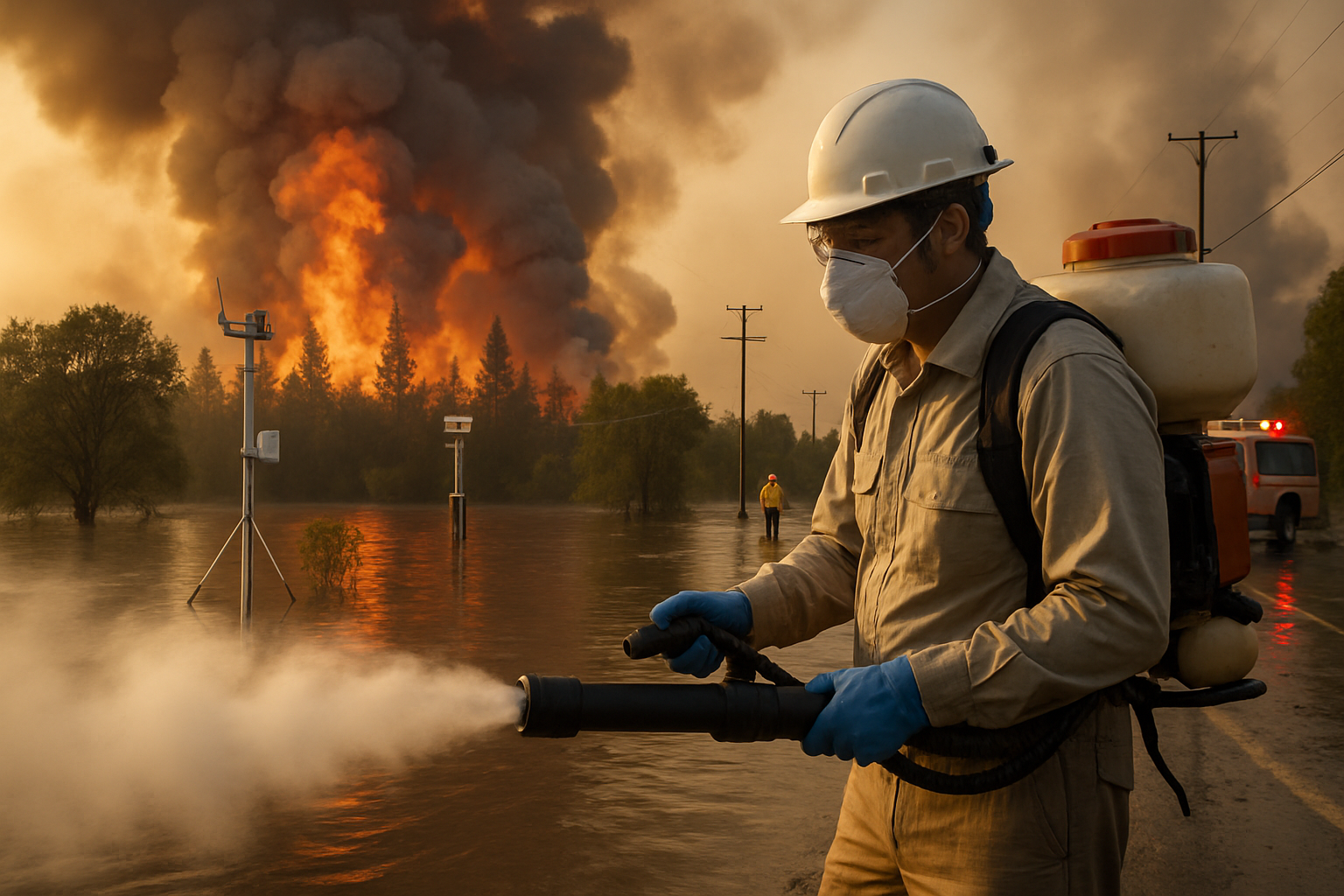
As Canada begins its official wildfire season amid lingering spring snow, communities across Alberta face mounting anxiety about which areas will next be touched by nature's increasingly volatile patterns, while Bolivia suspends anti-mosquito campaigns due to unexpected flooding, and global temperatures reach their 20th consecutive month above critical thresholds.
The convergence of these environmental challenges represents a fundamental shift from the sequential disasters that emergency systems were designed to handle to simultaneous, multi-continent crises that are overwhelming traditional response frameworks. According to historical climate data, January 2026 marked the hottest month ever recorded in human history, extending an unprecedented 20-month streak of temperatures exceeding 1.5°C above pre-industrial levels.
Alberta's Wildfire Anxiety Builds Despite Snow Cover
Despite spring snow still dusting parts of Alberta, the province has officially entered wildfire season, bringing with it what residents describe as a "gnawing worry" about which community will be next affected. The psychological toll of repeated extreme weather events is becoming as significant as the physical damage, with mental health services reporting increased demand for support related to climate anxiety.
In Canmore, residents are witnessing unprecedented wildfire mitigation efforts, including the creation of extensive fire breaks and burn piles from clear-cut operations. Local farmer Murray Orr, who has lived in the region for 70 years, recently stated he has "never seen rain like yesterday's deluge" while helping motorists navigate flooded roads, highlighting how traditional weather patterns are becoming increasingly unpredictable.

The situation in Alberta reflects a broader pattern of climate volatility where global warming enables both extreme heat events and regional cold snaps through disrupted atmospheric circulation patterns. Emergency management experts note that communities must now prepare for previously unimaginable scenarios where drought conditions and flooding risks exist simultaneously.
Bolivia's Disease Vector Campaign Disrupted by Climate
In Santa Cruz, Bolivia, intensive efforts to combat chikungunya, dengue, and Zika virus transmission faced an unexpected setback when heavy rainfall forced the suspension of community cleaning campaigns. The multi-day "minga" (community work effort) had been targeting mosquito breeding sites through systematic elimination of standing water and fumigation of potential habitats.
Local authorities explained that the suspension was necessary to ensure participant safety and maintain the effectiveness of vector control operations. The campaign, which began with door-to-door cleaning, disinfection, and fumigation efforts in parks, gardens, and residential areas, represents a critical public health initiative as these tropical diseases expand their geographic range due to rising global temperatures.
"The situation demonstrates how climate change amplifies existing vulnerabilities in fire-prone regions while creating new challenges for disease vector management."
— Dr. Maria Rodriguez, International Emergency Response Coordination Center
Health authorities have emphasized the importance of maintaining preventive actions in individual homes, particularly the elimination of standing water that provides breeding grounds for Aedes aegypti mosquitoes. The interruption of coordinated community efforts due to extreme weather illustrates how climate change creates cascading effects across multiple public health interventions.
Infrastructure Overwhelmed by Simultaneous Crises
The convergence of environmental challenges is exposing critical vulnerabilities in emergency response systems worldwide. Transportation networks, power grids, and communication systems designed for historical climate patterns are repeatedly operating beyond their operational parameters.
Traditional mutual aid mechanisms, which have historically allowed regions to assist each other during localized emergencies, are proving inadequate when multiple continents face simultaneous disasters. Emergency services globally report capacity limitations as they manage overlapping rather than sequential emergency responses.
Professor James Chen of the Global Climate Adaptation Institute warns of a critical juncture: "We're witnessing the breakdown of traditional emergency response frameworks. The scale and simultaneity of these events requires fundamental restructuring for what experts are calling a 'permanent climate volatility era.'"
Economic and Social Consequences Intensify
The economic implications of simultaneous environmental crises are proving more severe than traditional disaster models predicted. Agricultural sectors face mounting losses as extreme weather destroys crops and disrupts supply chains during critical growing seasons. Tourism industries are experiencing extended cancellations and infrastructure damage during what should be peak seasons.
Recovery timelines have shifted from weeks to months or even years, representing a fundamental change in disaster response and preparation strategies. The concept of "building back better" has evolved from an optional enhancement to an essential survival strategy for communities facing repeated extreme weather events.
Scientific Warnings Point to Routine 2030s Conditions
Climate scientists warn that current conditions provide a preview of what may become routine circumstances in the 2030s without significant climate action and adaptation investment. The "climate volatility paradox" enables both global heat records and regional extreme events through disrupted polar vortex patterns and altered Atlantic circulation.
The World Meteorological Organization reports a 50-60% probability of El Niño development between July and September 2026, which could potentially drive unprecedented global temperatures during an already unprecedented warming streak. This comes as La Niña cooling effects, which typically moderate global temperatures, are being overridden by human-induced climate change.
Traditional meteorological models based on historical patterns are becoming increasingly inadequate, requiring weather forecasting systems to be updated for a climate changing faster than the evolutionary adaptation capabilities of natural ecosystems and human infrastructure.
Coordinated Response Innovations Emerge
Despite the overwhelming challenges, communities are demonstrating remarkable innovation in their responses. Hybrid approaches that integrate traditional knowledge with modern technology are showing particular promise. In Estonia, agricultural wisdom is being combined with advanced climate monitoring, while Australia is integrating Indigenous fire management practices with sophisticated meteorological forecasting.
Advanced monitoring systems utilizing satellite imagery, environmental DNA sampling, and AI-powered analysis are enhancing conservation and disaster preparedness capabilities. However, these technological solutions require sophisticated integration with traditional ecological knowledge and community-based management to be truly effective.
International Cooperation Under Strain
Environmental systems crossing political boundaries are requiring unprecedented international coordination. Ocean currents carry pollution across continents, atmospheric systems transport environmental effects globally, and climate change affects weather patterns regardless of national borders.
Traditional aid frameworks designed for sequential disasters are proving inadequate for multiple continents facing simultaneous emergencies. Cooperation mechanisms require fundamental restructuring to address the new reality of parallel rather than sequential global crises.
Success requires coordinated policy frameworks, shared monitoring systems, collaborative enforcement, and innovative financing that recognizes ecosystem services as essential to economic stability and human prosperity.
The Path Forward: Transformation or Crisis
March 2026 represents a critical watershed moment for global climate response. The choice between reactive crisis management and proactive climate resilience building is becoming increasingly urgent as additional weather systems develop across the Atlantic and Pacific regions.
Authorities worldwide remain on high alert, understanding that current crisis conditions may persist for weeks, potentially establishing a "new normal" characterized by extreme weather frequency and intensity that challenges traditional emergency response frameworks on a permanent basis.
Implementation challenges include funding sustainability for developing nations, technical capacity building, and climate disruption of project timelines requiring adaptive management. However, opportunities exist through international partnerships, technology transfer, and South-South cooperation that maintains local autonomy while building global resilience.
The tools, knowledge, and cooperation frameworks exist for comprehensive environmental protection, but success depends on unprecedented speed and coordination through sustained international cooperation, enhanced political commitment, and recognition that environmental protection represents essential infrastructure for human prosperity and planetary sustainability.
As communities worldwide face these converging environmental challenges, the choices made in the coming weeks and months may prove decisive for climate resilience strategies that will shape responses for decades ahead. The convergence of wildfires, disease vectors, flooding, and extreme weather represents not just a series of isolated crises, but a fundamental test of humanity's capacity to adapt to an era of permanent climate volatility.