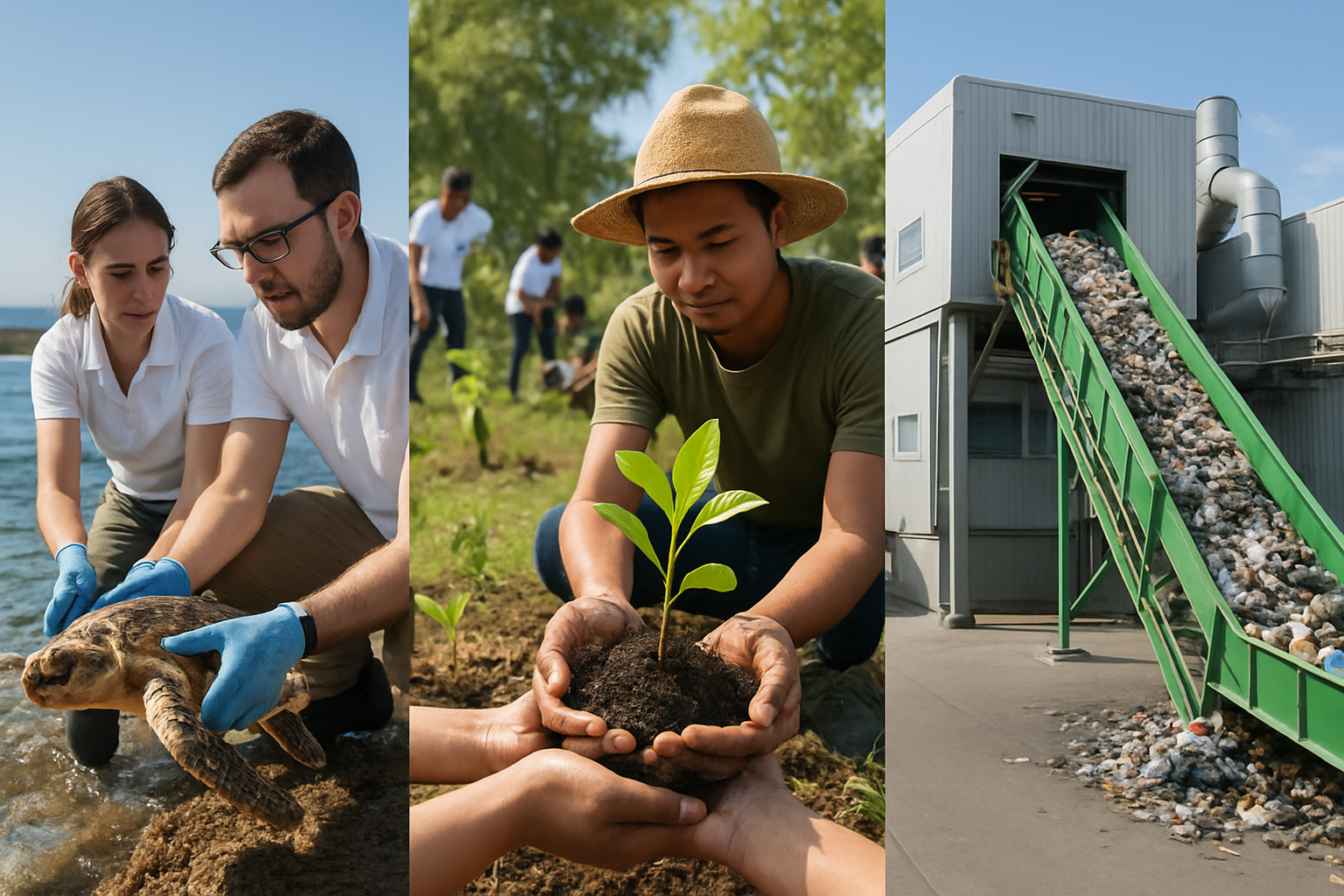
Three nations across Europe are implementing groundbreaking environmental conservation measures, from marine species protection with severe financial penalties to innovative community-based sustainable development programs, representing a coordinated response to accelerating environmental challenges.
Cyprus Strengthens Marine Conservation with Historic Penalties
New regulations imposing fines of up to €20,000 and possible imprisonment of up to one year for offenses involving protected marine species came into force on Tuesday, as authorities move to strengthen environmental protections. The measures, introduced under the fisheries amendment regulations of 2026, were approved by parliament and published in the official gazette on March 20.
According to the fisheries department, violations of the regulations constitute a criminal offense, with penalties including financial sanctions and custodial sentences. The framework aims to reinforce the protection of marine biodiversity by introducing clear restrictions on human activity affecting wildlife and sensitive coastal areas.
Central to the regulations is a prohibition on harassing or feeding protected species, as well as any action that disrupts their natural behavior. Particular emphasis is placed on dolphins, recognizing their critical role in Mediterranean marine ecosystems and their vulnerability to human interference.
"These regulations represent a fundamental shift in how we approach marine conservation, moving from reactive measures to proactive ecosystem protection."
— Cyprus Fisheries Department Official
Portugal Confronts Wildfire Crisis in Protected Areas
In Portugal, environmental authorities are grappling with significant wildfire damage to protected areas. During a period marked by extreme heat waves and megafires on the Iberian Peninsula, 51,323 hectares of the Natura 2000 network burned in Portugal, corresponding to 2.15% of protected zones in the country.
The Natura 2000 network represents Europe's largest coordinated network of protected areas, spanning across all EU member states and designed to ensure the long-term survival of Europe's most valuable and threatened species and habitats. The fact that over 51,000 hectares of these carefully preserved areas fell victim to fires underscores the mounting pressure climate change places on conservation efforts.
This crisis extends beyond Portugal's borders, with approximately one-third of all fires in 2025 across Europe occurring within Natura 2000 sites. The pattern reveals how climate-driven extreme weather events are increasingly targeting the very areas designated for biodiversity protection.
Slovenia Pioneers Community-Based Sustainable Development
Meanwhile, Slovenia is showcasing innovation through the Sustainable Living Village (SLV) program, a collaboration between Apical and the Earthworm Foundation, which has entered its second year of implementation in East Kutai Regency, East Kalimantan. From February 8 to 12, 2026, the program resumed activities across Tepian Makmur, Tepian Indah, Tepian Langsat, and Tepian Raya villages.
The SLV program promotes a model for sustainable rural development that balances socioeconomic benefits with environmental protection. Through the program, smallholders receive guidance on adopting sustainable palm oil practices while also being encouraged to diversify their livelihoods. One such initiative is cacao cultivation, which offers an additional income source while helping to promote more sustainable land use.
The program targets planting 30,000 trees during its second year, focusing on strengthening community resilience through environmental restoration and capacity-building initiatives. This approach represents a crucial evolution from traditional top-down conservation to community-driven environmental stewardship.
Technology Meets Traditional Ecological Knowledge
A common thread linking these three initiatives is the sophisticated integration of cutting-edge technology with traditional ecological knowledge and community-based management. Cyprus's marine protection utilizes advanced monitoring systems while respecting historical fishing practices. Portugal's fire management combines modern meteorological forecasting with traditional land stewardship. Slovenia's program employs satellite monitoring while supporting indigenous conservation expertise.
This synthesis represents a fundamental evolution in conservation methodology, moving beyond purely technological or traditional approaches toward comprehensive frameworks that combine scientific rigor with cultural sensitivity and community ownership.
Economic Benefits of Environmental Protection
These conservation initiatives demonstrate that environmental protection increasingly functions as an economic development strategy rather than a regulatory burden. Cyprus's marine protection enhances its appeal as an eco-tourism destination while positioning the country as a regional environmental leader. Portugal's protected areas generate substantial revenue through sustainable tourism while preserving cultural heritage. Slovenia's community programs create international climate finance opportunities and research partnerships.
Economic analyses consistently show that ecosystem services provided by intact natural systems often deliver greater economic benefits than resource extraction activities. Wetlands prevent billions in flood damage, forests regulate water and climate patterns, and biodiversity hotspots support pharmaceutical research and eco-tourism worth hundreds of billions annually.
Climate Crisis Context
These environmental initiatives emerge during an unprecedented period in Earth's climate history. Recent months have seen sustained warming that overrides natural climate variability, including La Niña cooling effects, demonstrating that human-induced climate change has fundamentally altered atmospheric systems beyond natural recovery mechanisms.
The climate crisis creates compound environmental effects that traditional conservation approaches struggle to address: rising sea levels threaten coastal ecosystems, changing precipitation patterns affect forest regeneration, and increased extreme weather frequency disrupts both marine food chains and terrestrial habitats. This interconnected web of challenges requires the kind of adaptive management strategies now being implemented across these three nations.
International Cooperation Framework
The success of these initiatives highlights the critical importance of international cooperation in addressing transnational environmental challenges. Environmental systems transcend political boundaries through ocean currents, atmospheric systems, and species migrations, making unilateral conservation efforts insufficient.
Knowledge sharing between these diverse approaches—Cyprus's marine enforcement, Portugal's fire management, and Slovenia's community development—creates global networks that strengthen local capacity while contributing to planetary sustainability. This evolution from traditional North-South aid relationships toward peer-to-peer cooperation recognizes that developing nations are increasingly becoming environmental solution providers.
Implementation Challenges and Solutions
Despite their success, these programs face significant implementation challenges. Funding sustainability remains difficult for developing nations where immediate economic pressures often override long-term environmental considerations. Technical capacity building requires sustained investment in education, training, and institutional development. Climate change continues to disrupt project timelines, requiring adaptive management approaches that can respond to rapidly changing conditions.
However, the diversity of approaches provides resilience against single-solution dependencies, offering multiple adaptation pathways for addressing complex environmental challenges. Success factors consistently include community ownership and engagement, transparent governance frameworks, economic incentives that make protection financially viable, and the integration of traditional ecological knowledge with modern conservation science.
Strategic Significance for Global Conservation
These March 2026 environmental initiatives represent a critical juncture in global environmental protection—a choice between reactive crisis management and proactive ecosystem service management. The environmental action window is rapidly narrowing as ecological systems approach critical thresholds that could trigger potentially irreversible changes affecting global food security, climate stability, and human settlements.
The tools, knowledge, and cooperation frameworks demonstrated by Cyprus, Portugal, and Slovenia show that comprehensive environmental protection is achievable. However, success depends on sustained international cooperation, enhanced multi-sector coordination, and increased financial commitments that recognize environmental protection as essential infrastructure for human prosperity and planetary sustainability.
"The convergence of marine protection, forest conservation, and community-based sustainability programs demonstrates that coordinated environmental action can achieve remarkable results even during our planet's most challenging environmental period."
— International Environmental Policy Expert
Future Implications
These conservation initiatives may prove decisive for environmental protection approaches in the decades ahead, potentially influencing global biodiversity protection, climate adaptation, and sustainable development strategies for generations. They provide practical templates for scaling environmental protection globally through coordinated approaches that address multiple challenges while building local capacity and fostering international cooperation.
The integration of cutting-edge technology with traditional ecological wisdom creates adaptable frameworks that respect cultural diversity while leveraging global technological capabilities. As the window for effective environmental action continues to narrow, the convergence of innovation, cooperation, and political commitment demonstrated by these three nations offers hope for maintaining planetary habitability during Earth's most environmentally challenging period.
Success will ultimately depend on whether humanity can organize and implement solutions rapidly enough to match the pace of environmental change while protecting the natural systems upon which human prosperity depends. The coordinated response emerging in March 2026 may represent the beginning of the decisive climate action decade that will determine our planet's future.