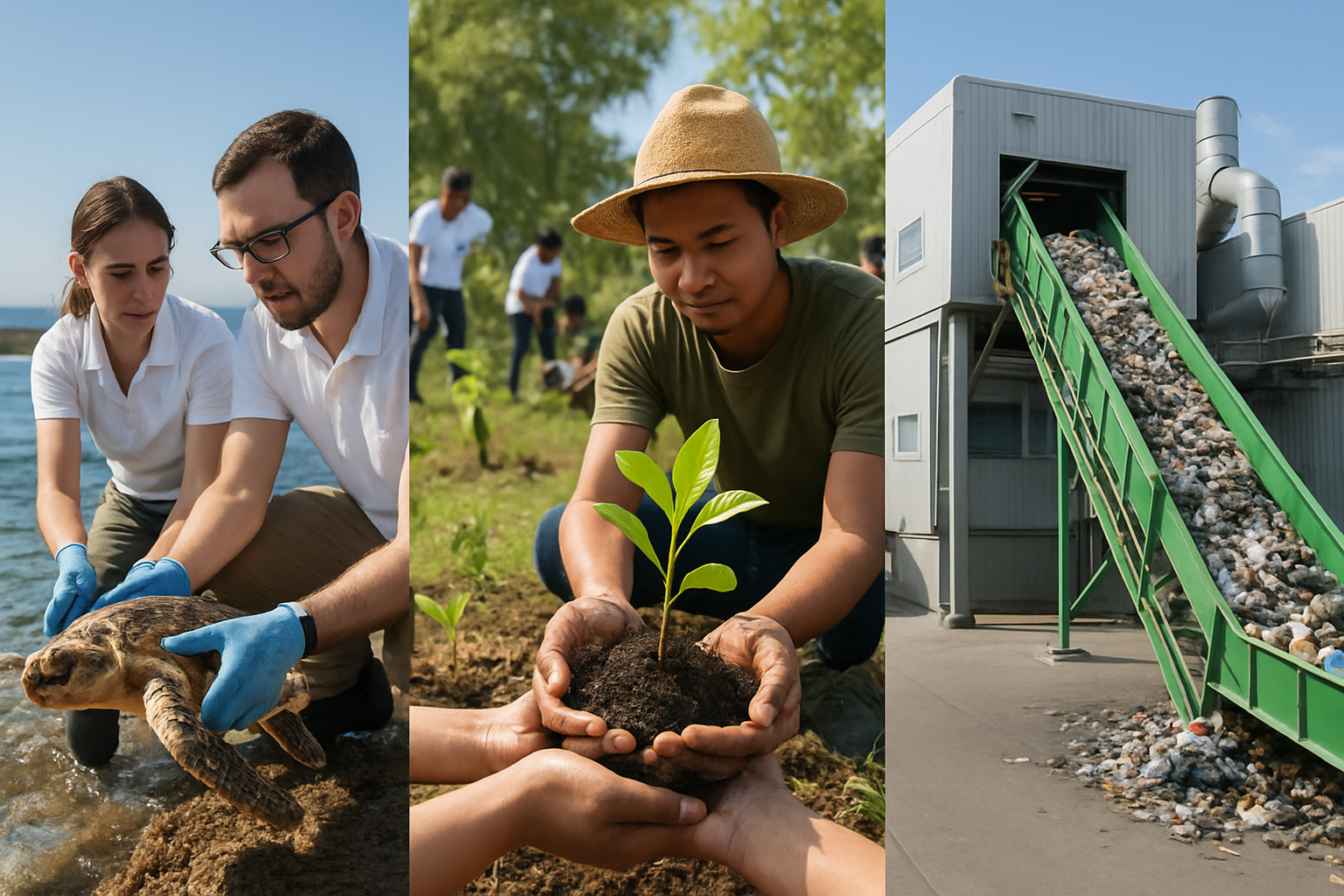
Environmental conservation initiatives are experiencing unprecedented global momentum as nations across four continents coordinate breakthrough programs spanning wildlife protection, renewable energy development, and community-led conservation frameworks during the 20th consecutive month of temperatures exceeding 1.5°C above pre-industrial levels.
From Austria's examination of traditional bird catching practices to Monaco's ambitious forest conservation partnerships, the international community is demonstrating remarkable coordination in addressing accelerating environmental challenges through innovative approaches that blend cutting-edge technology with traditional ecological knowledge.
Austria Confronts Cultural Conservation Challenges
Austria's environmental landscape faces complex decisions as the Austrian UNESCO Commission reviews whether songbird catching in Upper Austria's Salzkammergut region should retain its cultural heritage status. The Verein gegen Tierfabriken (VGT) has presented compelling documentary evidence questioning this practice amid growing international scrutiny of traditional activities that may conflict with modern conservation priorities.
This examination reflects broader European debates about balancing cultural traditions with environmental protection during a period when climate change has fundamentally altered atmospheric systems beyond natural recovery mechanisms. The Austrian case highlights the evolution from reactive crisis management to proactive ecosystem service management that characterizes contemporary environmental policy across Europe.
Greece Powers Renewable Energy Leadership
Greece continues establishing itself as a Mediterranean renewable energy leader through systematic expansion of clean energy infrastructure. The Independent Power Transmission Operator (ADMIE) reports that renewable energy sources connected to the electrical grid are effectively reducing wholesale electricity costs, creating an economic buffer against price increases that benefit both consumers and businesses.
This high integration rate of new clean energy units demonstrates Greece's commitment to accelerated decarbonization essential for meeting climate targets. The success positions Greece as a regional leader in sustainable energy transition, attracting international investment while reducing dependence on volatile fossil fuel markets during a period when European energy security remains paramount.
"The systematic connection of renewable energy sources is creating measurable economic benefits while advancing our climate commitments during a critical period for global environmental action."
— ADMIE Environmental Assessment
Liberia Pioneers Community-Led Conservation Revolution
Liberia's Forestry Development Authority has unveiled a revolutionary Community Conservation Area (CCA) guide that transforms local communities from passive conservation recipients into active environmental stewards. This groundbreaking initiative represents a fundamental shift from top-down conservation approaches to community-driven protection that empowers local populations in sustainable natural resource management.
Early implementation results demonstrate increased forest coverage alongside improved community incomes through eco-tourism and sustainable forestry practices. The model is being studied across West Africa as a continental template for scaling community-based conservation, reflecting the broader evolution toward recognizing indigenous and local communities as frontline guardians of forest ecosystems.
The CCA guide employs sophisticated integration of GPS tracking and satellite monitoring with centuries of traditional forest stewardship knowledge, creating a comprehensive framework that respects cultural autonomy while leveraging global technological capabilities. This approach has attracted significant climate finance and research partnerships, positioning Liberia as an environmental solution provider rather than merely an aid recipient.
Monaco Advances Global Forest Conservation Partnerships
The Prince Albert II of Monaco Foundation has announced three ambitious partnerships supporting forest conservation and Indigenous communities across the Amazon, Southeast Asia, and Congo Basin, strategically timed ahead of the United Nations' International Day of Forests. These collaborations exemplify the Foundation's Forests and Communities Initiative (FCI), which directs support to Indigenous Peoples and Local Communities as frontline guardians of forest ecosystems.
The centerpiece Amazon partnership with Brazil's Associação Floresta Protegida supports the Kayapo Project, safeguarding 9.4 million hectares of tropical forest across six Indigenous Territories in south-central Pará and northern Mato Grosso. Running from 2026 to 2028, this partnership will strengthen the Kayapo Forest School, training the next generation of Indigenous forest guardians through programs that combine traditional ecological knowledge with modern conservation science.
In Southeast Asia, the Foundation is supporting forest conservation initiatives that address the complex intersection of biodiversity protection and sustainable development. The Congo Basin partnership focuses on strengthening community-based forest management systems that have proven effective in maintaining both ecosystem integrity and local livelihoods.
Technology-Tradition Integration: The New Conservation Paradigm
The most successful environmental programs consistently demonstrate sophisticated integration of cutting-edge technology with traditional ecological knowledge and community-based management. Austria employs advanced monitoring systems while respecting historical cultural practices, Greece combines modern renewable energy infrastructure with Mediterranean sustainability traditions, Liberia leverages satellite monitoring enhanced by generations of forest stewardship wisdom, and Monaco utilizes digital tracking systems supported by indigenous conservation expertise.
This represents a fundamental evolution in environmental protection methodology, moving beyond either purely technological or traditional approaches toward comprehensive frameworks that combine scientific rigor with cultural sensitivity and community ownership. Environmental DNA sampling, satellite monitoring, and AI-powered analysis now work alongside traditional tracking techniques and indigenous resource management systems.
Economic Development Through Environmental Protection
Environmental protection increasingly functions as an economic development strategy rather than a regulatory burden. Countries implementing comprehensive protection demonstrate greater economic resilience and attract sustainable investment across multiple sectors including eco-tourism, green technology manufacturing, and environmental services.
Greece's renewable energy leadership attracts billions in sustainable investment while positioning the nation as a clean technology export hub. Liberia's community conservation programs generate international climate finance and research partnerships while supporting local economic development. Monaco's forest partnerships enhance the principality's environmental leadership reputation while contributing to global biodiversity protection.
Economic multiplier effects extend far beyond direct environmental sectors, encompassing improved public health, enhanced agricultural productivity through ecosystem services, and reduced infrastructure costs through natural disaster prevention. Ecosystem service valuation reveals that intact natural systems often provide economic benefits exceeding short-term resource extraction profits.
International Cooperation in the Climate Crisis Era
The coordinated environmental initiatives across Austria, Greece, Liberia, and Monaco reflect an evolution in international environmental cooperation during Earth's most challenging period in recorded history. Success requires unprecedented cooperation as atmospheric systems, ocean currents, and species migrations cross political boundaries, making unilateral efforts insufficient.
Knowledge sharing creates global networks that strengthen local capacity while contributing to planetary sustainability. Austrian cultural assessment methodologies inform worldwide heritage evaluation, Greek renewable energy innovations advance clean technology internationally, Liberian community models influence tropical forest protection globally, and Monaco's partnership frameworks provide templates for international conservation finance.
This represents a shift from traditional North-South aid relationships toward peer-to-peer cooperation where developing nations emerge as environmental solution providers, leveraging local innovation and indigenous knowledge systems to address global challenges.
Climate Context: The Urgency of Coordinated Action
These environmental initiatives emerge during an unprecedented period in Earth's climate history. January 2026 marked the hottest recorded month, extending to 20 consecutive months of temperatures exceeding the critical 1.5°C pre-industrial threshold. This sustained warming overrides natural climate variability, including La Niña cooling effects, demonstrating that human-induced climate change has fundamentally altered atmospheric systems beyond natural recovery mechanisms.
The climate crisis creates compound environmental effects that traditional conservation approaches struggle to address. Rising sea levels threaten coastal ecosystems, changing precipitation patterns affect forest regeneration, and increased extreme weather frequency disrupts marine food chains and terrestrial habitats. These interconnected challenges require adaptive management that can respond to rapidly changing baseline conditions while maintaining long-term sustainability goals.
Implementation Challenges and Success Factors
Despite remarkable progress, significant implementation challenges persist across all environmental initiatives. Funding sustainability remains critical for developing nations where immediate economic pressures often override long-term environmental considerations. Technical capacity building requires sustained investment in education, training, and institutional development. Climate change continues to disrupt project timelines, requiring adaptive management capabilities that can respond to rapidly changing conditions.
Success factors consistently include community ownership and engagement, transparent governance frameworks, economic incentives that make protection financially viable, and integration of traditional ecological knowledge with modern conservation science. International cooperation, innovative financing mechanisms, and recognition of ecosystem services' economic value are also essential components.
The diversity of approaches provides resilience against single-solution dependencies, offering multiple adaptation pathways for addressing complex environmental challenges that span biological, physical, and human systems.
Strategic Significance: A Critical Juncture
March 2026 represents a critical juncture for global environmental protection, presenting a choice between reactive crisis management and proactive ecosystem service management. This decision may determine whether conservation efforts can keep pace with accelerating environmental change during what scientists consider a decisive climate action decade.
The environmental action window is narrowing rapidly as ecological systems approach critical thresholds that could trigger potentially irreversible changes affecting global food security, climate stability, and human settlements. However, the tools, knowledge, and cooperation frameworks exist for comprehensive environmental protection, as demonstrated by the diverse international initiatives across Austria, Greece, Liberia, and Monaco.
Success depends on sustained international cooperation, enhanced multi-sector coordination, and increased financial commitments that recognize environmental protection as essential infrastructure for human prosperity and planetary sustainability.
Future Trajectory: Templates for Global Scaling
The conservation initiatives spanning four nations provide practical templates for scaling environmental protection globally through coordinated approaches that address multiple challenges while building local capacity and fostering international cooperation. Effective conservation requires sophisticated synthesis of scientific knowledge, community engagement, technological innovation, and international cooperation through locally-appropriate combinations rather than isolated approaches.
Austria's cultural-environmental balance, Greece's renewable energy leadership, Liberia's community-driven conservation, and Monaco's international partnership model offer complementary strategies that can be adapted to diverse geographic, cultural, and economic contexts while maintaining respect for local autonomy and cultural sensitivity.
The window for effective environmental action continues to narrow, but the convergence of innovation, cooperation, and political commitment demonstrated in these initiatives offers hope for maintaining planetary habitability during Earth's most environmentally challenging period in recorded history. The success or failure of current environmental initiatives may prove decisive for conservation approaches in the decades ahead, influencing global biodiversity protection, climate adaptation, and sustainable development strategies for generations to come.