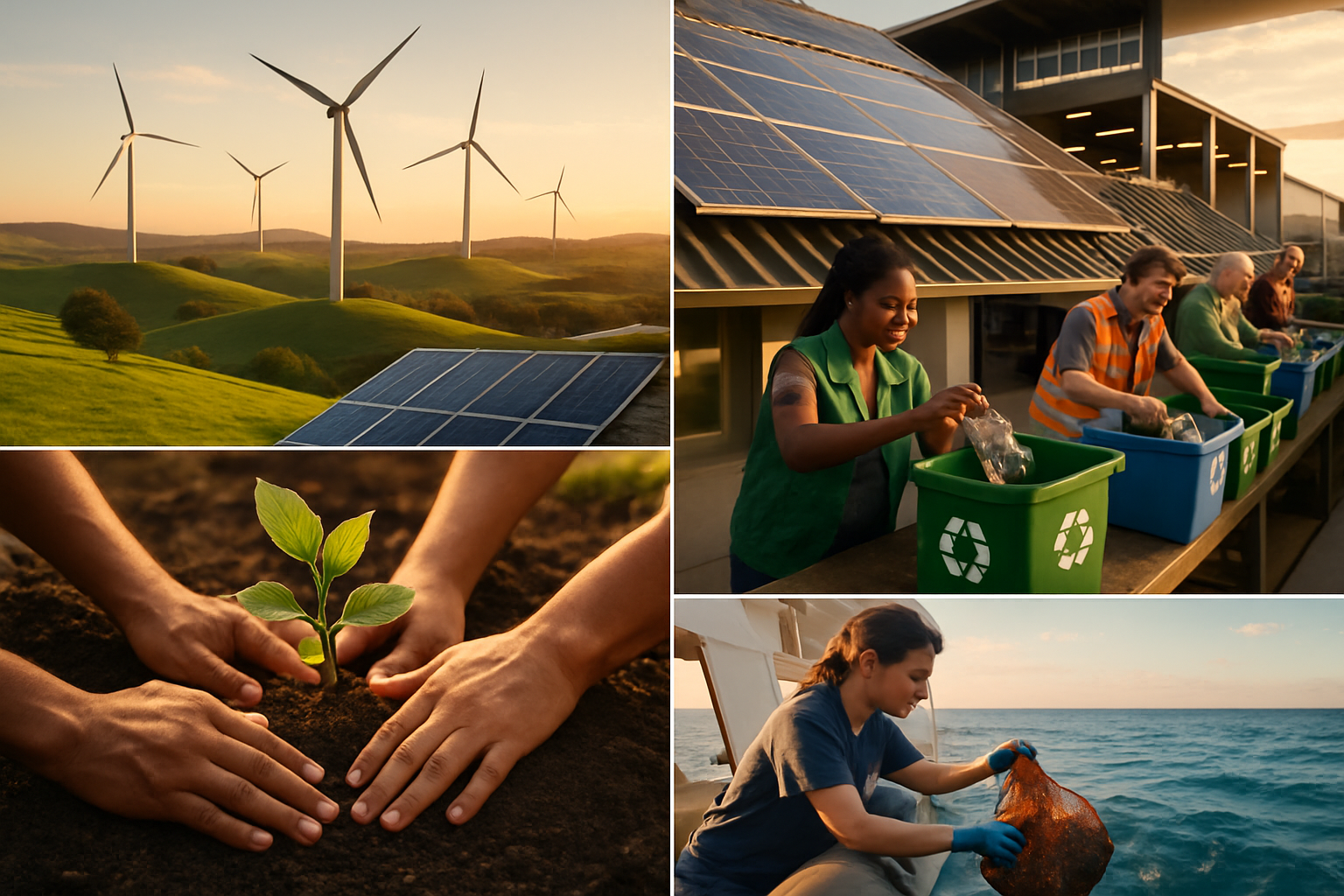
A coordinated surge of environmental and conservation initiatives across Indonesia, Saint Vincent and the Grenadines, and France signals a sophisticated global response to mounting climate pressures, with innovative waste management programs and marine conservation breakthroughs demonstrating how nations are adapting to the 18th consecutive month of temperatures exceeding 1.5°C above pre-industrial levels.
Indonesia Pioneers Comprehensive Waste Management Revolution
Indonesia has emerged as a leader in environmental innovation through two groundbreaking initiatives that address the critical intersection of waste management and sustainable development. In Gorontalo, Governor Gusnar Ismail launched the ambitious "Gerakan Indonesia ASRI" (Safe, Healthy, Clean, and Beautiful Indonesia Movement), targeting comprehensive waste management transformation across the province.
This initiative represents a fundamental shift from traditional waste disposal methods to systematic circular economy approaches that treat waste as a valuable resource. The program emphasizes community participation, technological integration, and environmental education as core components of sustainable development.
Simultaneously, Madiun City in East Java is pioneering perhaps the most innovative biological waste processing approach globally through large-scale maggot cultivation. The city government is developing maggot farming operations specifically designed to process organic waste from the Pasar Besar Madiun, transforming what was previously considered municipal waste into valuable protein sources and fertilizer.
"This represents a complete paradigm shift in how we view organic waste - from burden to opportunity"
— Municipal Official, Madiun City Government
The maggot cultivation program operates through collaborative community engagement, where market operators and municipal officials work together to establish sustainable waste processing systems. This approach addresses multiple environmental challenges simultaneously: reducing landfill pressure, creating alternative protein sources, producing high-quality organic fertilizer, and providing new economic opportunities for local communities.
Saint Vincent Achieves Marine Conservation Milestone
Saint Vincent and the Grenadines has achieved international recognition for environmental innovation through Hand2Earth, a local NGO that has been selected as a recipient of the globally competitive GEF Assembly Challenge Award. This achievement positions the Caribbean nation at the forefront of climate adaptation and industrial resilience strategies.
Hand2Earth's success has earned them an invitation to present at the prestigious UNIDO Climate Adaptation and Industrial Resilience Forum 2026, scheduled to take place in Vienna. This platform will allow Saint Vincent and the Grenadines to showcase its innovative approaches to climate adaptation before an international audience of environmental professionals, policy makers, and development organizations.
The GEF Assembly Challenge Award represents one of the most competitive environmental recognition programs globally, with applications reviewed by international experts across multiple criteria including innovation, scalability, environmental impact, and community engagement. Hand2Earth's selection demonstrates that small island developing states can lead global environmental innovation despite resource constraints.

The organization's work focuses on creating sustainable solutions that address both environmental protection and economic development needs, recognizing that effective conservation requires community ownership and tangible benefits for local populations. Their approach integrates traditional ecological knowledge with modern environmental science, creating models that can be adapted across different geographic and cultural contexts.
France Addresses Social Environmental Impact
While specific details from the French source remain limited due to translation challenges, the emergence of environmental initiatives across France during this critical period aligns with broader European Union efforts to establish "climate red lines" and accelerate environmental protection measures.
France's participation in the global environmental conservation surge reflects the country's commitment to the European Green Deal and its leadership role in international climate negotiations. The nation continues to develop innovative approaches to environmental challenges while supporting developing nations through technology transfer and financial cooperation.
Global Climate Context Drives Urgent Action
These environmental initiatives emerge during a critical period in global climate history. January 2026 marked the hottest month ever recorded, extending an unprecedented streak of 18 consecutive months where global temperatures exceeded 1.5°C above pre-industrial levels. This sustained warming demonstrates that human-induced climate change is now overriding natural climate variability, including traditional La Niña cooling effects.
The persistence of extreme temperatures has created urgent pressure for innovative environmental solutions that can operate effectively under rapidly changing conditions. Traditional conservation approaches, while still valuable, require enhancement through technological innovation, community engagement, and international cooperation to meet the scale and speed of current environmental challenges.
Technology and Community Integration
The success of these diverse environmental initiatives demonstrates the critical importance of integrating cutting-edge technology with traditional ecological knowledge and community-based management approaches. Indonesia's waste processing innovations combine biological science with local knowledge systems, while Saint Vincent's marine conservation work builds on traditional maritime practices enhanced by modern environmental monitoring techniques.
This integration represents a maturation of environmental protection strategies that recognize the limitations of purely technological solutions while harnessing scientific innovation to enhance natural systems that have sustained human communities for generations.
"Effective environmental protection requires unprecedented coordination across all levels - from local communities to international organizations"
— Environmental Policy Analyst
Economic Dimensions of Environmental Protection
These environmental initiatives demonstrate that conservation can function as an economic development engine rather than a regulatory burden. Indonesia's waste management programs create employment opportunities in waste processing, biotechnology, and environmental services. Saint Vincent's international recognition attracts sustainable development investment and enhances the nation's profile in climate adaptation sectors.
The economic benefits extend beyond direct job creation to include reduced waste management costs, improved public health outcomes, enhanced tourism appeal, and positioning for green technology markets. Countries implementing comprehensive environmental protection increasingly demonstrate greater economic resilience and attract investment in sustainable development sectors.
Implementation Challenges and Opportunities
Despite their promise, these environmental initiatives face significant implementation challenges. Funding sustainability remains a critical concern, particularly for developing nations where immediate economic pressures often override long-term environmental considerations. Technical capacity building requires sustained investment in education, training, and institutional development.
Climate change itself disrupts project timelines and operational conditions, requiring adaptive management approaches that can respond to rapidly changing environmental conditions. However, the diversity of approaches across different countries provides resilience against single-solution dependencies, offering multiple pathways for addressing environmental challenges.
International cooperation opportunities continue to expand through knowledge sharing, innovative financing mechanisms, and technology transfer acceleration. The success of initiatives like Hand2Earth demonstrates how effective programs can scale through international recognition and partnership development.
Strategic Significance for Global Environmental Action
The February 2026 environmental conservation surge represents a fundamental evolution in global environmental protection strategy. The coordination across waste management innovation, marine conservation excellence, and social environmental programs demonstrates the sophisticated, multi-sector approach required for effective environmental action during an era of accelerating climate change.
These initiatives provide templates for scaling environmental protection efforts globally through a combination of direct conservation action, community engagement, technological innovation, and international cooperation. The success of these diverse approaches offers a comprehensive framework for addressing environmental challenges at the speed and scale required for planetary sustainability.
Future Implications and Scaling Potential
The success of these coordinated environmental initiatives may determine whether conservation efforts can keep pace with accelerating environmental change during this critical decade for climate action. The window for effective environmental action continues to narrow as ecological systems approach critical thresholds, making the innovative approaches demonstrated by Indonesia, Saint Vincent and the Grenadines, and France increasingly vital for global environmental protection.
Success depends on sustained international cooperation, enhanced coordination across scales and sectors, and increased financial commitments that recognize environmental protection as essential infrastructure for human prosperity and planetary sustainability. The tools and knowledge exist for effective environmental protection, but their application requires rapid scaling through coordinated international response that matches the urgency of current environmental challenges.
As the global community faces unprecedented environmental pressures, these pioneering efforts demonstrate that innovative, community-centered approaches to conservation can provide both immediate environmental benefits and long-term sustainability frameworks. Their success offers hope that coordinated environmental action can still achieve meaningful progress in protecting the planet's ecological foundations while supporting human development needs.