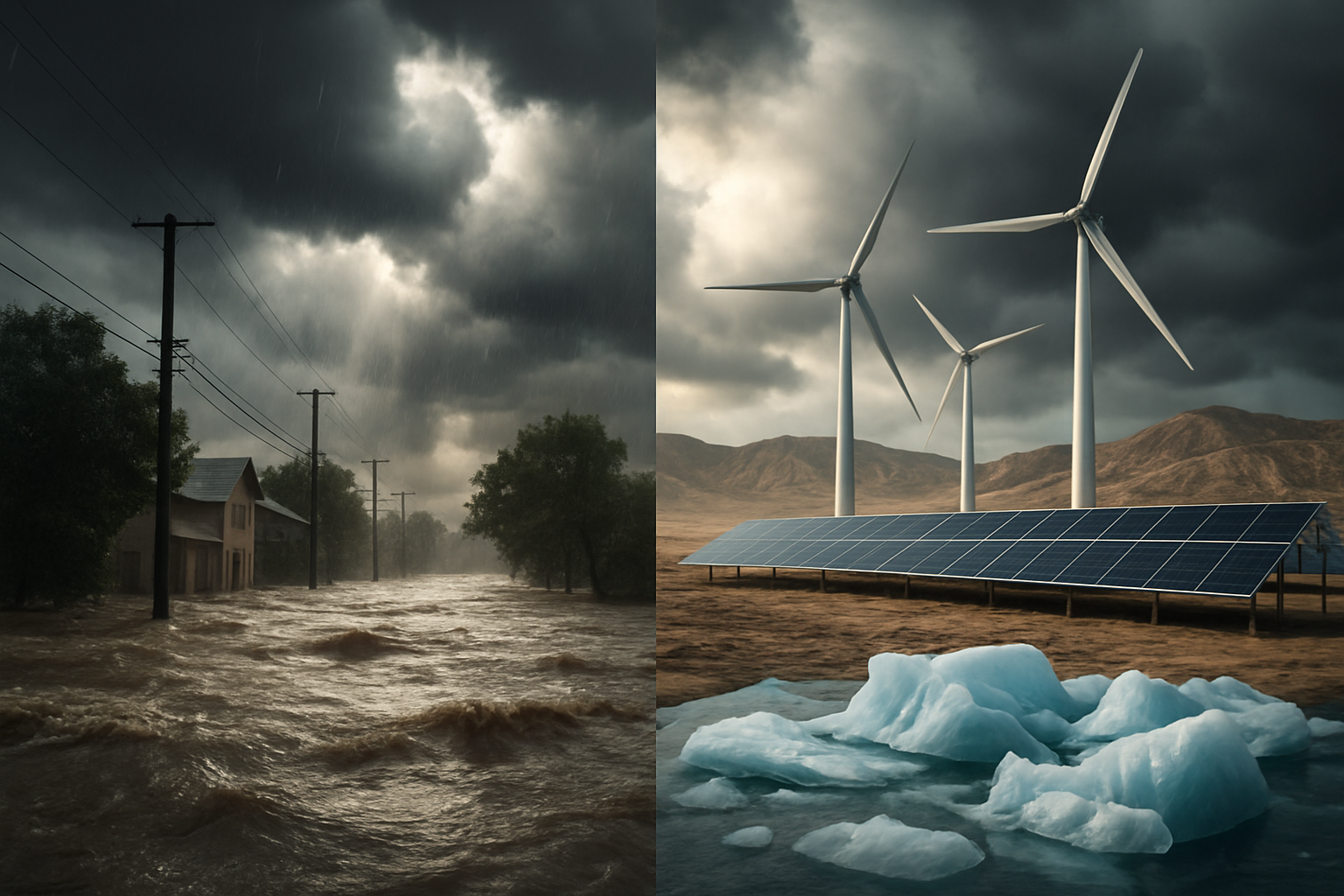
From Austria's renewable energy political battles to Colombia's flood emergencies and Cyprus's water crisis, a convergence of environmental challenges across multiple continents is testing humanity's capacity to respond to accelerating climate change during February 2026.
The month has witnessed an unprecedented array of interconnected environmental crises that span energy infrastructure, water security, extreme weather events, and climate adaptation failures. These challenges are unfolding against the backdrop of January 2026 marking the 18th consecutive month of global temperatures exceeding 1.5°C above pre-industrial levels—a threshold scientists warn represents a critical tipping point for Earth's climate systems.
Austria's Renewable Energy Political Turbulence
In Austria, political tensions over renewable energy policy have reached a crescendo as FPÖ leader Manfred Haimbuchner faces criticism for opposing wind power development while simultaneously complaining about high electricity prices. The political paradox reflects broader European challenges in balancing energy costs with climate commitments.
Austria's situation exemplifies what climate economists call the "transition valley of death"—the period when renewable energy infrastructure requires massive upfront investment while fossil fuel costs remain artificially low. The country's approach to wind power development has become emblematic of the complex political calculations required for successful energy transitions.
Water Crisis Escalates Across Mediterranean
Cyprus faces one of its most severe water crises in decades, as government officials were forced to abandon their original desalination plant site at Nissi Beach following opposition from tourism interests. The decision to relocate to Ayia Thekla beach—within the protected Natura 2000 network—will delay critical water infrastructure by at least one year, pushing relief for the Famagusta district to October 2027.
"The earliest the district can now expect relief is October 2027—a full year later than originally planned."
— Cyprus Government Official
This delay comes as the Mediterranean region experiences intensifying drought conditions and rising temperatures that are straining existing water resources. The Famagusta district's predicament illustrates how environmental protection requirements can sometimes conflict with urgent climate adaptation needs, creating policy dilemmas that require sophisticated balancing of immediate human needs with long-term ecological preservation.
Colombian Flooding Threatens Infrastructure
In Colombia, authorities have placed the Hidroituango dam operation under enhanced scrutiny following increased rainfall in Antioquia province. The situation has prompted emergency meetings between the National Disaster Risk Management Unit (UNGRD) and EPM, Colombia's largest utility company, as concerns mount about the safety of communities downstream from the controversial hydroelectric project.
The Hidroituango crisis represents a microcosm of global climate adaptation challenges. Originally designed for historical rainfall patterns, the dam now operates in a climate regime characterized by more intense precipitation events and unpredictable weather systems. Colombian authorities face the complex task of managing flood risks while maintaining electricity generation for millions of residents.
Extreme Weather Intensifies Across Continents
Georgia's capital Tbilisi experienced significant disruptions from heavy rainfall and snow, part of a broader pattern of extreme weather affecting the Caucasus region. The weather system has created dangerous conditions for transportation and infrastructure, with emergency services reporting numerous incidents related to flooding and ice accumulation.
These regional impacts connect to a global pattern of climate volatility that has characterized early 2026. From devastating storms in Europe that have claimed over 30 lives and required the largest peacetime rescue operation in Portuguese history, to unprecedented flooding across multiple continents, the frequency and intensity of extreme weather events continues to challenge emergency response systems worldwide.
The Economic Reality of Climate Transition
The convergence of these environmental challenges reveals the complex economic dimensions of climate adaptation. Cyprus's water crisis delays will cost hundreds of millions in economic losses and emergency water imports. Colombia's infrastructure modifications to handle extreme weather represent billions in additional investment. Austria's renewable energy political battles reflect the difficulty of maintaining public support for expensive transitions during economic uncertainty.
These costs are occurring against a backdrop of supply chain vulnerabilities that threaten renewable energy deployment. Global memory chip shortages have driven prices up sixfold, affecting smart grid technologies and renewable energy control systems. Meanwhile, China's dominance in critical materials—controlling 60% of production and 90% of refining capacity for lithium, cobalt, and rare earth elements—creates strategic dependencies that complicate climate transition planning.
Romania's Climate Adaptation Through Sports
Romania offers an unexpected perspective on climate challenges through the lens of winter sports popularity. Following the Milano-Cortina Olympics, interest in winter sports has surged across the country, but climate change threatens the infrastructure that supports these activities. Rising temperatures and unpredictable snowfall patterns are making traditional winter sport venues unreliable, forcing adaptations in tourism and recreation industries.
This phenomenon extends beyond Romania to affect winter sport destinations globally. The Alps, historically reliable for winter sports, now face shortened seasons and increasingly artificial snow requirements. The economic implications extend far beyond sports, affecting tourism revenues, employment, and regional economic development strategies that have been built around predictable winter conditions.
Technology Integration and Traditional Solutions
Across all these challenges, a pattern emerges of successful responses requiring integration of cutting-edge technology with traditional ecological knowledge and community-based management. Cyprus combines modern desalination technology with traditional water conservation practices. Colombia uses advanced meteorological monitoring alongside community-based flood warning systems. Austria's renewable energy debates reflect tensions between technological solutions and traditional energy approaches.
The most effective climate responses increasingly demonstrate that neither purely technological nor traditional approaches alone are sufficient. Success requires sophisticated synthesis that respects local knowledge while deploying modern tools for monitoring, prediction, and response.
International Cooperation Under Strain
These environmental challenges are testing international cooperation mechanisms that were designed for sequential rather than simultaneous global crises. Traditional mutual aid assumes some regions will be available to assist others during emergencies, but when multiple continents face disasters simultaneously, these frameworks become inadequate.
The European Union's Civil Protection Mechanism has been activated repeatedly throughout February 2026, with Sweden and Denmark providing €246 million in assistance—the largest coordinated European weather response on record. However, these efforts represent responses to symptoms rather than systematic prevention of the underlying causes driving environmental crisis convergence.
Looking Forward: Adaptation Imperatives
February 2026 represents what scientists describe as a watershed moment in global environmental protection. The choice between reactive crisis management and proactive ecosystem service management is becoming increasingly urgent as ecological systems approach critical thresholds that could trigger irreversible changes.
Climate scientists warn that current conditions preview what routine circumstances might look like in the 2030s without significant climate adaptation investment. The window for effective climate action is narrowing rapidly, while the costs of both adaptation and inaction continue to escalate.
Success in addressing these converging environmental challenges will require unprecedented coordination across technological innovation, international cooperation, financial commitment, and adaptive management responding to rapidly evolving conditions. The events of February 2026 provide both urgent warnings about accelerating environmental change and valuable lessons for building the resilience necessary for planetary sustainability.
As emergency services operate at capacity limits globally and traditional aid mechanisms strain under simultaneous disasters, the need for transformative approaches to environmental protection has never been more apparent. The choice facing humanity is clear: develop adaptive capacity to protect essential environmental systems, or face increasingly severe consequences as climate crisis acceleration outpaces human response capabilities.