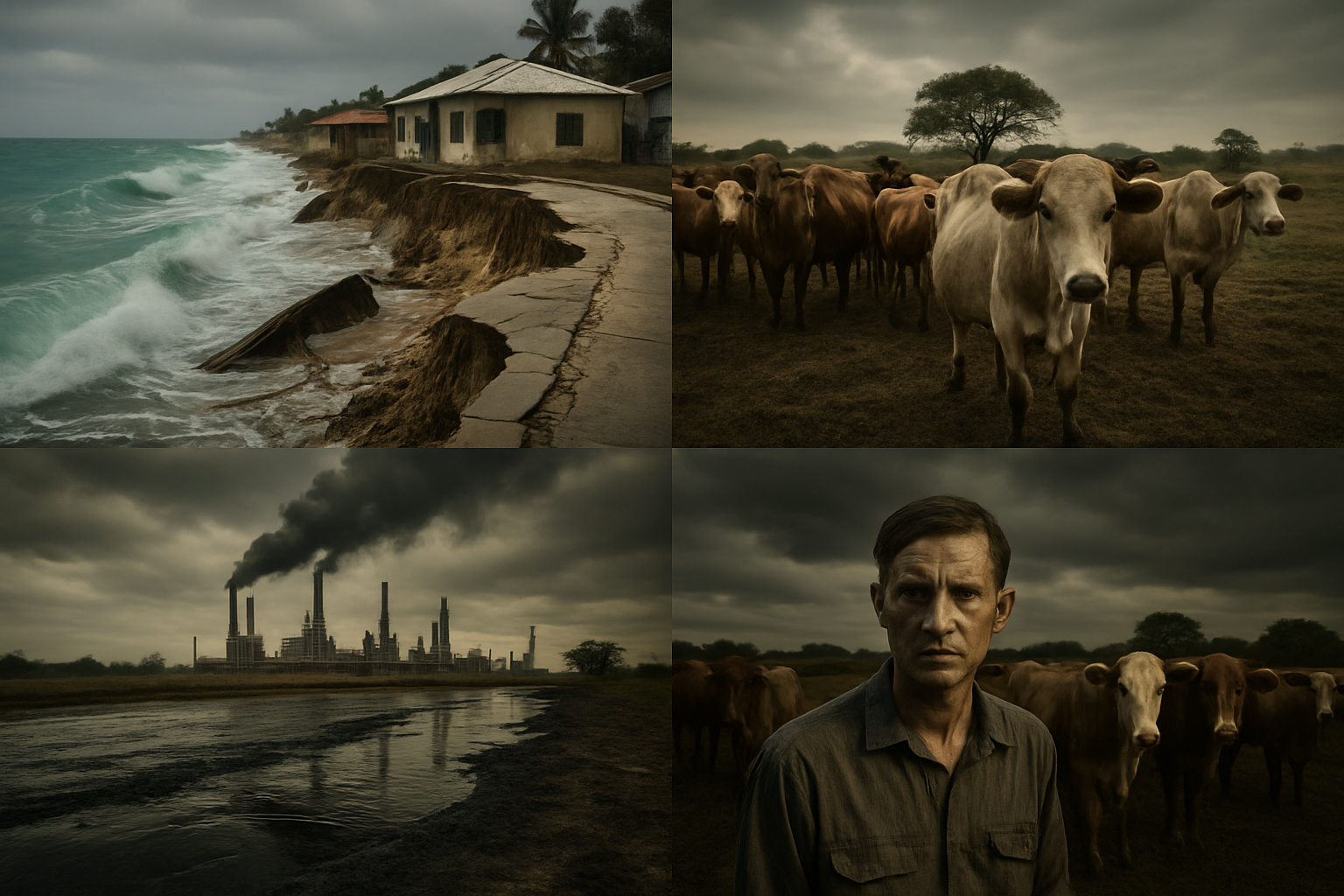
A convergence of environmental crises spanning three continents has exposed critical vulnerabilities in global climate adaptation systems as the world experiences its 20th consecutive month of temperatures exceeding 1.5°C above pre-industrial levels, marking the longest sustained warming streak in recorded human history.
From asbestos contamination poisoning communities in Austria to catastrophic coastal erosion threatening entire villages in Belize, and livestock disease outbreaks challenging food security in Cyprus, the simultaneous environmental challenges reveal how traditional crisis management approaches are failing to keep pace with the accelerating pace of climate change.
Austria Faces Unprecedented Asbestos Crisis
Greenpeace Austria has issued urgent warnings following new analysis revealing extensive asbestos contamination around the Steinbruch Badersdorf quarry. The environmental organization's latest findings show dangerous levels of asbestos fibers on surfaces and plants throughout the surrounding area, posing severe health risks to local residents.
The contamination discovery near Badersdorf represents a significant escalation of environmental health threats in the region, with Greenpeace demanding immediate action from the Burgenland state government to implement comprehensive remediation strategies and establish ongoing health monitoring programs for affected communities.
"This contamination poses immediate and long-term health risks that require urgent government intervention and comprehensive community protection measures."
— Greenpeace Austria spokesperson
The asbestos crisis comes at a particularly challenging time as Austria continues to position itself as a climate pioneer, with cities like Krems implementing comprehensive 2040 climate roadmaps. The contamination incident highlights how legacy industrial pollution intersects with contemporary climate challenges, creating compound environmental threats that traditional approaches struggle to address effectively.
Belize Battles Catastrophic Coastal Erosion
In Belize's Toledo District, the coastal community of Monkey River is witnessing renewed hope as significant government efforts address decades of devastating coastal erosion that has fundamentally altered the landscape and forced families to relocate.
Dr. Osmond Martinez, Area Representative for Toledo East and Minister of State for Economic Transformation, confirmed that climate resilience efforts are now prioritizing the vulnerable community where coastal erosion has become so severe that the village cemetery now sits partially surrounded by the sea.
The situation in Monkey River exemplifies the broader Caribbean climate crisis, where small island developing states and coastal communities face existential threats from rising sea levels and intensifying storms. Recent research has revealed that global sea level rise projections may have been systematically underestimated by 30 centimeters to one full meter over the past 15 years, potentially affecting up to 132 million people worldwide with greater coastal threats than previously calculated.
Simultaneously, Belize is advancing climate-resilient urban development through a national summit focused on "Resilient Infrastructure and Sustainable Urban Land Management." The initiative brings together government agencies, municipalities, village councils, and private sector organizations to strengthen local governance capacity for managing urban growth while ensuring development remains sustainable and climate-resilient.
Cyprus Confronts Livestock Disease Emergency
Cyprus faces a critical test of its biosecurity systems as European Commissioner for Animal Health and Welfare Oliver Varhelyi visits the island to assess the ongoing foot-and-mouth disease outbreak and evaluate the country's response capabilities.
The commissioner's visit includes meetings with Agriculture Minister Maria Panayiotou and representatives from affected livestock operations, highlighting the international significance of containing the outbreak. The disease response has required unprecedented coordination across multiple agencies, with discussions focusing on producers' requests to avoid slaughtering asymptomatic animals—a departure from traditional containment protocols.
The outbreak occurs amid broader climate-driven challenges to agricultural systems worldwide. As documented in our extensive environmental monitoring, Cyprus has been experiencing the effects of sustained global warming, with January 2026 marking the hottest month in recorded history and extending an unprecedented streak of 19 consecutive months exceeding the critical 1.5°C threshold.
A Pattern of Accelerating Environmental Challenges
These concurrent crises represent more than isolated incidents—they illustrate a dangerous pattern of environmental challenges that are overwhelming existing response systems. The convergence of asbestos contamination, coastal erosion, and livestock disease outbreaks demonstrates how climate change acts as a threat multiplier, exacerbating existing vulnerabilities while creating new forms of environmental stress.
Recent memory of global environmental protection efforts shows that successful responses require sophisticated integration of cutting-edge technology with traditional ecological knowledge and community-based management. From Arctic marine ecosystem monitoring to Mediterranean reforestation initiatives, effective environmental protection has evolved from reactive crisis management to proactive ecosystem service management.
Climate Context: Unprecedented Warming Continues
The environmental challenges facing Austria, Belize, and Cyprus unfold against the backdrop of unprecedented global warming. Human-induced climate change has fundamentally altered Earth's atmospheric systems beyond natural recovery mechanisms, with sustained warming now overriding natural climate variability including La Niña cooling effects that typically moderate global temperatures.
This sustained warming creates compound environmental effects that traditional conservation approaches struggle to address. In Austria, changing temperature patterns may be affecting how industrial pollutants behave in the environment. In Belize, accelerated sea level rise compounds the erosion challenges facing coastal communities. In Cyprus, climate stress on agricultural systems makes livestock more vulnerable to disease outbreaks.
Technology and Traditional Knowledge Integration
Success across these diverse environmental challenges consistently depends on sophisticated synthesis of cutting-edge technology with traditional ecological knowledge and community-based management approaches.
Austria's response to asbestos contamination requires advanced environmental monitoring combined with community health surveillance systems. Belize's coastal protection efforts integrate modern engineering with traditional coastal management practices developed by fishing communities over generations. Cyprus's disease management protocols combine veterinary science with traditional animal husbandry knowledge.
This integration represents a fundamental evolution in environmental protection strategy—moving beyond purely technological or purely traditional approaches toward comprehensive frameworks that combine scientific rigor with cultural sensitivity and community ownership.
Economic Development Through Environmental Protection
Across all three situations, environmental protection functions as an economic development strategy rather than a regulatory burden. Successful contamination cleanup in Austria could enhance the region's environmental credentials and attract sustainable investment. Effective coastal protection in Belize maintains tourism assets while supporting fishing community livelihoods. Disease containment in Cyprus protects agricultural export markets and international trade relationships.
Countries implementing comprehensive environmental protection consistently demonstrate greater economic resilience and attract sustainable investment across multiple sectors, including green technology manufacturing, environmental services, and nature-based tourism. The economic multiplier effects extend beyond environmental sectors to include improved public health, enhanced agricultural productivity, and reduced infrastructure costs through natural disaster prevention.
International Cooperation Imperative
The transnational nature of environmental challenges demands unprecedented international cooperation. Pollution plumes, climate systems, and species migrations cross political boundaries, making unilateral efforts insufficient for effective environmental response.
The diversity of approaches demonstrated across Austria's industrial remediation, Belize's climate adaptation, and Cyprus's agricultural crisis management provides resilience against single-solution dependencies. Knowledge sharing between these different environmental responses creates global networks that offer multiple adaptation pathways for addressing complex, interconnected environmental challenges.
Implementation Challenges and Opportunities
Environmental protection efforts face systematic challenges, particularly in developing nations where immediate economic pressures often override long-term environmental considerations. Funding sustainability, technical capacity building, and climate change disruption of project timelines require adaptive management approaches capable of responding to rapidly changing conditions.
However, the diversity of environmental approaches provides opportunities for enhanced international cooperation, accelerated technology transfer, and innovative financing mechanisms. South-South cooperation is expanding, with developing nations emerging as environmental solution providers rather than solely aid recipients.
Critical Action Window
March 2026 represents a critical juncture for global environmental protection—a choice between reactive crisis management and proactive ecosystem service management that could determine whether conservation efforts can keep pace with accelerating environmental change during this decisive climate action decade.
Environmental action windows are narrowing as ecological systems approach critical thresholds that could trigger potentially irreversible changes affecting global food security, climate stability, and human settlements. However, the tools, knowledge, and cooperation frameworks exist for comprehensive environmental protection, as demonstrated by successful initiatives worldwide.
Success depends on sustained international cooperation, enhanced coordination across scales and sectors, and increased financial commitments that recognize environmental protection as essential infrastructure for human prosperity and planetary sustainability.
Future Implications for Global Environmental Policy
The environmental challenges documented across Austria, Belize, and Cyprus provide critical lessons for scaling environmental protection efforts globally. Each situation demonstrates that effective environmental response requires community ownership and engagement, transparent governance frameworks, economic incentives that make protection financially viable, and integration of traditional knowledge with modern science.
These experiences offer templates for addressing multiple, simultaneous environmental threats through coordinated international response. The success or failure of current environmental protection efforts may prove decisive for conservation approaches in the decades ahead, influencing global strategies for biodiversity protection, climate adaptation, and sustainable development.
As the world faces its most environmentally challenging period in recorded history, the convergence of innovation, cooperation, and political commitment offers hope for maintaining planetary habitability. However, the window for effective environmental action continues to narrow, making coordinated international responses more critical than ever before.