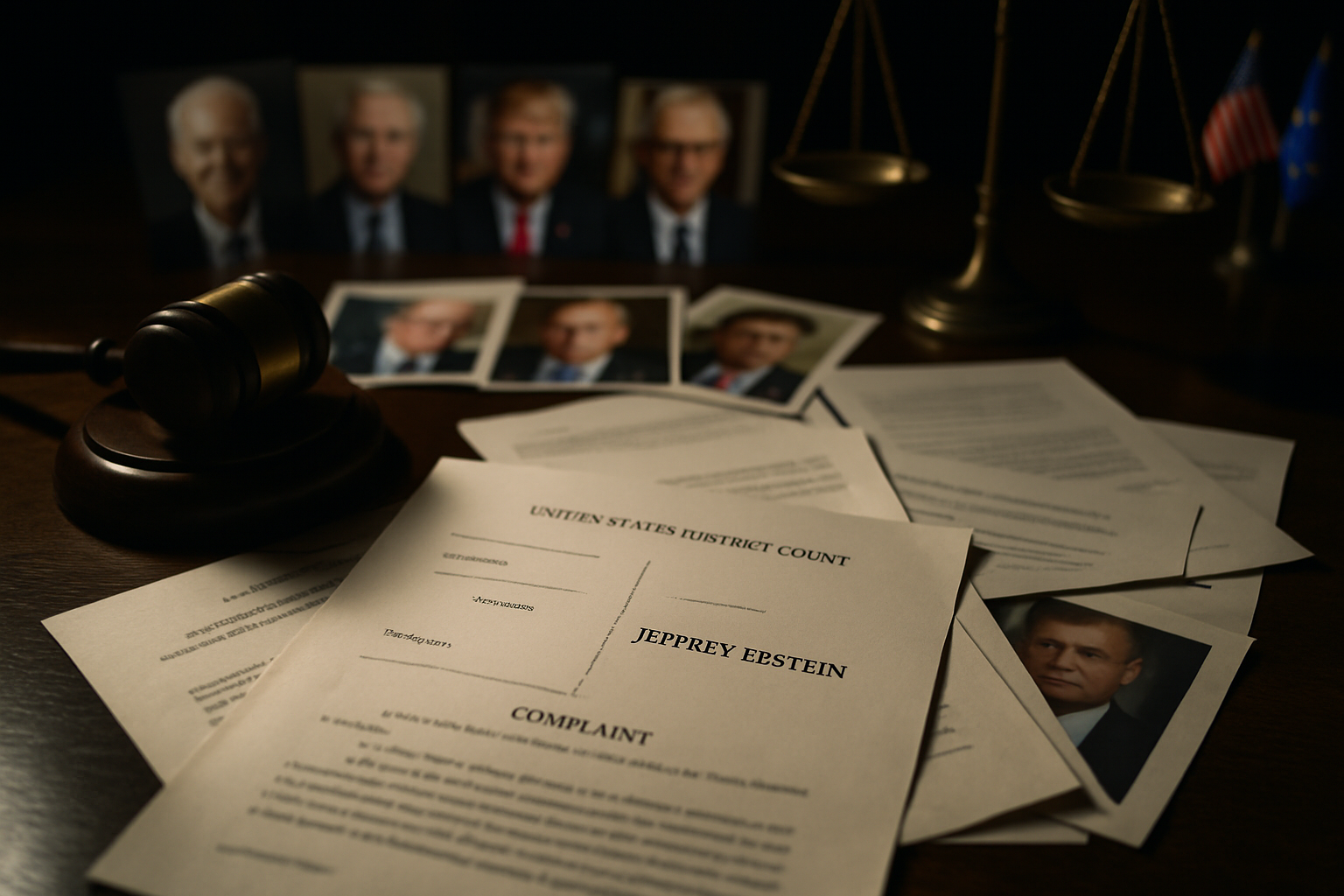
The latest release of Jeffrey Epstein documents by the U.S. Department of Justice has sent shockwaves across the global political establishment, exposing communications and connections that span continents and implicate some of the world's most powerful figures in what investigators describe as the largest international elite network exposure in recent memory.
The massive document dump, consisting of over 3 million pages, 2,000 videos, and 180,000 images, has triggered criminal investigations across multiple countries and forced high-profile resignations while threatening the careers of prominent politicians, business leaders, and members of royal families worldwide.
Tech Billionaire Bill Gates Under Scrutiny
Microsoft co-founder Bill Gates finds himself at the center of renewed controversy as the documents contain allegations about his relationship with the convicted sex offender. The files include claims that Gates contracted a sexually transmitted disease and had contact with "Russian girls," allegations his spokesperson has denounced as "absolutely absurd."
Gates has publicly stated he "regrets every minute" spent with Epstein, acknowledging he attended dinners with the financier but denying ever visiting Epstein's island or meeting girls through him. His ex-wife, Melinda French Gates, has said Gates needs to "answer to those things," describing the revelations as taking her back to "painful moments" in their marriage.
"I regret ever knowing him. These new allegations are completely false and I categorically deny them."
— Bill Gates, Microsoft Co-founder
European Royal Families in Crisis
Norway's Crown Princess Mette-Marit faces the gravest crisis in modern Norwegian royal history as her name appears over 1,000 times in the documents, revealing what investigators describe as "intimate messages" and an "unexpectedly close relationship" with Epstein. The Norwegian financial crimes authority, Økokrim, is now considering criminal proceedings against members of the royal family.
The scandal has prompted Sex og Samfunn (Sex and Society), a major Norwegian organization, to immediately terminate all collaborative partnerships with the Crown Princess - marking the first institutional rejection of the royal family in modern Norwegian history. Royal expert Sigrid Hvidsten has called it the "largest royal scandal in modern history" and warned that the kingdom's security may be at risk.
In the United Kingdom, Prince Andrew was forced to evacuate the Royal Lodge under cover of darkness, moving to temporary accommodation at Sandringham Estate after new allegations emerged from a second woman claiming Epstein sent her to the Royal Lodge in 2010. The departure ends Andrew's 22-year association with the prestigious Windsor property.
An email in the documents appears to confirm the authenticity of the controversial photograph showing Andrew with Virginia Giuffre, despite the former prince's previous claims that the image had been doctored and his denial of ever meeting Giuffre.
Global Political Fallout Spreads
The scandal has reached the highest levels of government across Europe. UK Prime Minister Keir Starmer expressed regret over appointing Peter Mandelson as U.S. ambassador following fresh allegations about the Labour politician's ties to Epstein. Mandelson faces calls to relinquish his peerage after "Where r u? I miss you" emails were revealed in the documents.
In France, the correspondence has "splashed" multiple French personalities, with documents revealing the extent of relationships various political and cultural figures maintained with the billionaire financier. The emails show how Epstein cultivated connections across French high society and political circles.
Germany's media reports suggest that new traces from the Epstein files lead to the Kremlin, with Russian President Vladimir Putin's name appearing in documents. Russian state media has dismissed Western coverage as "Russiagate 2.0," calling it a discredited conspiracy theory aimed at deflecting from Western elite corruption.
Baltic States and International Recruitment Networks
The documents have exposed extensive recruitment networks across the Baltic states, with Lithuania's Valdas Petreikis mentioned in correspondence about "many women from Lithuania." Latvia's State Police have launched investigations into the "Natalie" modeling agency, while an Estonian "agent" allegedly operated across all three Baltic countries.
Finland's media reports that Epstein maintained contact with Norway's royal house and politicians, prompting calls for answers about why these relationships were cultivated and maintained. Swedish diplomat Lisa Svensson had decade-long "extensive contact" with Epstein and even borrowed his New York apartment, leading the Swedish Foreign Ministry to take the revelations "seriously."
Norway's Parallel Crisis
The Epstein revelations come at the worst possible time for the Norwegian royal family, coinciding with the ongoing rape trial of Crown Princess Mette-Marit's son, Marius Borg Høiby. The 29-year-old faces 38 criminal charges including four rape counts, creating an unprecedented dual royal crisis that has shaken public confidence in the monarchy.
Financial Networks and Intelligence Allegations
The documents reveal sophisticated financial networks spanning continents. French-German banker Ariane de Rothschild of the Edmond de Rothschild Group maintained "very close proximity" with Epstein between 2013-2019, serving as an unofficial adviser to Swiss banking operations.
Intelligence connections continue to surface, with documents including recorded conversations between former Israeli Prime Minister Ehud Barak and Epstein discussing "gigantic" consulting payments to Tony Blair. Speculation persists about possible Israeli Mossad connections, with researchers like Whitney Webb and Ari Ben-Menashe arguing the network operated as a sex-trafficking and blackmail honeypot operation.
Turkish and Portuguese Connections
New documents reveal that Reid Weingarten, the lawyer who represented Turkish cleric Fethullah Gülen, also represented Jeffrey Epstein. This connection adds another layer to the international scope of Epstein's legal network and raises questions about the intersection of his operations with various geopolitical actors.
In Portugal, newly released documents identified beneficiaries of Epstein's fortune, revealing that the millionaire planned to marry his then-girlfriend Karyna Shuliak, to whom he left approximately $100 million and most of his properties.
Unexpected Victims and False Connections
Norwegian influencer Emma Ellingsen discovered her name in the documents after someone sent Epstein her Instagram profile in 2019, describing her as a transgender woman who is "pretty, with a small surprise." Ellingsen, who was 17 at the time and about to turn 18, expressed shock at the discovery, saying she "woke up from a nap to a message" about being mentioned in the files.
Former U.S. Senator George Mitchell, who played a key role in Northern Ireland's peace process, has denied allegations linking him to Epstein, with his spokesman calling it a case of "mistaken identity." Mitchell says he "declined or deflected" meeting Epstein amid renewed allegations from Virginia Giuffre.
Congressional Action and Legal Consequences
The political fallout has reached the U.S. Congress, where Bill and Hillary Clinton have agreed to testify before the House Oversight Committee after initially refusing subpoenas. The agreement came just days before a scheduled contempt of Congress vote that could have led to criminal charges.
The testimony will be conducted under oath with full public transcripts, focusing on Bill Clinton's documented flights on Epstein's aircraft and both Clintons' knowledge of any criminal activities. The agreement represents a major political victory for Republican committee chair James Comer, who had aggressively pursued their testimony.
Despite the "disturbing" material revealed in the documents, Deputy Attorney General Todd Blanche has confirmed that no new federal prosecutions are planned. However, multiple international investigations are now underway across several continents, with the Metropolitan Police in London formally investigating British figures mentioned in the files.
Institutional Responses and Damage Control
The scandal has prompted swift institutional responses across affected countries. Multiple cultural institutions are severing ties with named figures, while governments are launching internal investigations into their officials' connections to Epstein.
The Norwegian case has become particularly acute, with former Prime Minister Erna Solberg demanding complete transparency, stating that "only honesty can end this crisis." Public opinion polling shows nearly half of Norwegians now believe Crown Princess Mette-Marit is unfit to become queen, with some calling for the "royal family to be gone within ten years."
Ongoing Investigations and Global Impact
The scale of the document release has overwhelmed investigators worldwide, with law enforcement agencies coordinating across multiple jurisdictions to examine the evidence. The network's reach extended from Epstein's properties in New York, Florida, and the Virgin Islands to European capitals, Asia, and Africa.
The DOJ was forced to remove thousands of additional documents after accidentally exposing the identities of approximately 100 survivors, including 31 of 32 minor victims. This massive confidentiality breach has prompted emergency petitions in federal courts and threatens future cooperation with law enforcement.
The revelations represent a fundamental alteration of the international political landscape, forcing a reckoning with the intersection of power, privilege, and criminal behavior at the highest levels of global society. The impact on democratic institutions, international relations, and individual careers continues to unfold as prosecutors, investigators, and the public examine this vast trove of evidence.
As investigations proceed across multiple continents, the Epstein files stand as a critical test of international justice cooperation and democratic accountability when confronting elite criminal networks that span multiple jurisdictions. The varying national responses demonstrate the complex intersection of law enforcement capabilities, international relations, and domestic political pressures in addressing what may be the largest exposure of high-level corruption and criminal activity in recent memory.