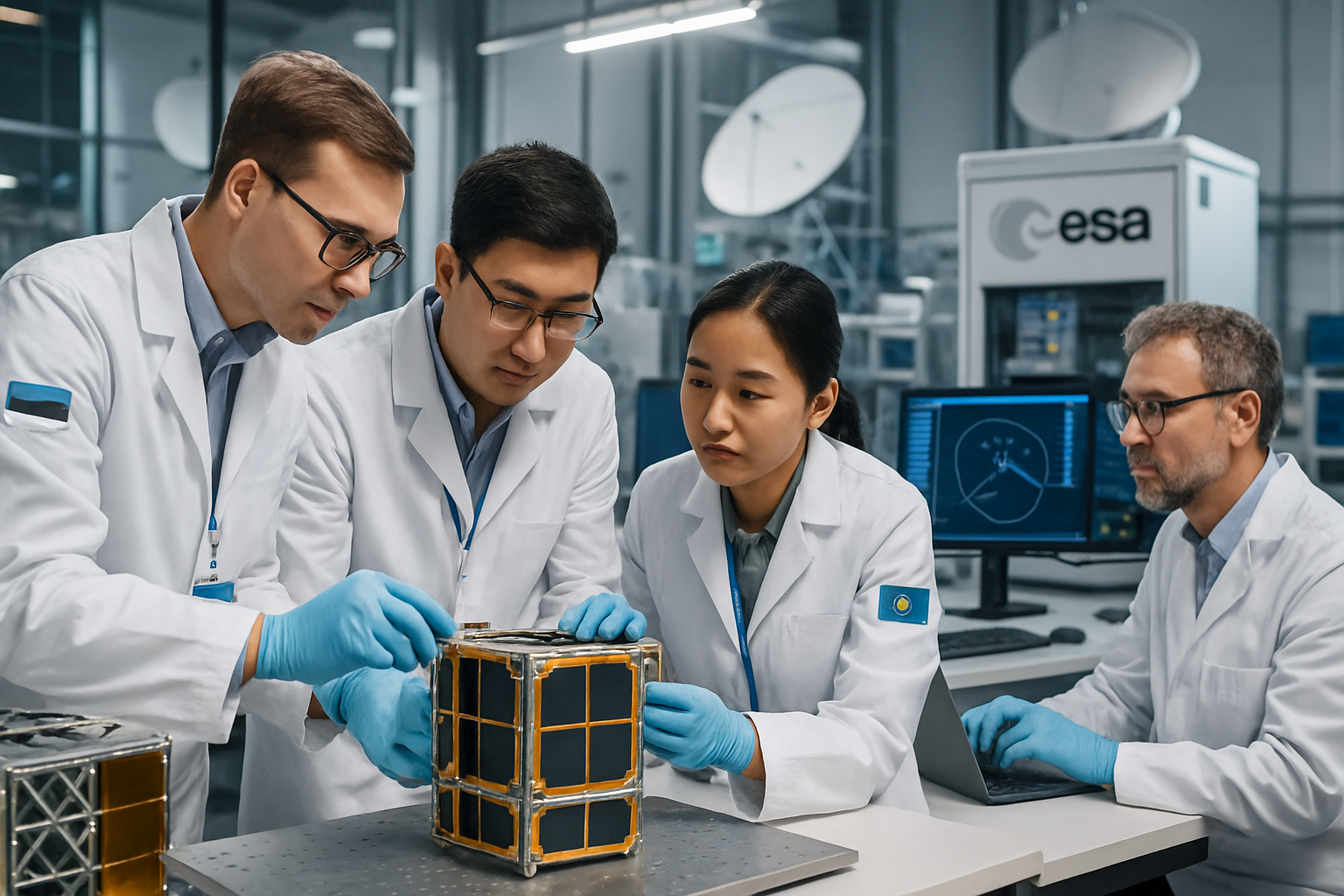
Estonia emerges as a critical player in Europe's space defense architecture while Kazakhstan advances ambitious export-oriented space projects, marking a significant shift in the global space landscape as smaller nations leverage technological sovereignty to compete in the rapidly expanding trillion-dollar space economy.
President Alar Karis's declaration that "Estonia has its part to play in space tech in Europe, including in defense" comes at a pivotal moment when the space industry transitions from what experts call the "AI revolution" to the "space economy golden age." This transformation is characterized by unprecedented international cooperation alongside intensifying strategic competition, with global space economy projections exceeding $1 trillion by 2030.
Estonia's Strategic Defense Role in European Space Architecture
Estonia's position as a key European space defense contributor reflects the broader democratization of space capabilities, where smaller nations achieve disproportionate influence through specialized technological excellence rather than massive resource investment. The Baltic nation's expertise in cybersecurity and advanced manufacturing has positioned it as an essential partner in Europe's drive toward space independence.
The significance of Estonia's role becomes apparent within the context of Europe's €10 billion investment in advanced satellite systems, including Germany's SATCOMBw 4 program and Sweden's Isar Aerospace facilities testing 30 engines monthly. This coordinated European approach represents a strategic response to growing space competition from established players like SpaceX, which is preparing for a potentially trillion-dollar IPO in June 2026, and emerging capabilities from China and other nations.
"Estonia has its part to play in space tech in Europe, including in defense."
— President Alar Karis
Estonia's integration into European space defense frameworks aligns with broader NATO initiatives, including the Arctic Sentry program, which requires sophisticated space-based monitoring capabilities for comprehensive northern defense coverage. The nation's technological contributions complement traditional space powers while providing specialized capabilities essential for modern space-based defense systems.
Kazakhstan's Export-Oriented Space Ambitions
Simultaneously, Kazakhstan is pursuing an ambitious strategy to develop export-oriented space projects, leveraging its established position as home to the Baikonur Cosmodrome—the world's oldest and largest operational space launch facility. The Central Asian nation's approach represents a pragmatic evolution from serving primarily as a launch location to developing indigenous space capabilities for international markets.
Kazakhstan's space strategy capitalizes on several key advantages: its geographic location providing optimal launch trajectories, decades of accumulated aerospace expertise through Baikonur operations, and growing international demand for cost-effective space services. The nation's approach reflects a broader trend where emerging space nations focus on specialized capabilities rather than attempting to replicate comprehensive space programs.
The timing of Kazakhstan's space expansion aligns with unprecedented global demand for satellite services, driven by applications including communications, Earth observation, weather monitoring, and emerging space-based data centers. Industry projections suggest space-based computing could become cost-effective within 36 months, offering unlimited expansion potential with continuous solar power and no cooling requirements compared to terrestrial data centers consuming billions of gallons of water annually.
Global Context: Space Economy Golden Age
These developments occur during what space industry analysts describe as the transition from the "AI revolution" to the "space economy golden age," characterized by several converging trends. Commercial space enterprises are increasingly leading innovation beyond traditional government programs, with companies like SpaceX achieving routine space operations through over 573 successful booster recoveries.
The international space landscape demonstrates complex cooperation-competition dynamics. While traditional partnerships continue through International Space Station operations involving NASA, ESA, and Roscosmos, new competitive elements emerge through China's advancing Shenlong reusable spacecraft program, Pakistan's first astronaut mission to China's Tiangong station scheduled for October-November 2026, and Thailand's leadership in UN space governance frameworks.
Recent technological breakthroughs underscore the rapid pace of advancement. NASA's DAGGER AI system achieved revolutionary 30-minute geomagnetic storm prediction capability, protecting satellite infrastructure worth billions of dollars. Chinese scientists used AI to determine the Moon's far side chemical composition through Chang'e-6 samples, providing first detailed mapping of permanently hidden lunar regions. These achievements demonstrate how AI integration is revolutionizing space operations through autonomous navigation and sophisticated analytical capabilities.

Space Medicine and Human Exploration Advances
Critical space medicine research continues to advance human spacefaring capabilities, with French astronaut Sophie Adenot's record eight-month ISS mission providing invaluable data on lung tissue cultivation and Space-Associated Neuro-Ocular Syndrome (SANS) research. These studies are essential for understanding human physiology during extended missions beyond Earth evacuation possibility, directly informing medical protocols for future lunar settlements and Mars exploration.
The convergence of space medicine breakthroughs, advanced materials science, and international cooperation creates comprehensive frameworks for sustainable human presence beyond Earth orbit. Recent developments include cryogenic brain tissue preservation breakthroughs demonstrated by scientists in Bosnia, showing complex neural tissue can survive extreme cold preservation while maintaining biological function upon thawing—potentially revolutionary for long-duration interplanetary missions.
Nuclear Propulsion and Deep Space Capabilities
NASA's announcement of the Space Reactor 1 Freedom nuclear spacecraft program represents a paradigm shift toward deep space exploration capabilities. Nuclear propulsion enables faster transit times, continuous power generation, and reduced radiation exposure for missions where solar power proves insufficient. This technology positions humanity for sustained deep space operations and multi-planetary expansion beyond the Moon-Earth system.
The nuclear propulsion breakthrough complements NASA's historic $20 billion commitment toward establishing a permanent lunar surface base by 2030—the largest space infrastructure investment in agency history. This strategic pivot from the cancelled Lunar Gateway project toward surface operations reflects pragmatic approaches to achieving sustainable lunar presence as a stepping stone for Mars exploration.
Space Debris and Sustainability Challenges
Growing space activity necessitates immediate attention to sustainability challenges, with over 30,000 tracked orbital objects creating collision risks at 17,500 mph. Romanian scientists warn that cascade collision effects could potentially trap humanity on Earth through chain reaction debris fields, while Austrian research documents atmospheric pollution from rocket debris including tenfold lithium elevation.
China's Hukeda-2 orbital servicing mission, featuring flexible "octopus tentacle" robotic arms for satellite servicing and debris disposal, demonstrates practical approaches to space sustainability. The technology extends satellite lifespans while preventing cascade effects that threaten long-term space access—critical for the trillion-dollar space economy's sustainable development.
Technological Democratization and Market Access
The emergence of nations like Estonia and Kazakhstan as significant space technology contributors exemplifies the democratization of space capabilities. Rather than requiring massive resource investments, countries achieve influential positions through focused technological excellence, strategic partnerships, and innovative approaches to specialized market segments.
This democratization trend extends beyond government programs to commercial enterprises, with companies like Space One in Japan attempting to become the first private entity to reach orbit, despite recent technical challenges. The persistence through setbacks demonstrates the maturation process where safety-first approaches ensure long-term viability despite short-term economic pressures.
"The space economy golden age represents humanity's transition toward becoming a truly spacefaring civilization, with space infrastructure becoming essential rather than experimental."
— Industry Analysis Report, 2026
Economic Implications and Future Prospects
The economic implications of expanding space capabilities extend far beyond traditional aerospace sectors. Space-based infrastructure addresses critical terrestrial challenges including the global memory crisis, with sixfold semiconductor price increases driving interest in orbital computing alternatives. Space-based data centers offer solutions to infrastructure constraints while providing unlimited expansion potential.
Estonia's focus on space defense technology creates high-value employment opportunities and positions the nation competitively in emerging security markets. Kazakhstan's export-oriented approach leverages existing infrastructure while developing new revenue streams from international space services. Both strategies demonstrate how smaller nations can achieve significant economic benefits through focused space sector investment.
International Cooperation Frameworks
Success in the modern space economy requires sophisticated international cooperation frameworks balancing competition with collaboration. The Artemis Accords provide one model for peaceful lunar exploration, while UN space governance initiatives led by Thailand address commercial activities beyond traditional government space law.
Estonia's integration into European space defense and Kazakhstan's export-oriented projects demonstrate different approaches to international engagement—both essential for comprehensive space capability development. These models provide templates for other emerging space nations seeking to establish meaningful roles in the global space economy.
Strategic Implications for Spacefaring Civilization
The convergence of Estonian space defense capabilities, Kazakhstan's commercial ambitions, and global technological breakthroughs represents a watershed moment in human space development. These advances occur alongside historic achievements including NASA's successful Artemis II mission ending the 54-year gap in human deep space exploration, validating systems essential for permanent lunar settlements and Mars exploration.
The transition toward what experts describe as a "spacefaring civilization" requires diverse contributions from nations with varying capabilities and strategic objectives. Estonia's defense focus and Kazakhstan's commercial orientation complement larger nations' comprehensive programs, creating a resilient international framework for sustained cosmic expansion.
As the space economy enters its golden age with projected growth exceeding $1 trillion by 2030, the success of nations like Estonia and Kazakhstan in establishing meaningful space roles demonstrates that technological sovereignty and international cooperation can coexist effectively. Their achievements provide models for other emerging space nations while contributing to humanity's broader cosmic future through specialized excellence and strategic partnership development.
The coming decade will likely determine whether humanity successfully transitions from experimental space activities to essential infrastructure supporting a truly spacefaring civilization. Estonia's space defense contributions and Kazakhstan's export-oriented projects represent critical components of this transformation, demonstrating that every nation can play a meaningful role in humanity's cosmic expansion through focused technological development and strategic international cooperation.