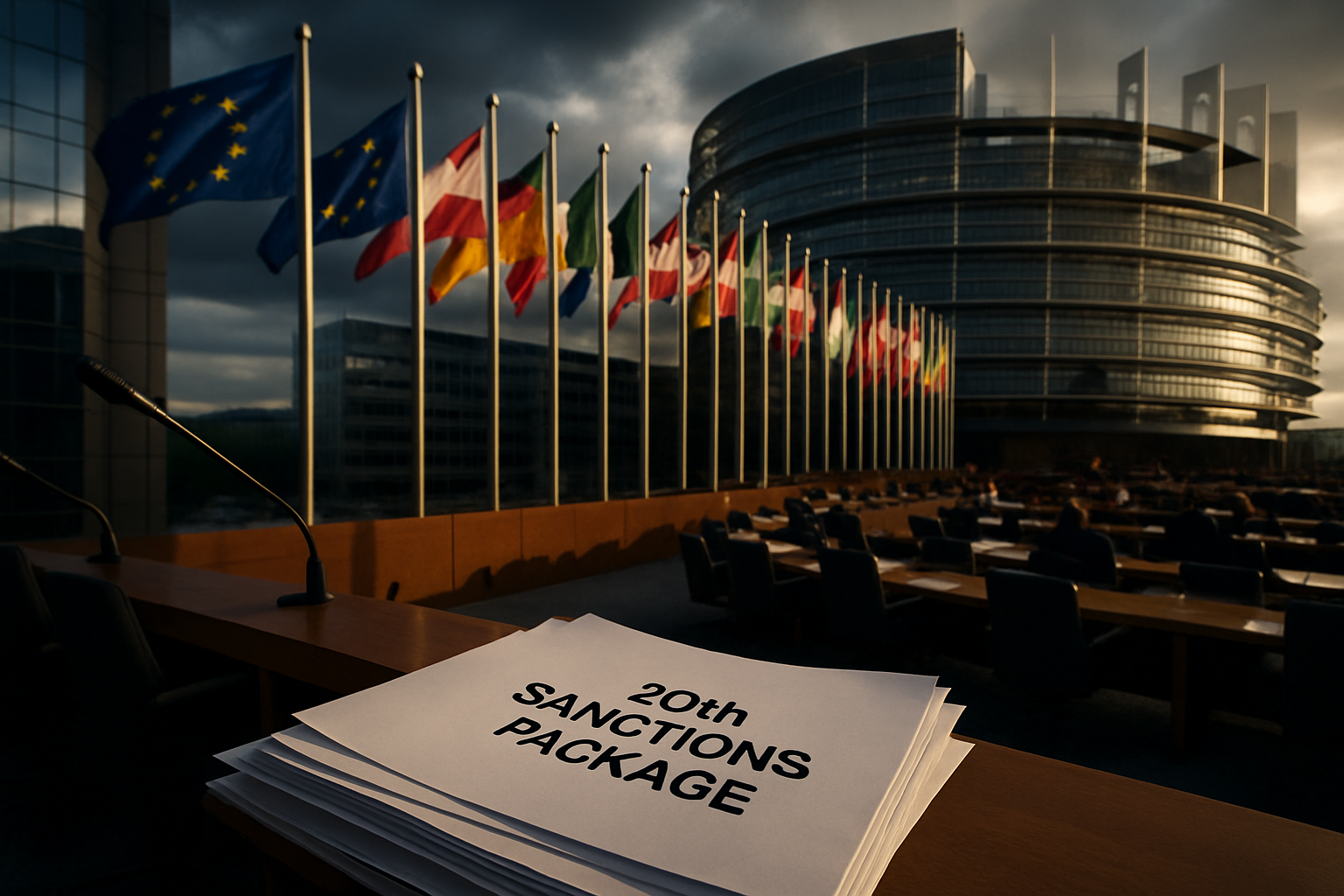
The European Union has announced its 20th comprehensive sanctions package against Russia, introducing sweeping restrictions on energy services, financial institutions, and maritime operations in what European Commission President Ursula von der Leyen described as the bloc's most targeted effort to undermine Moscow's war financing capabilities.
The landmark package, unveiled on Friday, February 6, 2026, represents a significant escalation in the EU's economic warfare strategy against Russia, nearly four years after the full-scale invasion of Ukraine. The measures specifically target Russia's ability to circumvent existing sanctions through sophisticated workaround mechanisms.
Complete Maritime Services Ban
At the heart of the new restrictions lies an unprecedented prohibition on all maritime services for Russian crude oil exports. "For the first time, we are implementing a complete ban on maritime services," von der Leyen announced, detailing measures that extend far beyond previous limitations.
The comprehensive maritime restrictions encompass insurance services, maintenance operations, port access, and technical support for vessels carrying Russian petroleum products. This represents a dramatic expansion from earlier sanctions that primarily focused on direct oil imports.
Most significantly, the package adds 43 additional vessels to the EU's blacklist of Russia's so-called "shadow fleet" - tankers operating under false documentation and ownership structures designed to evade international sanctions. These vessels have been identified through intelligence cooperation among EU member states and partner nations.
Anti-Circumvention Measures Activated
For the first time since the sanctions regime's inception, the European Commission is activating its anti-circumvention mechanism, introducing export bans on digital control machinery, computers, and radio equipment to high-risk third countries suspected of re-exporting to Russia.
EU High Representative for Foreign Affairs Kaja Kallas emphasized the strategic importance of this development: "We are requesting activation of the anti-evasion instrument toward specific countries for the first time. This is designed to prevent sensitive products from reaching Russia through indirect channels."
The anti-circumvention tool represents a sophisticated response to Russia's evolving sanctions evasion network, which has increasingly relied on intermediary countries and complex supply chains to access restricted technologies and materials.
Expanded Financial Restrictions
The sanctions package introduces sweeping new restrictions on Russian financial institutions and services, targeting both traditional banking operations and emerging cryptocurrency mechanisms used to circumvent existing prohibitions.
Banking sanctions now encompass additional Russian financial institutions and their international subsidiaries, while new cryptocurrency restrictions aim to close loopholes that have allowed Russia to access international financial markets through digital assets.
These financial measures build upon the existing framework that has already excluded major Russian banks from the SWIFT international payment system and frozen hundreds of billions of euros in Russian assets held in EU jurisdictions.
Enforcement Challenges and Implementation
The comprehensive nature of the 20th sanctions package presents significant enforcement challenges, particularly regarding the identification and tracking of shadow fleet vessels that frequently change flags, ownership structures, and documentation.
Maritime security experts have identified the shadow fleet as comprising over 600 vessels worldwide, with sophisticated networks designed to obscure ownership and destination of Russian oil exports. The additional 43 vessels now sanctioned represent ongoing intelligence efforts to identify and disable these operations.
EU officials acknowledge that effective implementation will require enhanced cooperation with international partners, particularly regarding port inspections and maritime surveillance capabilities.
International Context and Timing
The sanctions announcement comes during a period of renewed diplomatic activity, coinciding with ongoing trilateral peace talks between Ukraine, Russia, and the United States in Abu Dhabi. The timing underscores the EU's commitment to maintaining pressure on Russia regardless of parallel diplomatic initiatives.
The package also reflects growing concerns about Russia's energy revenue streams, which have shown resilience despite previous sanctions through price adjustments and alternative market development. Recent intelligence estimates suggest Russian oil revenues have stabilized at levels sufficient to sustain military operations.
European officials have coordinated closely with G7 partners on the maritime restrictions, seeking to ensure consistency with the $60-per-barrel price cap mechanism introduced in late 2022.
Economic Impact Assessment
Preliminary economic analysis suggests the maritime services ban could significantly impact global oil transportation costs, as Russian crude represents a substantial portion of international petroleum trade flows.
The restrictions on maritime services are expected to force Russia into increasingly expensive and inefficient transportation arrangements, potentially requiring the development of an entirely state-controlled shipping infrastructure.
However, EU economists acknowledge that complete enforcement remains challenging given the global nature of maritime commerce and the sophisticated methods employed by sanctioned entities to disguise their operations.
Member State Coordination
The 20th sanctions package required extensive coordination among EU member states, with particular attention to countries heavily dependent on maritime commerce and energy transportation.
Several member states, including Greece and Cyprus with significant shipping industries, negotiated specific implementation timelines to allow for industry adaptation. The package includes transitional provisions for existing contracts and humanitarian exemptions for certain categories of goods.
Polish officials have been particularly vocal in supporting the comprehensive approach, with the country's foreign ministry stating that "maximum economic pressure remains essential for achieving sustainable peace in Ukraine."
Russian Response and Adaptation
Russian officials have consistently denounced EU sanctions as economically counterproductive and politically motivated, while simultaneously developing alternative economic relationships and payment mechanisms.
The Kremlin's response to previous sanctions packages has included the development of alternative financial systems, expansion of trade relationships with non-Western countries, and investment in sanctions-resistant infrastructure.
Intelligence assessments suggest Russia has been preparing for expanded maritime restrictions by increasing state control over shipping assets and developing domestic capabilities for vessel maintenance and insurance.
Long-term Strategic Implications
The 20th sanctions package represents a fundamental shift toward comprehensive economic isolation, moving beyond targeted restrictions to systematic disruption of Russia's international economic integration.
European officials frame the measures as part of a long-term strategy designed to fundamentally alter the cost-benefit calculation for Russia's continued military operations in Ukraine. The approach acknowledges that sanctions effects often require extended periods to achieve maximum impact.
The package also reflects growing EU confidence in its ability to absorb potential economic costs from comprehensive sanctions, supported by successful diversification of energy supplies and development of alternative economic relationships.
As the sanctions regime approaches its fourth anniversary, the 20th package demonstrates the EU's commitment to sustained economic pressure while adapting to Russia's evolving evasion capabilities. The effectiveness of these latest measures will likely determine the trajectory of both the sanctions regime and broader international efforts to resolve the conflict through economic rather than military means.