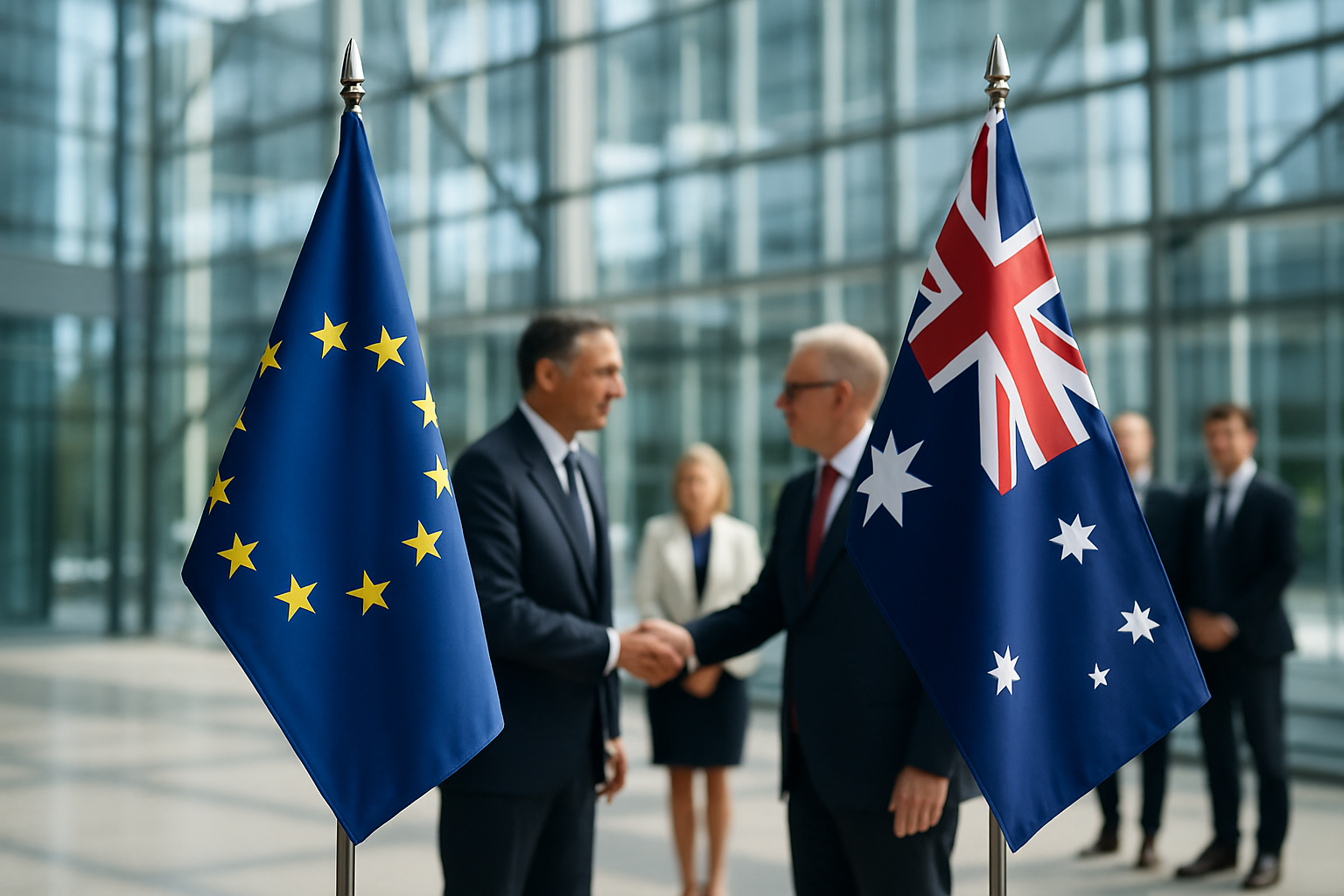
The European Union and Australia have officially completed their comprehensive free trade agreement after eight years of complex negotiations, eliminating tariffs on billions of dollars worth of goods annually while creating new opportunities for 475 million consumers across both regions.
The landmark deal, announced March 24, 2026, removes barriers for nearly all Australian critical minerals exports to Europe while providing enhanced market access for European goods to Australia's 26 million consumers. The agreement comes at a crucial time when global supply chains face unprecedented pressures and democratic nations seek to reduce dependencies on authoritarian regimes.
Consumer Benefits and Market Access
Australian households will see immediate benefits through reduced prices for European automobiles, machinery, chemicals, and pharmaceuticals. The tariff elimination particularly impacts the electric vehicle market, where Australian consumers have faced some of the world's highest EV prices due to import duties.
"This agreement eliminates tariffs for almost all European goods entering Australia," confirmed sources familiar with the negotiations. The deal also facilitates enhanced job mobility between regions, allowing skilled professionals easier access to employment opportunities across the expanded market.
For European consumers, the agreement provides access to Australian products at reduced costs, with the 450 million-person European market gaining preferential access to Australian agricultural products and raw materials.
Critical Minerals Strategic Partnership
Central to the agreement is an unprecedented critical minerals partnership addressing European supply chain vulnerabilities. Australia's lithium, cobalt, and rare earth element exports will face virtually no EU tariffs, directly challenging China's dominance in these sectors.
China currently controls approximately 60% of global production and 90% of refining capacity for essential materials used in renewable energy technologies, electric vehicles, and advanced electronics. The EU-Australia partnership aims to create alternative supply chains supporting Europe's green transition while reducing strategic dependencies.
"The minerals partnership is crucial for reducing Chinese supply chain dependence."
— European Commission sources
The arrangement aligns with broader international efforts, including the US-EU-Japan Critical Minerals Partnership encompassing 55 countries, to create resilient supply chains for democratic nations.
Agricultural Sector Mixed Results
While the overall agreement received praise, Australian meat exporters expressed significant disappointment with the final terms. Despite eight years of negotiations, Australian beef and sheep meat remain subject to export quotas that industry representatives describe as insufficient.
Agricultural groups criticized the "subpar" market access provisions, arguing that the limited quotas fail to reflect Australia's competitive advantages in livestock production. The restrictions represent a compromise with European agricultural interests concerned about increased competition.
However, the Belgian Businesses Federation welcomed the agreement for its export boost potential, indicating that European businesses see substantial opportunities in enhanced trade relations.
Parliamentary Approval Process
Implementation requires ratification by both the European Parliament and Australian federal parliament, potentially extending timelines before the agreement takes effect. European Parliament scrutiny will focus on environmental standards alignment, while Australian parliamentary concerns center on agricultural quota limitations.
The approval process reflects the comprehensive nature of the deal, which covers goods, services, investment protection, digital commerce, and environmental standards. Technical negotiations continue over specific implementation details, including digital trade provisions and dispute resolution mechanisms.
Strategic Geopolitical Context
The agreement represents part of European Commission President Ursula von der Leyen's broader "commercial trilogy" strategy, alongside agreements with South America and India, to accelerate EU global trade engagement and establish Europe as a "third pole" in international competition.
The timing proves significant as democratic nations seek to strengthen partnerships amid rising authoritarianism and supply chain vulnerabilities exposed during recent global crises. The deal demonstrates the EU's capacity to negotiate bilateral agreements while maintaining multilateral commitments.
Environmental and Sustainability Framework
Comprehensive sustainability chapters require adherence to Paris Agreement commitments and anti-deforestation measures. Environmental enforcement mechanisms ensure trade expansion supports climate objectives rather than undermining environmental protection.
The framework addresses European concerns about environmental standards in trade partnerships, establishing monitoring systems and compliance requirements that could serve as templates for future agreements.
Economic Impact and Market Integration
Brussels projects significant European investment growth potential through Australian market access, benefiting key European sectors including automotive, chemical, and pharmaceutical industries. The agreement creates market integration covering over 475 million people across both regions.
The deal's economic impact extends beyond traditional trade metrics, supporting technological cooperation, innovation partnerships, and educational exchanges that strengthen long-term economic relationships.
Template for Democratic Trade Partnerships
The EU-Australia agreement establishes a precedent for democratic trade partnerships that combine traditional commerce with strategic cooperation on supply chain security. The structure addresses 21st-century challenges including technological sovereignty, environmental protection, and economic resilience.
Success could influence broader European engagement in the Indo-Pacific region and provide a framework for future agreements balancing economic opportunities with strategic autonomy objectives. The template may guide negotiations with other developed democracies seeking alternatives to Chinese-dominated supply chains.
As implementation proceeds, the agreement's success in delivering promised benefits while maintaining environmental and social standards will determine its influence on international trade architecture in an increasingly complex global economy.