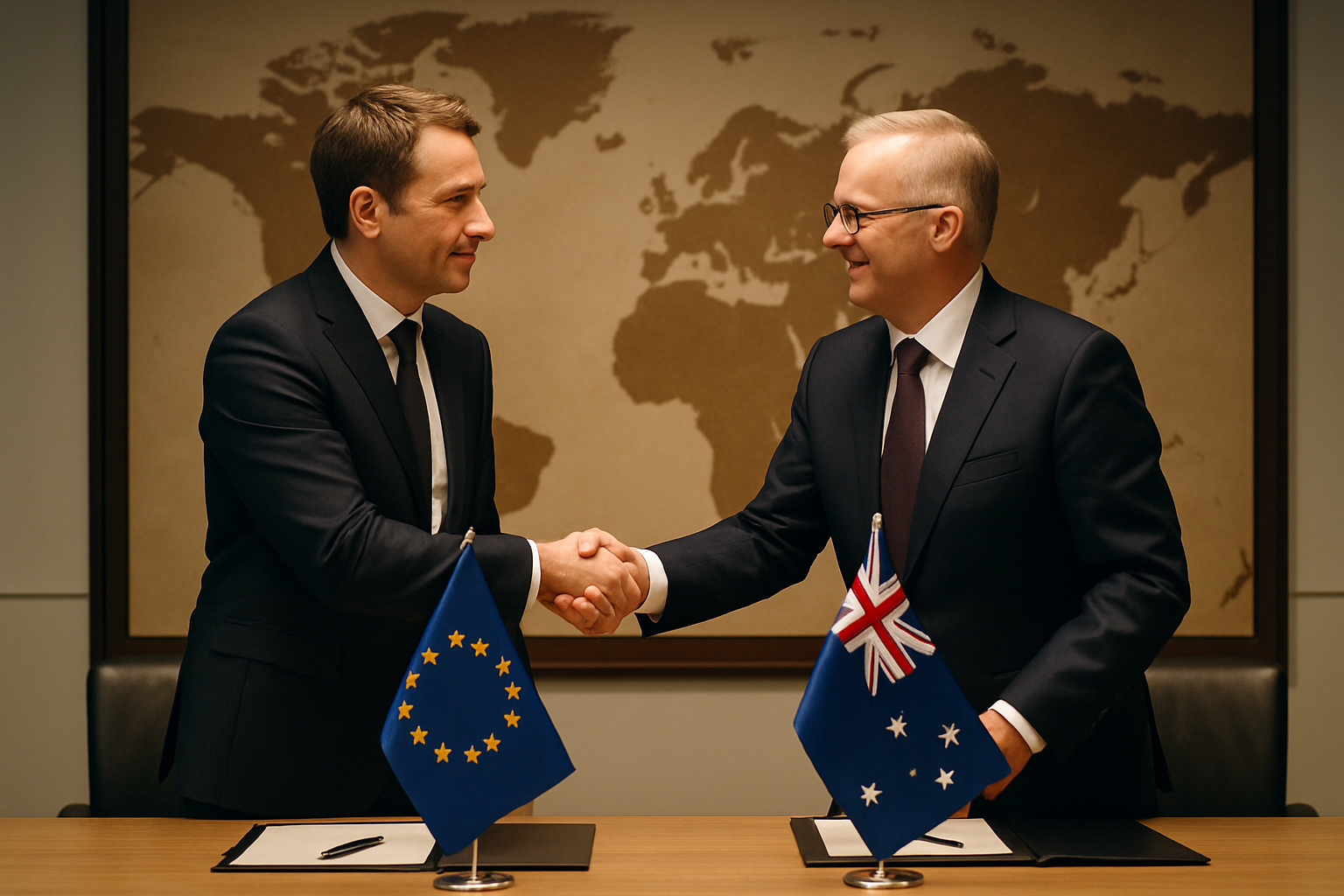
The European Union and Australia have reached a landmark free trade agreement after years of intensive negotiations, with European Commission President Ursula von der Leyen and Australian Prime Minister Anthony Albanese announcing the breakthrough deal on Tuesday.
The historic accord aims to boost bilateral trade and strengthen economic cooperation between the 27-member EU bloc and Australia, representing a significant milestone in the relationship between Europe and the Asia-Pacific region. The agreement addresses long-standing trade barriers and creates new opportunities for businesses and consumers on both sides.
Key Agreement Provisions
According to multiple sources, the deal will remove tariffs for almost all European goods entering Australia and eliminate barriers for nearly all exports of Australian critical minerals to European markets. This represents a comprehensive overhaul of the existing trade relationship, which has faced various restrictions and limitations over the years.
The final contentious issues that delayed the agreement included improved access for Australian lamb and beef to EU markets, as well as disputes over luxury taxes on European automobiles. These agricultural and automotive trade disputes had been among the most challenging aspects of the negotiations, requiring careful balance between protecting domestic industries and opening new market opportunities.
Strategic Context and Global Implications
The timing of this agreement is particularly significant given current global trade uncertainties and geopolitical tensions. Von der Leyen has positioned this deal as part of a "commercial trilogy" that Brussels has built in recent months to accelerate EU trade with the rest of the world, alongside agreements with South America and India.
This development comes amid efforts by both the EU and Australia to diversify their supply chains and address energy vulnerabilities linked to ongoing Middle East conflicts. The agreement reflects a broader strategic pivot toward strengthening democratic partnerships and reducing dependence on less reliable trading partners.
"This agreement will remove barriers that have hindered our economic relationship for too long, creating unprecedented opportunities for businesses and consumers in both regions."
— European Commission Official
Critical Minerals and Economic Security
One of the most strategically important aspects of the agreement involves Australia's critical minerals exports to Europe. This component addresses European concerns about supply chain vulnerabilities, particularly regarding materials essential for renewable energy infrastructure and technological development.
The deal provides the EU with improved access to Australian lithium, rare earth elements, and other critical minerals that are essential for Europe's green transition goals. This arrangement helps reduce European dependence on Chinese-dominated supply chains, which currently control approximately 60% of critical materials production and 90% of refining capacity globally.
Agricultural Market Access Breakthrough
After years of contentious negotiations, the agreement provides Australian agricultural exporters with enhanced access to European markets. The resolution of disputes over lamb and beef imports represents a significant compromise, balancing European agricultural protection concerns with Australian export interests.
For European exporters, the deal eliminates numerous Australian tariffs and reduces barriers for automotive exports, machinery, chemicals, and pharmaceutical products. This creates substantial new opportunities for European manufacturers to expand their presence in the Australian market.
Implementation Timeline and Challenges
The agreement will require approval through comprehensive parliamentary processes in both the EU and Australia, potentially extending implementation timelines. European Parliament approval is expected to be necessary, along with ratification by Australia's federal parliament.
Technical negotiations are continuing over specific details regarding digital trade provisions, environmental standards, and dispute resolution mechanisms. These ongoing discussions reflect the complexity of modern trade agreements, which must address not only traditional goods and services but also digital commerce, intellectual property, and sustainability standards.
Geopolitical Dimensions
The EU-Australia agreement strengthens democratic partnerships in the Indo-Pacific region amid expanding Chinese influence. This alignment supports broader strategic initiatives, including the US-EU-Japan Critical Minerals Partnership involving 55 countries aimed at reducing Chinese supply chain dependence.
The deal aligns with von der Leyen's "realistic" foreign policy approach, which emphasizes using trade agreements to support democratic partners while reducing dependencies on authoritarian regimes. This represents a significant evolution in European trade policy, moving toward more strategic and values-based economic partnerships.
Economic Impact Assessment
Trade experts estimate the agreement will eliminate tariffs on billions of euros worth of goods annually, providing European consumers with greater access to Australian products while offering Australian exporters access to the EU's 450 million consumers.
The comprehensive framework includes provisions for services trade, investment protection, digital commerce regulations, and environmental standards. These elements create a modern trade relationship template that addresses 21st-century economic challenges beyond traditional goods exchange.
Broader EU Trade Strategy
This agreement represents the latest success in the EU's accelerated trade agenda, following the controversial provisional implementation of the EU-Mercosur deal despite French opposition. The Australian agreement benefits from stronger internal EU consensus compared to the South American deal, which faced significant agricultural and environmental concerns.
Von der Leyen has emphasized that Europe can no longer be the "guardian of the old world order" and must pursue more assertive trade policies. The Australian deal demonstrates the EU's capacity to negotiate complex bilateral agreements while maintaining its commitment to multilateral frameworks and democratic values.
Next Steps and Future Prospects
Success of the EU-Australia agreement could serve as a template for other EU bilateral initiatives in the Asia-Pacific region, potentially including enhanced agreements with New Zealand, Singapore, and ASEAN member states. The deal's completion after years of technical obstacles represents a significant diplomatic achievement for both sides.
The agreement's implementation will be closely watched as a test of whether the EU can overcome institutional challenges to achieve breakthroughs that serve both immediate economic interests and long-term strategic objectives in an era of intensifying great power competition.
With 89% of Europeans demanding greater EU unity and 86% wanting a stronger global voice according to recent polling, the Australian agreement provides democratic legitimacy for ambitious trade initiatives that strengthen European autonomy while building partnerships with like-minded democracies worldwide.