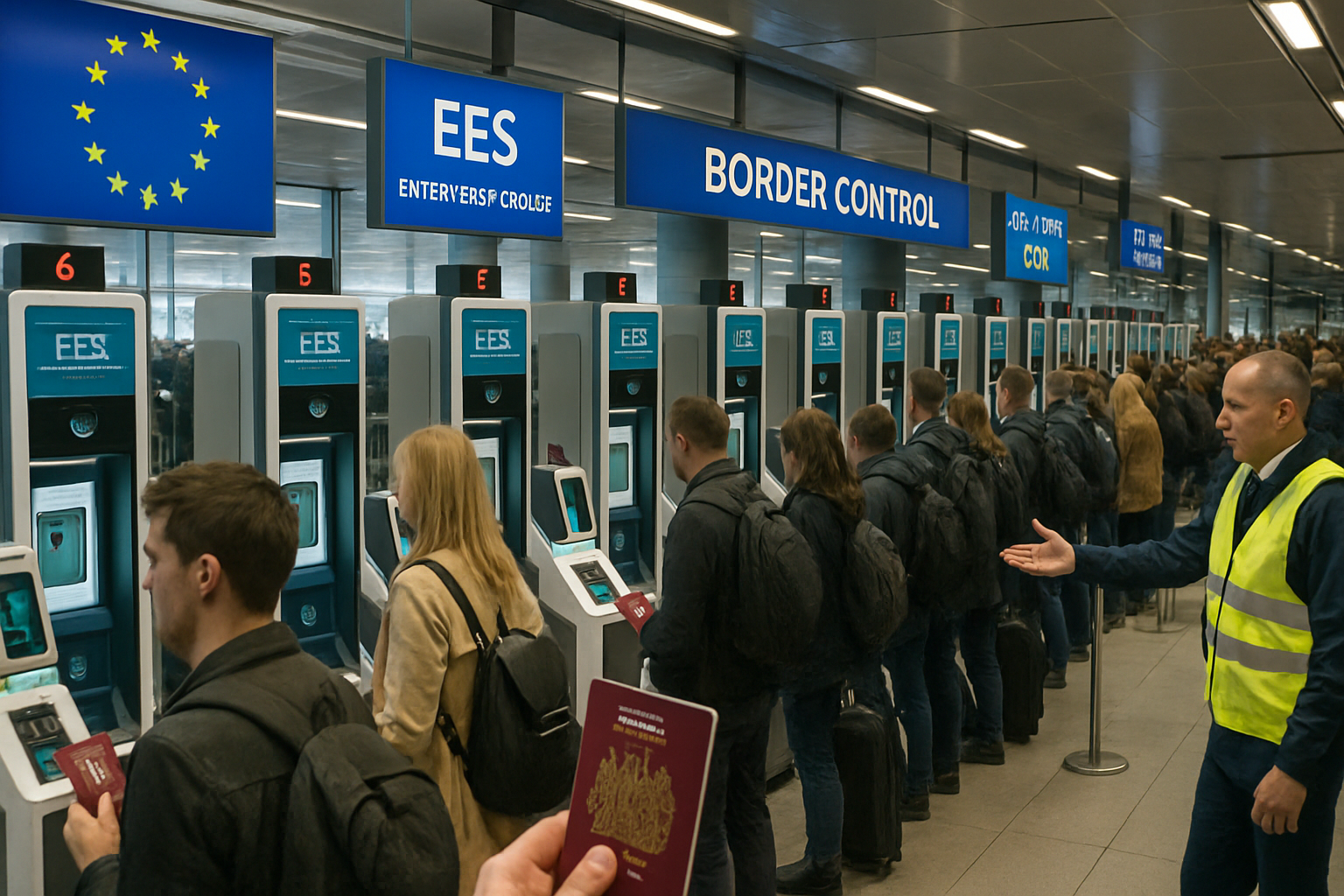
The British government has issued urgent warnings to UK tourists planning Easter travel to the Schengen area, alerting them to allow additional time for journeys as the European Union's new Entry/Exit border system (EES) reaches full implementation, creating unprecedented processing delays at major European entry points.
The comprehensive biometric border control system, which has been gradually rolled out across the Schengen zone since October 2025, represents the most significant transformation of European border management in decades. The system requires non-EU citizens to provide facial photographs, fingerprints, and detailed accommodation and payment information upon entry.
EES Success Shadowed by Operational Challenges
Despite achieving remarkable enforcement success—detecting over 4,000 visa overstayers in its first four months of operation, far exceeding initial expectations—the Entry/Exit System has created severe bottlenecks at Europe's busiest travel hubs. Aviation industry sources predict queue times could extend to four hours during peak summer travel periods, prompting the European Commission to authorize partial system suspensions during high-volume periods.
The system's effectiveness in identifying immigration violations has been unprecedented. Previously, tracking overstayers across EU member states was extremely challenging due to inconsistent data sharing and manual passport stamping procedures. The new biometric database creates a comprehensive record of non-EU movements, supporting both law enforcement operations and legitimate travel facilitation.
"This represents the largest border control technological transformation in decades, combining security imperatives with digital innovation capabilities"
— EU Border Management Official
Industry Warnings of Travel Chaos
European airlines have issued coordinated warnings about potential summer travel disruptions, with industry representatives from Spain, Germany, Italy, and France expressing serious concerns about system readiness for the millions of travelers expected during peak holiday seasons. Airlines have called for immediate EU action including expanded suspension provisions and enhanced passenger education programs.
The technical challenges are particularly acute at older European airports struggling to implement biometric processing requirements during high-volume periods. Infrastructure limitations have forced a careful balance between security objectives and practical processing capacity.
Current low-season operations have already revealed significant strain on the system, raising questions about capacity during peak travel periods when passenger volumes multiply dramatically. The tourism industry, still recovering from pandemic impacts, faces potential negative publicity that could undermine broader economic recovery efforts.
Digital Border Revolution Across Europe
The EES implementation is part of a broader European digital border management revolution. The United Kingdom has simultaneously implemented its own Electronic Travel Authorization (ETA) system, requiring €16 digital applications from all European visitors, effectively ending decades of freedom of movement privileges for EU citizens traveling to Britain.
This parallel development has created a complex web of new digital requirements for cross-channel travel. British dual nationals now face £589 "certificate of entitlement" fees to enter the UK using non-British passports, prompting widespread passport renewal requests at embassies globally and consideration of citizenship renunciation among British expatriates.
Broader Immigration Policy Transformation
These technological developments occur within a dramatically shifting European immigration landscape. In February 2026, the European Parliament approved historic asylum procedure changes allowing deportation to "safe" third countries through a coalition of center-right and far-right parties, representing a fundamental shift from protection-based to deterrence-focused policies.
Enhanced cooperation mechanisms have enabled smaller groups of EU member states to advance controversial policies without unanimous consent, bypassing traditional humanitarian safeguards. Greece now leads a coalition with Germany, Netherlands, Austria, and Denmark to establish external processing centers in Africa for rejected asylum seekers whose home countries refuse readmission.
This policy evolution reflects broader European concerns about migration management, with 89% of Europeans demanding greater EU unity while 72% express border security concerns according to recent Eurobarometer polling. The demographic challenge of aging populations creates ongoing tension between migration restrictions and economic labor needs.
Climate Displacement Pressures
The border control transformation comes as climate displacement pressures intensify dramatically. March 2026 marked the 19th consecutive month of global temperatures exceeding 1.5°C above pre-industrial levels—the longest sustained warming streak in recorded history. This unprecedented environmental pressure is expected to generate new displacement patterns that will test the sustainability of current restrictive immigration approaches.
European policymakers face the challenge of managing both immediate operational constraints of new border technologies and longer-term pressures from climate-induced migration that could overwhelm current capacity regardless of technological sophistication.
Economic Contradictions and Labor Market Realities
The restrictive policy trajectory creates significant economic contradictions. While implementing increasingly stringent border controls, European countries face severe labor shortages in healthcare, agriculture, and construction sectors. Albania's success in integrating 27,000 foreign nationals to address workforce gaps contrasts sharply with restrictive approaches elsewhere.
The UK's emergency visa restrictions for Afghanistan, Cameroon, Myanmar, and Sudan nationals—citing a 470% surge in asylum applications from students between 2021-2025—threatens billions in international education revenue and risks damaging academic partnerships that have taken decades to build.
"We're seeing systematic abuse of legal migration channels leading to asylum claims, requiring immediate intervention"
— UK Home Secretary Shabana Mahmood
Technology Implementation Challenges
Despite the enforcement successes, the EES implementation faces significant technological hurdles. Global semiconductor shortages have driven memory chip prices up sixfold, affecting control system deployments and creating implementation delays until 2027 when new fabrication facilities come online.
The digital-first approach requires internet access and technological literacy, creating barriers for some travelers while potentially streamlining processes for others. Uneven enforcement across entry points has created traveler uncertainty, highlighting the need for standardized procedures continent-wide.
Processing delays during peak tourism seasons mirror similar challenges faced during the European Commission's approach to other digital initiatives, suggesting industry-wide difficulties in managing the transition to comprehensive digital border management.
International Monitoring and Global Implications
International observers are closely monitoring the European external processing and biometric border control experience as potential templates for other developed democracies managing complex migration flows. The success or failure of these approaches will influence international migration management strategies for decades to come.
Human rights organizations are preparing legal challenges to external processing arrangements, citing concerns about non-refoulement violations and departures from traditional asylum protection principles established after World War II. Constitutional challenges are expected in multiple jurisdictions regarding the balance between border security and humanitarian obligations.
Strategic Implications for Democratic Border Management
March 2026 represents a watershed moment in European migration governance, with policy decisions affecting humanitarian principles, democratic values, and international cooperation frameworks for years ahead. The enhanced cooperation precedent could reshape EU decision-making on other sensitive issues, enabling smaller member groups to advance policies without traditional consensus requirements.
The convergence of technological enforcement capabilities, restrictive policy frameworks, and mounting climate displacement pressures creates an unprecedented complex landscape that will influence migration patterns and international relations for decades. Democratic institutions face critical tests in maintaining humanitarian commitments while adapting to 21st-century migration realities.
Success in balancing security objectives with legitimate travel facilitation will determine whether Europe's approach becomes a model for other regions or a cautionary tale about the limits of technological solutions to complex humanitarian challenges. The coming months will provide crucial data on whether democratic border management can evolve to meet contemporary challenges while preserving fundamental values.
As Easter travelers prepare for potentially lengthy delays, they become unwitting participants in one of the most significant experiments in democratic border control in modern European history—an experiment whose outcomes will resonate far beyond the holiday season.