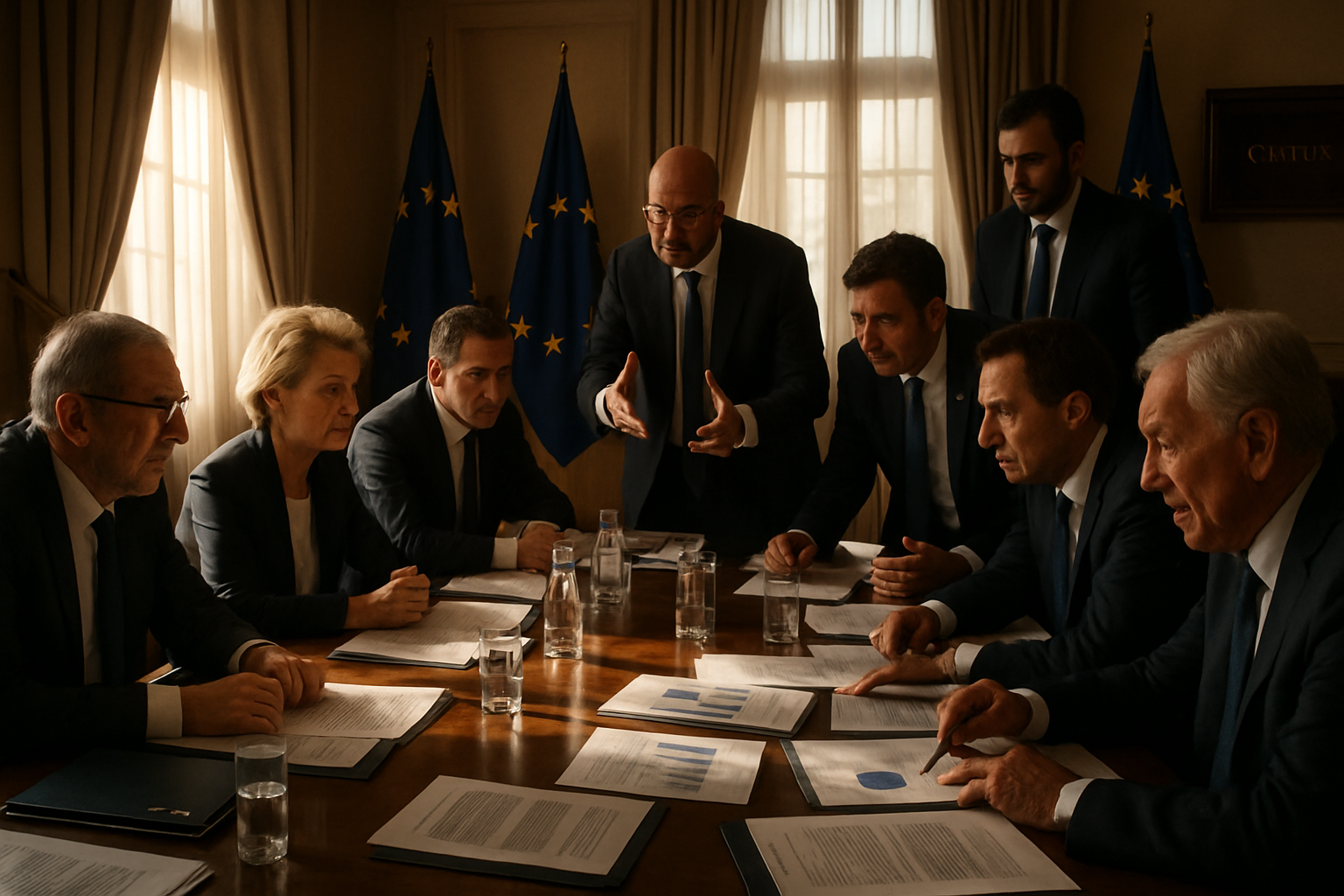
European Union leaders meeting in Nicosia, Cyprus have revealed sharply divergent positions on the next Multiannual Financial Framework, with Germany ruling out increased debt and European bonds while other member states push for more ambitious responses to mounting energy and security challenges across the continent.
The informal European Council summit, taking place during Cyprus's EU presidency in the first half of 2026, has become a critical juncture for determining Europe's fiscal and defense trajectory as the bloc faces unprecedented security pressures from multiple fronts.
Germany Rejects Increased EU Borrowing
German Chancellor Friedrich Merz delivered a firm stance against expanding EU debt mechanisms, declaring that "from Germany's perspective, increasing debt is out of the question, and European bonds on the capital market are also out of the question." Merz acknowledged that not all colleagues shared his view but insisted that Europe must manage with available resources while setting new priorities and reducing spending in other budget areas.
This position puts Germany at odds with several member states who argue that the scale of current challenges—from defense modernization to energy transition—requires unprecedented financial commitments that cannot be met through traditional budget reallocations alone.
Von der Leyen Calls for New Resources
European Commission President Ursula von der Leyen has taken a markedly different approach, arguing that additional revenue sources are indispensable for the EU budget. "Without additional revenue, there would be less Europe when more is needed," von der Leyen stated, emphasizing that current funding mechanisms are insufficient to address the continent's expanding responsibilities.
Von der Leyen's comments reflect growing recognition within EU institutions that traditional budget constraints may be incompatible with Europe's ambitions for strategic autonomy and enhanced defense capabilities. However, she has ruled out suspension of fiscal rules, noting that "suspension only in severe economic circumstances" and "this is not the case, but we are monitoring" the situation.
Enhanced Cooperation Mechanisms Under Discussion
With unanimity proving elusive on major fiscal issues, EU leaders are increasingly exploring enhanced cooperation mechanisms that would allow willing member states to proceed without requiring consensus from all 27 members. This approach has proven successful with initiatives like the European Public Prosecutor's Office and PESCO defense cooperation.
Recent Eurobarometer polling shows 89% of Europeans demanding greater EU unity, providing political mandate for more ambitious integration across defense, energy, technology, and climate policy. However, translating this public support into concrete policy implementation faces significant institutional and fiscal constraints.
Defense Spending Pressures Mount
The budget debates occur against a backdrop of dramatically increased defense spending requirements. All 32 NATO members achieved the historic milestone of reaching the 2% GDP defense spending target for the first time in the alliance's 75-year history, with combined spending reaching $1.4 trillion—a 6% increase. Poland leads at 4.3% of GDP, while the final five nations (Spain, Portugal, Albania, Belgium, and Canada) have had to more than double their military budgets in some cases.
European strategic autonomy has moved from aspiration to concrete reality following recent security crises. The Iranian drone attacks on RAF Akrotiri in Cyprus—the first attack on European territory since World War II—prompted an unprecedented four-nation naval coalition response within hours, demonstrating Europe's capacity for independent territorial defense.
Italian Position on Fiscal Flexibility
Italian Prime Minister Giorgia Meloni has emerged as a leading voice for fiscal flexibility, particularly regarding energy-related expenditures. Meeting bilaterally with Chancellor Merz, Meloni has emphasized "the will to come together" while maintaining that energy security requires some relaxation of fiscal constraints.
Italy's position reflects broader concerns among Mediterranean nations that rigid fiscal rules may be counterproductive during periods of external energy and security shocks. The energy crisis stemming from Middle East conflicts has exposed European vulnerabilities and the potential costs of under-investment in strategic autonomy.
Cyprus's Strategic Role
Cyprus's position as summit host carries particular significance given the island's recent experience managing crisis situations. The activation of the ESTIA evacuation plan during the Iranian attacks demonstrated Cyprus's crisis management capabilities and enhanced its credibility as a diplomatic venue for high-stakes negotiations.
The Mediterranean location provides strategic advantages for broader regional diplomacy while offering a more relaxed atmosphere for intensive bilateral discussions away from Brussels protocol constraints. Cyprus President Nikos Christodoulides has used this opportunity to advance both EU business and bilateral relationships with member state leaders.
Energy Security and Budget Implications
The budget discussions cannot be separated from Europe's energy security challenges. Recent oil price volatility, with Brent crude reaching over $100 per barrel during Middle East tensions, has exposed the fiscal implications of energy dependencies. Natural gas prices surged 24% in Europe during the recent crisis, directly impacting household budgets and industrial competitiveness.
This energy vulnerability strengthens arguments for increased EU investment in renewable energy infrastructure, strategic petroleum reserves, and enhanced energy interconnections—all of which require substantial budget commitments that traditional fiscal frameworks may struggle to accommodate.
Divisions Over European Bonds
The debate over European bonds represents a fundamental disagreement about the EU's fiscal architecture. Proponents argue that joint debt instruments are essential for financing large-scale strategic investments in defense, energy, and digital infrastructure. They point to the success of the NextGenerationEU recovery fund as evidence that European bonds can mobilize resources effectively while maintaining fiscal discipline.
Critics, led by Germany, worry about moral hazard and the precedent of joint debt instruments that could lead to unsustainable fiscal expansion. They prefer a combination of national fiscal responsibility and targeted EU programs funded through traditional own resources and limited borrowing mechanisms.
Southern European Perspective
Mediterranean member states have generally supported more flexible fiscal approaches, reflecting their experience with economic volatility and external shocks. Spain, having faced unique challenges including the closure of airspace to US military aircraft during Middle East operations, argues that rigid fiscal rules can undermine effective crisis response.
The Spanish position emphasizes that "Europe needs to be more ambitious" in responding to energy crises and security challenges, even if this requires innovative financing mechanisms that stretch traditional fiscal orthodoxy.
Future Implications
The outcome of these budget and defense spending debates will fundamentally shape Europe's trajectory for the remainder of the decade. Success in finding compromise solutions could strengthen European strategic autonomy and crisis management capabilities. Failure risks fragmenting European responses to common challenges and undermining public confidence in EU institutions.
The stakes extend beyond immediate budget numbers to questions of European sovereignty, democratic governance principles, and the EU's ability to adapt institutional frameworks to 21st-century challenges. As one senior EU official noted, Europe is "writing the template for 21st-century crisis management" with the world watching whether democratic institutions can preserve European values while adapting to an increasingly complex security environment.
The coming weeks will be decisive in determining whether European leaders can bridge their differences on fiscal policy while maintaining the unity necessary to address unprecedented security challenges. The success or failure of these negotiations will influence European governance, international cooperation frameworks, and continental security arrangements for decades to come.