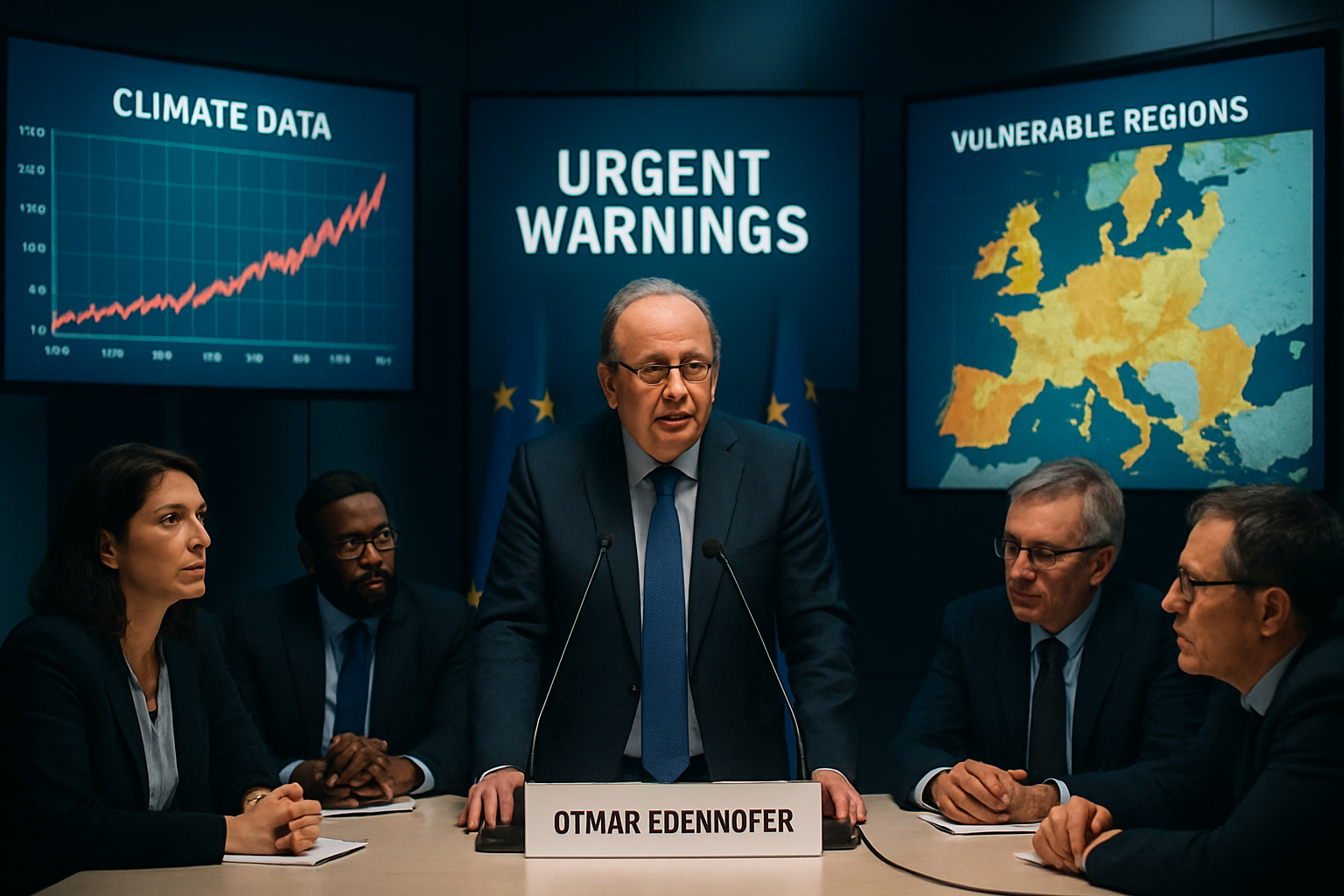
Climate experts across Europe are issuing unprecedented warnings that the European Union is critically unprepared for the rapidly escalating impacts of climate change, demanding immediate acceleration of adaptation measures as the continent faces its most challenging weather period in decades.
The alarm bells come from multiple European climate authorities, with the European Scientific Advisory Council on Climate Change leading calls for urgent action. "Extreme meteorological and climate phenomena are already causing severe losses across Europe," declared Otmar Edenhofer, chairman of the European Scientific Advisory Council on Climate Change, in a newly published report.
The warnings arrive as Europe endures an extraordinary succession of severe weather events that have killed more than 16 people across Portugal, Spain, and France during February 2026 alone. The continent has experienced four consecutive major Atlantic storms - Kristin, Leonardo, Marta, and Nils - representing the most intensive winter weather crisis in living memory.
Unprecedented Weather Devastation Exposes Vulnerabilities
The scale of the current crisis is staggering. Portugal has deployed 26,500 emergency personnel in what officials describe as the largest peacetime rescue operation in the nation's history. The deployment includes 1,975 military personnel and 30 naval vessels responding to over 1,800 weather incidents since the beginning of February.
Critical infrastructure has suffered catastrophic failures. The collapse of the A1 highway viaduct near Coimbra from Mondego River flooding has severed the crucial Lisbon-Porto corridor, with repair timelines extending "several weeks" according to Infrastructure Minister Miguel Pinto Luz. Transportation networks across the continent face unprecedented disruption, with 116 roads closed in Spain alone due to flooding and snow conditions.
The European Union has activated its Civil Protection Mechanism in response to the crisis, while Sweden and Denmark have committed €246 million in assistance - representing the largest coordinated European weather response in recent history.
Climate Scientists Sound Urgent Alarm
The current crisis occurs against a backdrop of accelerating global warming that has fundamentally altered Earth's climate systems. January 2026 marked the hottest month in recorded history - the 18th consecutive month to exceed 1.5°C above pre-industrial levels. This unprecedented warming has overridden natural climate variability, including La Niña cooling effects.
European climate experts emphasize that extreme heat events alone have led to tens of thousands of premature deaths across the continent. The European Scientific Advisory Council's report warns that coordination efforts across the entire bloc must be significantly improved to address the mounting challenges.
Norwegian climate authorities echo these concerns, with reports indicating that the EU is insufficiently prepared for climate change impacts and must do more to protect member states from escalating damage.
Infrastructure and Economic Vulnerabilities
The current weather emergency has exposed critical vulnerabilities in European infrastructure systems designed for historical rather than future climate conditions. Transportation networks, power grids, and communication systems are operating at capacity limits, with traditional mutual aid mechanisms strained by simultaneous disasters across multiple nations.
Economic impacts are mounting into the billions across agricultural, tourism, and infrastructure sectors. Spanish reservoirs have surged to 67.3% capacity, with 31 reservoirs at 100% capacity, while agricultural losses in olive groves and citrus farms across the Iberian Peninsula are reaching catastrophic levels.
The crisis has particularly affected France, where 450,000 households lost power during Storm Nils - representing one of the largest weather-related electrical disruptions in recent French history. Emergency services received over 1,600 calls for assistance with fallen trees and debris as wind gusts exceeded 162 km/h in western regions.
Supply Chain Dependencies Compound Risks
European Union auditors have previously warned that climate goals are threatened by critical raw materials shortages and dangerous dependence on China, which controls 60% of global production and 90% of global refining capacity for essential materials including lithium, cobalt, and rare earth elements necessary for renewable energy infrastructure.
These supply chain vulnerabilities compound the adaptation challenge, as Europe seeks to accelerate its green transition while building resilience against extreme weather events. The intersection of climate adaptation needs with geopolitical supply chain risks creates a complex policy landscape requiring unprecedented coordination.
Regional Responses and European Solidarity
Despite the challenges, the crisis has demonstrated European solidarity mechanisms in action. The activation of the EU Civil Protection Mechanism and the substantial Swedish-Danish assistance package represent the kind of coordinated response that climate experts argue must become standard operating procedure.
Individual member states are pursuing various adaptation strategies. Estonia has achieved remarkable progress with 88% renewable electricity and Europe's largest battery storage facility capable of serving 90,000 households, providing a model for grid resilience during extreme weather.
However, the current crisis reveals that such individual efforts, while commendable, remain insufficient without comprehensive EU-wide coordination and dramatically increased investment in climate adaptation infrastructure.
Democratic Resilience Under Pressure
The climate crisis is creating new challenges for European democratic governance. Portugal's recent presidential election proceeded despite the weather emergency, though 36,000 voters were unable to participate due to the crisis conditions. This "climate-democracy intersection" represents a new dimension of governance challenges that European leaders must address.
The scale and frequency of extreme weather events are testing the capacity of democratic institutions to maintain effective governance while responding to multiple simultaneous crises. Emergency services operating at capacity limits require new approaches to resource allocation and international coordination.
The Path Forward: Transformation vs. Reactive Management
Climate scientists and policy experts emphasize that Europe faces a fundamental choice between reactive crisis management and transformative adaptation approaches. The current model of responding to disasters as they occur is proving inadequate for the new reality of frequent, intense extreme weather events.
Experts argue for "build back better" climate-resilient infrastructure that can withstand the conditions expected in the 2030s rather than merely restoring systems designed for historical climate patterns. This requires unprecedented coordination across member states, sectors, and governance levels.
The warnings from climate experts represent more than technical assessments - they constitute a call for fundamental transformation in how Europe approaches climate adaptation. The current crisis may serve as a watershed moment, forcing European leaders to choose between gradual institutional evolution and the rapid transformation necessary for 21st-century climate survival.
International Implications
Europe's climate adaptation challenges have global implications. As a major economic bloc and climate policy leader, the EU's success or failure in building climate resilience will influence approaches worldwide. The current crisis occurs as other regions face similar challenges, from severe weather in New Zealand to ongoing climate impacts across multiple continents.
The European experience provides critical lessons for international climate adaptation strategies. The combination of extreme weather events, infrastructure vulnerabilities, supply chain dependencies, and democratic governance challenges creates a complex adaptation landscape that other regions must navigate.
As climate experts continue to sound the alarm about insufficient preparation, European leaders face mounting pressure to accelerate adaptation measures. The stakes extend beyond immediate weather responses to fundamental questions about societal resilience in an era of accelerating climate change.
The current crisis represents both a warning and an opportunity - a chance for Europe to demonstrate that democratic societies can adapt effectively to climate challenges while maintaining social cohesion and economic prosperity. The choices made in coming months may determine not only Europe's climate future but provide templates for global climate adaptation in the decades ahead.