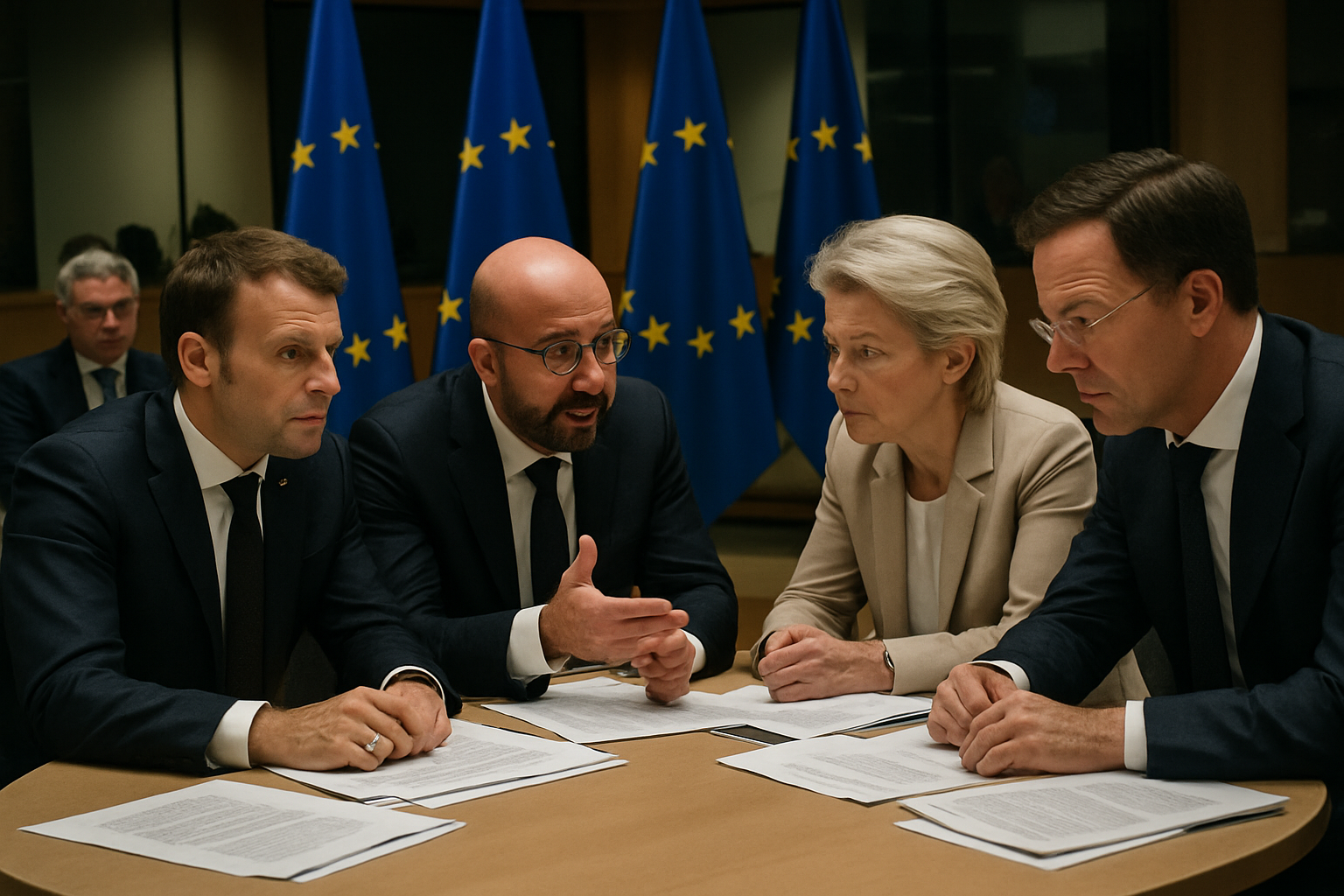
European Union leaders converge on Brussels Thursday facing the bloc's most serious internal crisis since its formation, as mounting pressure over ambitious climate policies collides with Hungarian Prime Minister Viktor Orbán's continued obstruction of a historic €90 billion Ukraine aid package amid escalating Middle East conflicts that have sent global energy markets into chaos.
The convergence of crises represents a perfect storm testing the fundamental principles of European integration, democratic solidarity, and multilateral governance at a moment when the continent faces its greatest security challenges since World War II.
Climate Policy Rebellion Reaches Critical Point
At the heart of the current turmoil lies an unprecedented rebellion against the EU's cornerstone climate policy - the Emissions Trading System (ETS) that has served as the foundation for European decarbonization efforts. Faced with soaring energy costs that have pushed oil prices above $100 per barrel for the first time since 2022, several member states are openly questioning the wisdom of maintaining stringent carbon pricing mechanisms.
French sources reveal that leaders of the Twenty-Seven are increasingly tempted to weaken or suspend the CO2 quota trading system, which has been the keystone of European decarbonization efforts. The system, which puts a price on carbon emissions to incentivize cleaner energy transitions, faces its most serious political challenge since implementation.
The rebellion has found unlikely allies across traditional political divides. Italian Prime Minister Giorgia Meloni, alongside Energy Minister Gilberto Pichetto Fratin and Industry Minister Adolfo Urso, has repeatedly called for suspending the European Union Emissions Trading System, arguing that carbon pricing mechanisms are imposing unsustainable costs on European businesses.
This pressure comes as the European Parliament recently approved a historic 90% greenhouse gas emissions reduction target by 2040 compared to 1990 levels - the most ambitious climate commitment by any major economic bloc. The legislation, passed with 413 votes in favor and 226 against, includes flexibility mechanisms such as international carbon credits and forest-based emissions compensation, but critics argue even these concessions are insufficient given current economic pressures.
Hungarian Obstruction Tests European Unity
Running parallel to the climate policy crisis is Viktor Orbán's systematic obstruction of EU decision-making processes, most notably his blocking of the €90 billion loan package to Ukraine - the largest EU financial assistance package ever approved for a single nation. The Hungarian Prime Minister has maintained this blockade for weeks over a dispute concerning the Druzhba oil pipeline.
Hungarian Foreign Minister Péter Szijjártó has made clear that Budapest will maintain its veto until Ukraine restores Russian oil transit through the Druzhba pipeline, which has been offline since late January. Hungary accuses Ukraine of deliberately manipulating oil supplies as "political blackmail," while Ukraine maintains the pipeline was damaged in Russian attacks requiring repairs.
The crisis has exposed fundamental vulnerabilities in European energy architecture. Hungary and Slovakia remain the only EU countries still dependent on Russian oil under special exemptions granted during the initial sanctions packages. Slovakia has already declared an oil emergency and released 250,000 tons of strategic reserves, representing one month of capacity for the Slovnaft refinery.
Lithuania's Foreign Minister Kestutis Budrys captured European frustration succinctly: "EU cannot become Budapest's hostage." This sentiment reflects growing impatience with Hungary's pattern of using unanimity requirements to extract concessions on unrelated issues.
Middle East Chaos Compounds European Woes
The EU's internal divisions have been dramatically amplified by external shocks from the Middle East, where escalating conflicts have created the worst global energy crisis since the 1970s. Iran's closure of the Strait of Hormuz, which handles 40% of global seaborne oil transit, has created a single-point failure in modern logistics that European leaders had long feared.
Spanish sources report that EU leaders are preparing to definitively reject Trump administration demands for European involvement in Middle East military operations, with the bloc positioning itself to "slam the door" on American pressure while clinging to multilateralism. As one Spanish official put it: "This is not Europe's war."
The energy crisis has forced European nations into emergency measures. Natural gas prices have exploded 24% across Europe, reaching €47.32/MWh - the highest levels since February 2025. Sweden predicts electricity increases of 10-20 öre and gasoline increases of 1-2 kronor, with the Malmö region particularly exposed due to continental integration.
The International Energy Agency has responded with the largest strategic petroleum reserve release in its 50-year history - 400 million barrels from 32 countries, double the response to the 2022 Ukraine crisis. Yet even this unprecedented coordinated action appears insufficient to stabilize markets.
Democratic Governance Under Strain
The convergence of these crises has pushed European democratic governance mechanisms to their breaking point. Enhanced cooperation discussions are accelerating as a means to bypass Hungary's systematic use of unanimity requirements, potentially representing the most fundamental shift in EU decision-making processes since the bloc's founding.
Swedish sources reveal growing anxiety about whether Viktor Orbán will "back down" again, as he has in previous confrontations, or whether this represents a more fundamental challenge to European integration. The Hungarian Prime Minister faces unprecedented electoral vulnerability with April 2026 elections approaching - the first time since 2010 that his Fidesz party is trailing opposition coalitions in polling.
European Commission President Ursula von der Leyen has acknowledged this unprecedented moment, declaring that Europe can no longer be "guardian of the old world order" and must adopt a "realistic" foreign policy approach. Her statement that the international rules-based system "has disappeared and will not return" marks a watershed in European strategic thinking.
Energy Architecture Transformation Imperative
The crisis has accelerated discussions about fundamental transformation of European energy architecture. Estonia's model - achieving 88% renewable electricity with continental Europe's largest battery storage facility serving 90,000 households - provides one template, but the transition timeline remains measured in decades rather than months.
Nuclear power has emerged as an increasingly attractive option for providing stable baseload electricity without dependence on volatile geopolitical regions. Hungary's Paks II nuclear project, representing a €39.1 billion investment and Europe's largest nuclear construction project, exemplifies this trend toward energy sovereignty through atomic power.
However, the transformation comes with significant challenges. EU auditors warn that climate goals are threatened by critical materials crises - China controls 60% of global production and 90% of refining capacity for lithium, cobalt, and rare earth elements essential for renewable energy infrastructure.
Diplomatic Innovation vs. Traditional Frameworks
The crisis occurs against the backdrop of major diplomatic initiatives that are testing traditional multilateral frameworks. Trump administration peace efforts, including the Board of Peace Council and June 2026 deadline for Ukraine-Russia negotiations, represent attempts at "business approach" diplomacy that bypass established UN mechanisms.
Yet even these innovative approaches face fundamental obstacles. The indefinite postponement of trilateral Ukraine-Russia-US negotiations due to the Iran crisis demonstrates how interconnected regional conflicts complicate resolution efforts in an increasingly multipolar world.
European leaders find themselves caught between maintaining principled support for international law and territorial sovereignty while managing practical pressures from energy costs, economic competitiveness, and domestic political constraints.
Stakes for European Integration
The outcome of Thursday's Brussels summit will have implications extending far beyond immediate policy decisions. Success in maintaining European unity while delivering promised aid to Ukraine would strengthen the union's credibility as a global actor capable of effective crisis management.
Failure, however, could signal broader fragmentation in the face of external pressure, undermining the democratic solidarity that has been the foundation of European integration since the post-war period.
The European Parliament's recent polling shows that 89% of Europeans demand greater EU unity and 86% want a stronger global voice, yet the reality of decision-making mechanisms designed for a different era continues to frustrate collective action during crises.
Long-term Implications
As European leaders gather in Brussels, they face choices that will define the continent's trajectory for decades. The window for effective climate action continues to narrow - January 2026 marked the 20th consecutive month of global temperatures exceeding 1.5°C above pre-industrial levels, the longest sustained warming streak in recorded human history.
Simultaneously, the war in Ukraine enters its fifth year with Russian territorial gains accelerating and systematic attacks on civilian infrastructure continuing despite diplomatic efforts. The €90 billion aid package represents not just financial assistance but European commitment to the principles of territorial sovereignty and democratic governance.
The resolution of Hungary's blockade, the future of EU climate policy, and Europe's response to Middle East-driven energy chaos will determine whether the European Union can adapt its institutional mechanisms to 21st-century challenges while preserving the democratic values and multilateral principles that define its identity.
As one senior EU official noted privately: "This is not just about policy - it's about whether democratic governance can function effectively in a multipolar world where authoritarian powers routinely violate international law and use economic interdependence as a weapon."
The answers emerging from Brussels this week will influence not only European integration but the broader question of whether democratic institutions can maintain effectiveness and legitimacy in an era of accelerating global challenges and increasing authoritarian pressure.