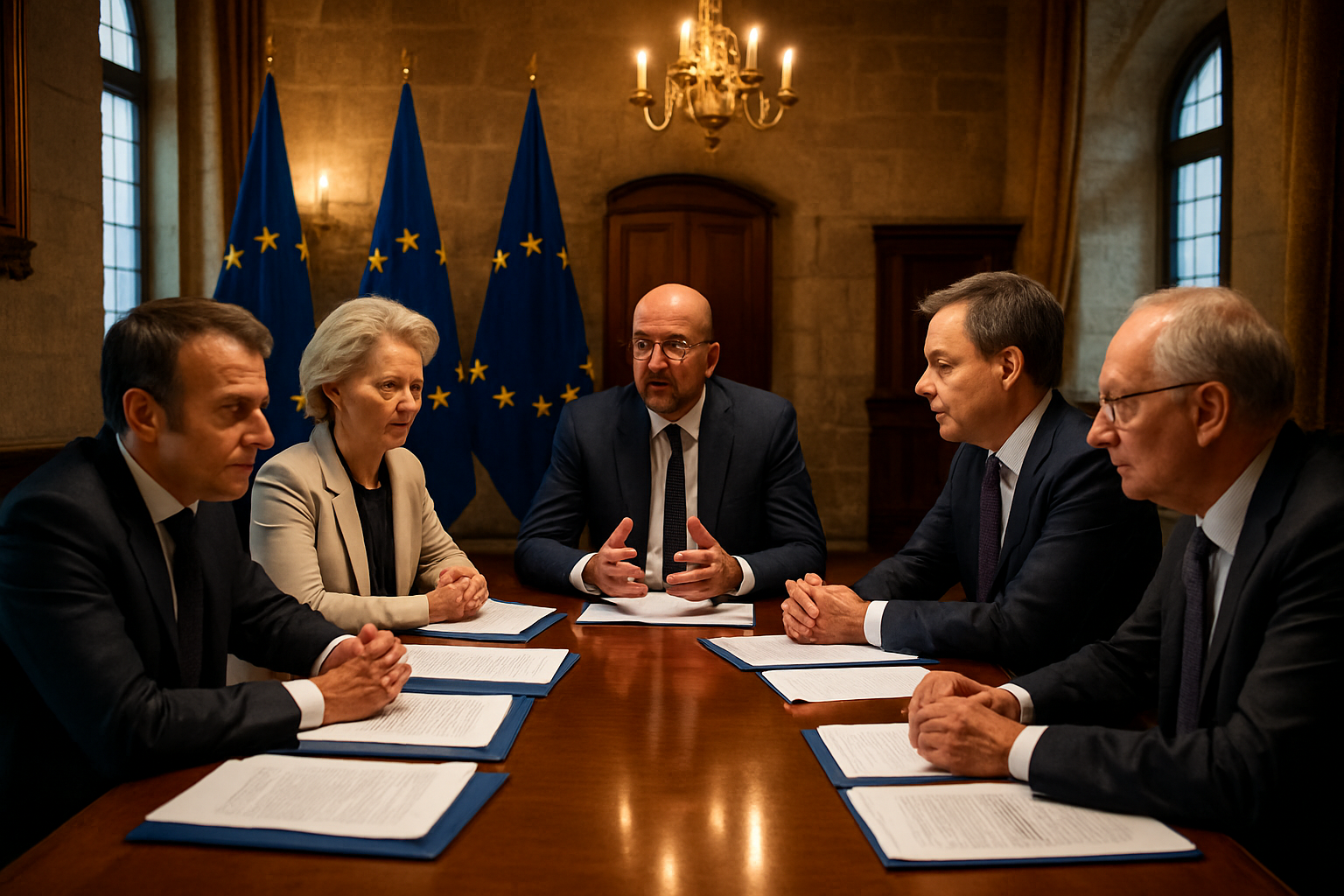
European Union leaders convened Thursday in Belgium for an emergency summit addressing what officials are calling the bloc's most severe competitiveness crisis since its inception, as the 27-nation union confronts simultaneous pressures from President Donald Trump's aggressive trade policies and China's economic expansion.
The high-stakes gathering at a Belgian castle represents a watershed moment for European economic strategy, with leaders acknowledging that incremental reforms are insufficient to counter existential threats to the bloc's economic sovereignty. European Commission President Ursula von der Leyen has positioned competitive reform as the "new line of defense" against what officials describe as coordinated economic pressure from both Washington and Beijing.
Crisis Triggers Unprecedented Unity
The summit follows months of mounting pressure that has transformed European attitudes toward economic integration. Portuguese Prime Minister António Costa has called for an immediate "political impulse," while French President Emmanuel Macron advocates for an economic "big bang" to accelerate stagnant growth that has plagued the eurozone for over a decade.
Romanian analysis reveals the depth of the challenge: European leaders are pursuing the elimination of internal barriers, reduction of administrative burdens, and protection of "Made in Europe" products as the continent faces what officials describe as "acerbic competition from China and unbridled American hyperpower."
Slovak officials emphasize that EU leaders are focusing on strengthening competitiveness and reducing strategic dependencies on third countries, with particular attention to regulatory framework reforms and single market barrier removal.
Trump's Trade War Escalation
The summit occurs amid Trump's systematic campaign to reshape global trade relationships through bilateral agreements and targeted sanctions. Recent developments include expanded Argentina beef imports (500% increase), lifted penalty tariffs on India, and threats of 25% tariffs against Iran's trading partners.
European officials express particular concern about Trump's "America First" approach, which has already resulted in significant trade disruptions. The administration's withdrawal from multilateral frameworks in favor of bilateral negotiations has left European exporters facing uncertainty about future market access.
Swedish analysis highlights European infrastructure dependence on American cloud services (AWS, Microsoft Azure, Google Cloud), creating what officials describe as "kill switch" vulnerabilities that could be exploited during trade disputes.
Chinese Economic Aggression Intensifies
Simultaneously, European leaders confront China's systematic campaign to dominate global supply chains, particularly in critical materials essential for the green transition. EU auditors warn that climate goals are threatened by China's control of 60% of critical mineral production and 90% of refining capacity for lithium, cobalt, and rare earth elements.
The challenge extends beyond raw materials to advanced manufacturing, where Chinese companies are increasingly competing with European firms in traditionally strong sectors including automotive, renewable energy, and telecommunications.
Memory from recent EU sanctions packages reveals the complexity of European responses to authoritarian regimes, with the 20th sanctions package against Russia demonstrating both European resolve and the challenges of coordinating policy across 27 member states.
Internal Barriers Hamper European Response
European competitiveness suffers from internal fragmentation that provides advantages to more unified competitors. The single market, despite decades of integration, remains incomplete with regulatory barriers that increase costs and reduce efficiency compared to unified American and Chinese markets.
Lithuanian officials note that European leaders must address fundamental structural problems while managing external pressures, requiring unprecedented coordination among member states with varying economic priorities and political systems.
The challenge is particularly acute in digital infrastructure, where European dependence on American technology platforms creates vulnerabilities during geopolitical tensions. European attempts to build digital sovereignty through initiatives like the Digital Services Act face resistance from global tech companies that can threaten economic disruption.
Economic Sovereignty at Stake
The summit represents European recognition that economic sovereignty requires active defense rather than passive reliance on international rules-based systems. Historical context from recent EU economic policies reveals growing European confidence in asserting regulatory sovereignty over global technology platforms and financial systems.
Portugal's leadership has characterized the competitiveness challenge as a crisis requiring emergency response rather than gradual adjustment. This represents a significant shift from previous European approaches that emphasized incremental integration and regulatory harmonization.
The urgency reflects European awareness that delay strengthens both American and Chinese advantages while reducing European maneuvering space in global economic competition.
Reform Package Under Development
Sources indicate that European leaders are developing comprehensive reforms addressing multiple competitiveness bottlenecks simultaneously. Key elements include accelerated single market integration, strategic autonomy in critical technologies, and coordinated responses to unfair trade practices.
The package builds on successful European initiatives including the NextGenerationEU recovery program, which demonstrated European capacity for coordinated economic responses during crises. Croatia's successful navigation of EU recovery mechanisms, including recent €897 million payments, provides a template for effective European program implementation.
However, the scale of required reforms exceeds previous European integration efforts, requiring member states to accept sovereignty transfers in areas traditionally reserved for national governments.
Implementation Challenges Ahead
The summit's success depends on translating political agreement into concrete policy implementation across diverse European economies. Historical experience from EU integration reveals significant gaps between summit declarations and actual policy implementation.
Member states face competing domestic pressures that may complicate European coordination. Some countries benefit from existing trade relationships with China and the United States, creating potential resistance to aggressive European responses that might provoke retaliation.
The timeline for implementation is compressed by the rapid pace of external pressure, requiring European leaders to accelerate decision-making processes traditionally characterized by extensive consultation and consensus-building.
Global Implications
The outcome of European competitive reforms will influence global economic architecture for decades. Success could establish Europe as a genuine third pole in global economic competition, while failure might result in European subordination to American and Chinese economic systems.
Other middle powers are closely monitoring European responses for lessons applicable to their own sovereignty challenges. The European model could provide templates for democratic societies seeking to maintain economic independence in an increasingly bipolar global system.
The summit represents a critical test of European political will and institutional capacity to respond effectively to coordinated external pressure while maintaining democratic governance and economic openness that define European values.