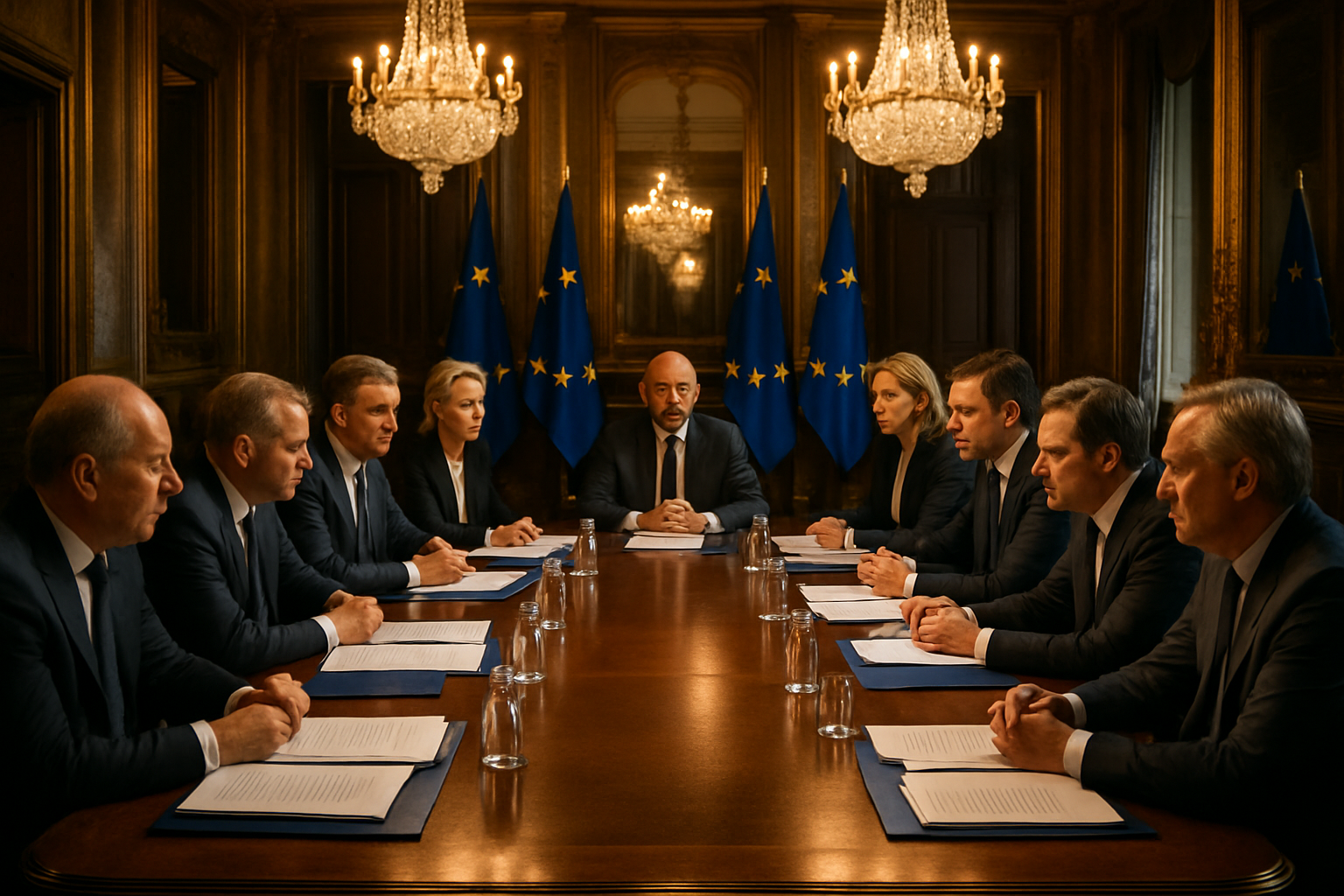
European Union leaders convened Thursday at the historic Alden Biesen castle in Belgium for an emergency summit on European competitiveness, as the bloc faces unprecedented economic pressure from both Chinese industrial dominance and the Trump administration's aggressive bilateral trade approach.
Belgian Prime Minister Bart De Wever hosted the informal gathering, following key industry and government leaders' discussions in Antwerp on Wednesday about the future of European industry. The summit represents a critical moment for the 27-member bloc as it struggles to maintain economic relevance against two global superpowers pulling Europe in opposing directions.
Mounting External Pressures
The urgency of Thursday's summit reflects the scale of challenges facing European competitiveness. China maintains crushing dominance over critical materials essential for Europe's green transition, controlling 60% of global production and 90% of refining capacity for lithium, cobalt, and rare earth elements. This dependency creates what officials describe as potential "kill switch" vulnerabilities for European infrastructure.
Simultaneously, the Trump administration's return to bilateral trade negotiations has bypassed traditional EU frameworks. Recent U.S. deals with Argentina (eliminating 1,600+ tariffs) and India (reducing duties from 50% to 18%) demonstrate America's preference for country-by-country agreements over multilateral EU engagement.
European Parliament President Roberta Metsola warned that "margins are narrowing" and "bold moves are needed to strengthen competitiveness," while citing affordable housing and cost of living as top Union concerns according to the latest Eurobarometer survey.
Strategic Sovereignty at Stake
The competitiveness crisis extends beyond trade statistics to fundamental questions of European strategic autonomy. EU auditors have warned that climate goals are threatened by critical materials shortages, while European dependence on American cloud services creates infrastructure vulnerabilities that could be exploited during geopolitical tensions.
Memory prices have surged sixfold, affecting European technology companies' ability to compete with Samsung, SK Hynix, and Micron. The semiconductor shortage is expected to persist until 2027, hampering Europe's digital transformation efforts just as artificial intelligence becomes central to economic competitiveness.
French President Emmanuel Macron has advocated for an economic "big bang," while European Commission President Ursula von der Leyen positions necessary reforms as a "new line of defense" against external pressure. The language reflects the stakes: European leaders increasingly view competitiveness not as an economic policy preference but as an existential necessity.
Digital Independence and Regulatory Power
Europe's response has emphasized regulatory sovereignty where technological independence remains elusive. Spain's implementation of criminal executive liability for tech platform violations represents the world's first such framework, while France has escalated enforcement through cybercrime raids on X's Paris offices and formal summons over AI violations.
The European Commission's TikTok investigation found Digital Services Act violations through "addictive design" features, potentially resulting in billions in penalties based on 6% of global revenue. This regulatory approach demonstrates how Europe leverages its market size to influence global technology governance despite lacking indigenous alternatives to American platforms.
However, critics argue that regulatory power cannot substitute for technological innovation. The Netherlands, despite having Europe's highest density of AI talent, struggles to convert this advantage into commercial success, with Dutch AI companies growing slower than EU competitors due to funding gaps and brain drain to Silicon Valley.
Economic Integration Versus National Sovereignty
The summit agenda focuses on accelerating single market integration while respecting member state sovereignty—a balance that has become increasingly difficult as external pressures mount. Eliminating internal barriers and reducing administrative burdens requires transferring additional sovereignty to Brussels, historically a sensitive issue for national governments.
Recent polling shows 89% of Europeans demand greater EU unity, with 86% wanting a stronger global voice and 72% worrying about conflicts near borders. Yet political reality reveals persistent divisions, with Slovakia, Czech Republic, and Hungary refusing to participate in the €90 billion Ukraine loan package, demonstrating limits to solidarity even during crisis.
The disconnect between public support for integration and governmental resistance to sovereignty transfer creates a fundamental implementation challenge. Success requires member states to act against traditional institutional reflexes while operating under compressed timelines driven by external pressure.
Strategic Industrial Policy Renaissance
European competitiveness increasingly depends on coordinated industrial policy—a concept previously dismissed as outdated state intervention. Croatia's successful absorption of 99.25% of Rural Development Program funding demonstrates effective utilization of EU mechanisms, while Estonia's achievement of 88% renewable electricity and continental Europe's largest battery storage facility shows technological leadership potential.
The digital euro initiative, led by Slovakia's €1.3 billion pilot project, represents Europe's most ambitious attempt at technological sovereignty. Unlike volatile cryptocurrencies that crashed 50% from their October 2025 peak, the digital euro offers government-backed stability while reducing dependence on American payment infrastructure.
Yet industrial policy success requires sustained investment and political commitment across electoral cycles. Germany's exposure of €940 billion in crisis costs reveals structural weaknesses in Europe's largest economy, while construction industry challenges create negative developer margins across multiple member states.
Global Implications and Strategic Choices
The Alden Biesen summit represents more than regional economic policy coordination—it constitutes a critical test of whether democratic societies can maintain economic sovereignty amid authoritarian competition and technological disruption. Success could establish Europe as a genuine third pole in global economic competition, while failure risks subordination to American or Chinese systems.
The broader context includes the expiration of the New START Treaty between the United States and Russia, eliminating 50+ years of nuclear constraints and creating unprecedented strategic uncertainty. Europe must navigate competitiveness challenges while managing great power competition that extends far beyond economics into existential security questions.
China's systematic advancement of the digital yuan and the Federal Reserve's exploration of a digital dollar add urgency to European monetary independence efforts. The window for establishing technological sovereignty may be narrowing as global economic blocs consolidate around competing digital currencies and payment systems.
Implementation Challenges and Timeline Pressures
European leaders face the challenge of implementing comprehensive reforms while maintaining democratic accountability and respecting diverse national economic structures. Unlike authoritarian competitors that can mandate rapid changes, the EU must coordinate across 27 democracies with varying economic priorities and institutional capacities.
The compressed timeline creates additional pressure. External challenges from Chinese materials dominance and American bilateral trade deals are advancing rapidly, while Europe's consensus-building mechanisms require extensive consultation and gradual implementation. This institutional disadvantage could prove decisive if European leaders cannot achieve unprecedented coordination speed.
Success requires balancing immediate crisis response with long-term structural reforms. European institutions must demonstrate they can adapt to 21st-century competition while preserving democratic governance principles that have underpinned European prosperity since World War II.
Looking Forward: The June Deadline
The February summit occurs against the backdrop of June deadlines for major geopolitical settlements, including potential Ukraine-Russia peace negotiations in Washington. European leaders must position the continent for a world where traditional alliance structures may be reconfigured around economic rather than purely security considerations.
The stakes extend beyond European prosperity to global governance architecture. If democratic societies cannot maintain economic competitiveness through voluntary coordination, authoritarian models may become increasingly attractive to other regions facing similar pressures from great power competition.
Thursday's Alden Biesen summit may be remembered as the moment European leaders chose between gradual institutional evolution and rapid transformation necessary for 21st-century survival. The outcome will influence not only European economic prospects but the global future of democratic governance in an era of unprecedented technological and geopolitical change.