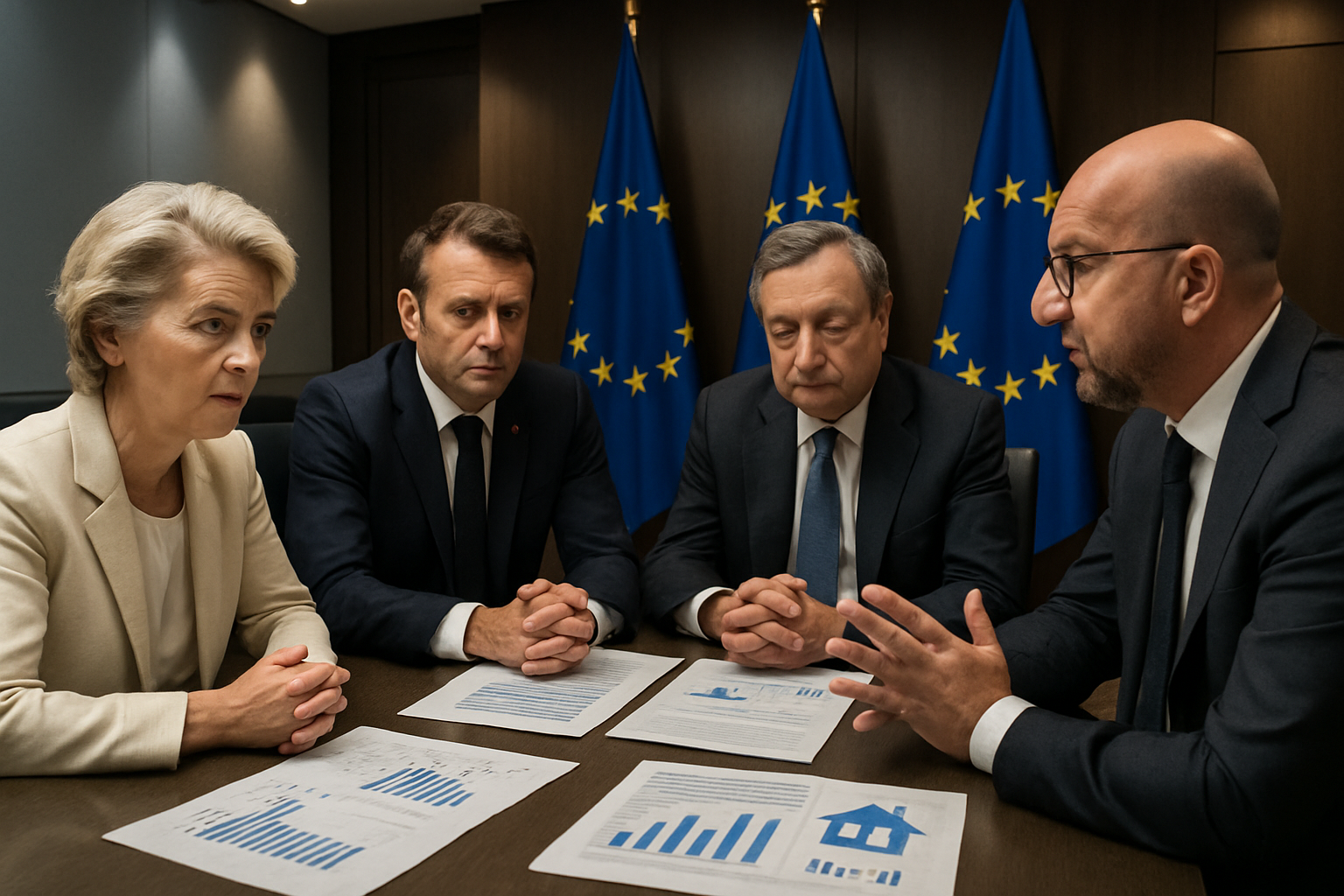
The European Union has launched its most comprehensive policy transformation in decades, simultaneously addressing a critical housing shortage affecting millions, implementing new carbon border adjustment mechanisms, and embracing nuclear energy expansion as geopolitical tensions reshape continental priorities.
The European Parliament adopted landmark recommendations on March 11, 2026, calling for urgent measures to tackle what lawmakers describe as Europe's most severe housing crisis since World War II. The report from the Special Committee on the Housing Crisis, approved by 367 votes in favor, 166 against, and 84 abstentions, warns that "a generation cannot build a future" amid soaring rental costs that have increased by 30% across the continent.
Housing Crisis Reaches Breaking Point
European officials report that the continent faces a shortage of 10 million homes, with millions of Europeans living in precarious conditions. The parliamentary report emphasizes the urgent need to improve living standards by ensuring decent housing conditions and strengthening the Commission's Affordable Housing Plan through coordinated action across member states.
The housing crisis has reached particularly acute levels in major urban centers, where rental markets have become increasingly unaffordable for middle-class families. MEPs emphasized that without immediate intervention, Europe risks creating a permanent housing underclass unable to achieve homeownership or secure stable rental arrangements.
The Parliament's recommendations include enhanced support for construction and renovation projects, with lawmakers calling for significant increases in public housing investment and streamlined approval processes for new residential developments. The measures represent the most ambitious European housing initiative since the post-war reconstruction era.
Carbon Border Mechanisms Take Effect
Simultaneously, European businesses are grappling with the implementation of the Carbon Border Adjustment Mechanism (CBAM), which fundamentally alters how the EU manages trade relationships with third countries. The Cyprus Chamber of Commerce and Industry organized emergency briefings on March 19, 2026, to help importers understand the complex compliance requirements affecting goods from non-EU nations.
The CBAM seminar, titled "CBAM in Practice: What Importers Need to Know Today," examined obligations, procedures, compliance issues, and sustainability requirements linked to the EU's carbon border policy. The mechanism aims to prevent carbon leakage by ensuring that imported goods face equivalent carbon pricing to EU-produced alternatives.
Industry representatives report significant operational challenges as businesses adapt to the new regulatory framework. The policy affects sectors including steel, cement, aluminum, fertilizers, and electricity, requiring extensive documentation and carbon accounting that many companies find technically demanding.
European officials emphasize that CBAM represents a crucial component of the continent's climate strategy, ensuring that EU climate policies do not disadvantage European manufacturers while providing incentives for global emissions reductions. The mechanism is expected to generate substantial revenues for EU climate initiatives.
Nuclear Renaissance Gains Momentum
Perhaps most significantly, the European Union has dramatically reversed its position on nuclear energy, with Commission President Ursula von der Leyen declaring nuclear power abandonment a "strategic error" during the World Nuclear Energy Summit in Paris. The announcement represents a fundamental shift in European energy policy driven by energy security concerns arising from geopolitical instability.
Von der Leyen announced new EU investment guarantees for nuclear projects, emphasizing that nuclear power provides "reliable 24-hour daily electricity" compared to weather-dependent renewable alternatives. The policy reversal has been accelerated by recent energy crises that exposed European vulnerability to supply disruptions from unstable regions.
Several member states are advancing ambitious nuclear programs. Hungary continues construction of Paks II, Europe's largest nuclear project worth $39.1 billion, while Romania leads in small modular reactor (SMR) technology development. Greece has established a ministerial committee to explore SMR deployment, and Slovakia positions nuclear energy as central to its carbon neutrality framework.
Estonia, despite achieving 88% renewable electricity and operating continental Europe's largest battery storage facility serving 90,000 households, is now considering nuclear baseload complement to ensure grid stability. Latvia is addressing capacity warnings and high electricity prices through potential nuclear investments.
Geopolitical Pressures Drive Policy Evolution
The comprehensive policy transformation occurs against the backdrop of unprecedented geopolitical tensions that have fundamentally altered European strategic calculations. The Middle East crisis has disrupted global energy markets, with oil prices surging above $100 per barrel and natural gas increasing 24% in Europe.
European policymakers acknowledge that traditional approaches to energy security, housing policy, and climate action require fundamental recalibration to address 21st-century challenges. The simultaneous pursuit of housing affordability, climate objectives, and energy security represents a complex balancing act requiring innovative policy solutions.
China's dominance in critical materials production—controlling 60% of production and 90% of refining capacity for lithium, cobalt, and rare earth elements—has prompted European efforts to diversify supply chains. The US-EU-Japan Critical Minerals Partnership, encompassing 55 countries, represents a strategic response to reduce dependencies on geopolitically sensitive suppliers.
Implementation Challenges and Opportunities
European officials acknowledge significant implementation challenges across all three policy areas. The housing crisis requires unprecedented coordination between national governments, regional authorities, and EU institutions to mobilize sufficient resources for construction and renovation programs.
CBAM implementation faces technical complexities as businesses adapt to new carbon accounting requirements. Small and medium enterprises particularly struggle with compliance costs, prompting calls for enhanced technical assistance and phased implementation schedules.
The nuclear renaissance confronts political opposition from environmental groups and some member states. Austria's environment commissioner criticized the "dangerous path" of nuclear expansion, while Spain maintains reservations about international legality and environmental protection. However, energy security imperatives are overriding traditional anti-nuclear positions.
Industry leaders emphasize that success requires sustained political commitment across electoral cycles, substantial financial investments, and coordinated international cooperation. The window for effective action is narrowing as climate pressures intensify and geopolitical tensions create additional urgency.
Long-term Strategic Implications
The comprehensive policy transformation represents Europe's most ambitious attempt to address multiple crises simultaneously while maintaining democratic governance and social cohesion. Success could establish templates for other developed economies facing similar challenges of housing affordability, climate action, and energy security.
Economic analysts suggest that the integrated approach—combining housing investment, carbon pricing, and energy diversification—could create synergistic benefits exceeding the sum of individual policies. Construction programs can incorporate advanced energy efficiency standards, while nuclear investments provide stable baseload electricity supporting both residential and industrial needs.
The policies position Europe as a test case for rapid decarbonization in developed economies while maintaining economic competitiveness and social equity. International observers are closely monitoring European approaches as potential models for global climate action during the decisive decade for emissions reductions.
European leaders emphasize that the transformation represents not merely policy adjustments but a fundamental reimagining of European governance capabilities in an increasingly complex and unstable international environment. The success or failure of these initiatives will influence European integration, global climate action, and international economic governance for decades to come.