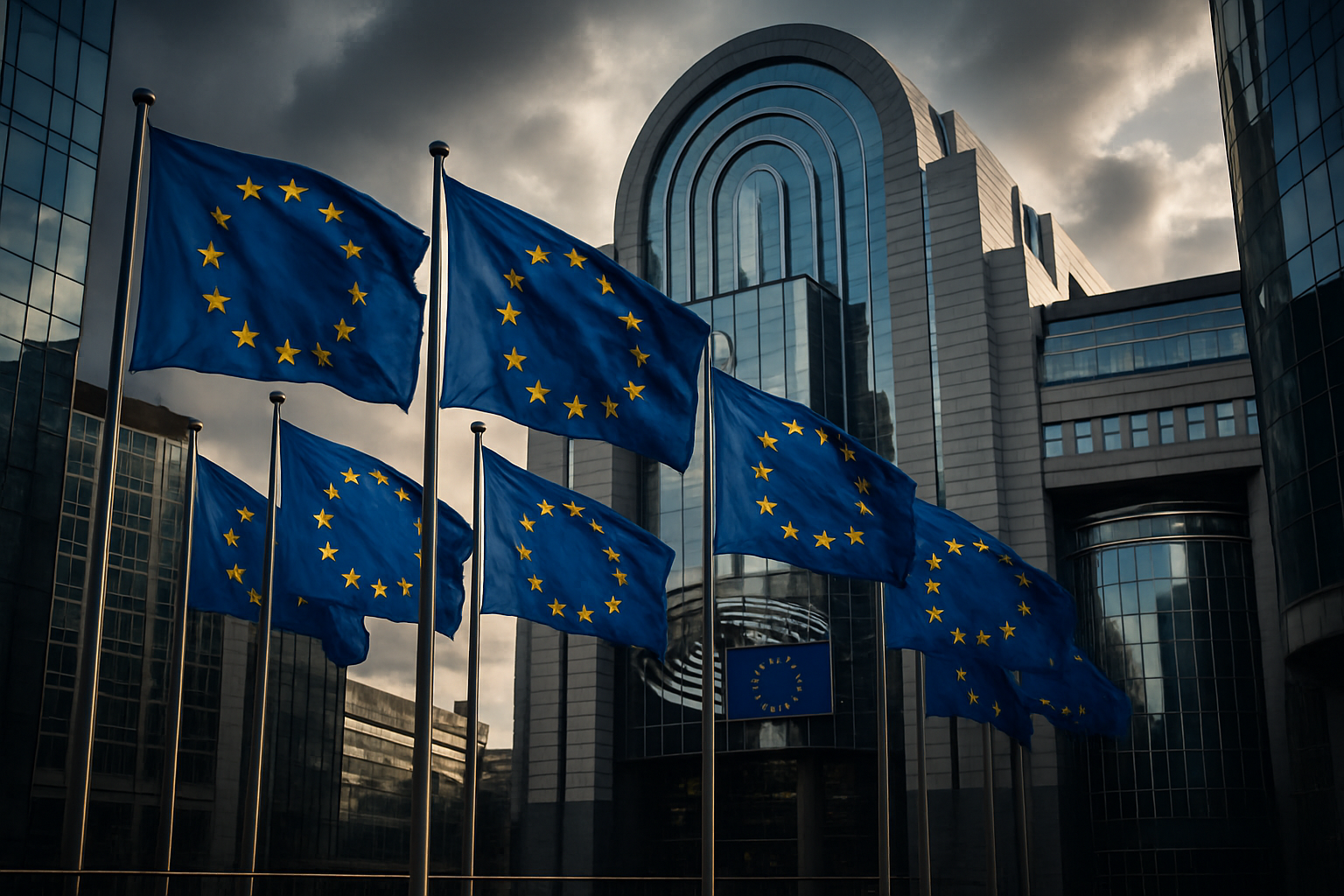
The European Union is grappling with its most severe economic challenges since the 2008 financial crisis, as ongoing conflicts in the Middle East drive unprecedented energy price volatility and force coordinated responses across member states to protect both businesses and consumers.
The crisis has reached critical proportions following Iran's closure of the Strait of Hormuz, which handles 40% of global seaborne oil transit, as part of escalating tensions stemming from the breakdown of nuclear negotiations with the United States. Oil prices have surged past $100 per barrel for the first time since 2022, with Brent crude peaking at $119.50 and WTI jumping 18.98% in what analysts describe as the largest single-day increase on record.
Energy Architecture Under Unprecedented Strain
The impact on European energy markets has been catastrophic. Natural gas prices have exploded by 24% across Europe, reaching €47.32/MWh – the highest levels since February 2025. The crisis has exposed fundamental vulnerabilities in European energy security, with Qatar's LNG production halted due to Iranian attacks on facilities that normally supply approximately 20% of global LNG exports.
Austria has implemented new corporate structures like "EU Inc." to help businesses navigate the crisis, providing regulatory relief for cross-border operations and business expansion during these challenging times. The initiative represents the EU's commitment to "exploit the potential of the single market" even as external pressures mount.
"The war cannot serve as a pretext for abusive price increases. We are implementing comprehensive monitoring to protect consumers during this crisis,"
— French Prime Minister Sébastien Lecornu
Member State Responses and Economic Coordination
European governments have implemented emergency measures across the continent. France has deployed 500 fuel station inspectors to prevent price manipulation, while Romania has developed five scenarios to prevent diesel prices from exceeding 10 lei per liter. Hungary has imposed immediate price caps on gasoline and diesel, citing concerns over "war-driven price explosions."
The economic ripple effects extend far beyond energy prices. Sweden is predicting electricity increases of 10-20 öre and gasoline price rises of 1-2 kronor, with the Malmö zone 4 region most exposed due to continental European market integration. Consumer impacts are spreading globally, with Ireland facing heating oil increases approaching €2 per liter.
Strategic Response and Policy Innovation
EU High Representative Kaja Kallas has activated emergency coordination protocols, representing the most comprehensive crisis management response since the bloc's formation. The European Union has rapidly developed emergency options to reduce energy prices, including state aid programs for energy-intensive industries and direct energy price compensation mechanisms.
Heavy industry across Europe is reporting factory closures due to unviable energy costs, prompting discussions of accelerated green transition elements as a long-term solution. However, renewable infrastructure requires years to replace current fossil fuel dependence, leaving Europe vulnerable during this critical transition period.
Financial Markets and Supply Chain Disruption
Financial markets have responded with alarm to the crisis. The Pakistan KSE-100 index crashed 8.97% in its largest single-day decline in history, while European markets have seen severe losses. Central banks including the European Central Bank and Bank of Japan are coordinating emergency liquidity provisions, though traditional monetary policy tools have limited effectiveness against structural geopolitical disruptions.
Supply chain vulnerabilities have been exposed on an unprecedented scale. The Persian Gulf serves as a critical global trade hub beyond energy, affecting consumer goods and industrial materials worldwide. Manufacturing in automotive, electronics, and textiles sectors faces severe disruptions due to Gulf-dependent logistics networks.
Aviation Crisis Compounds Economic Pressures
The economic crisis has been compounded by a parallel aviation emergency. Over 18,000 flights have been cancelled worldwide – the most extensive disruption since COVID-19 – as eight Middle Eastern countries simultaneously closed their airspace. Dubai International Airport, the world's busiest with 86 million passengers annually, remains completely shut down due to missile damage.
Major carriers including Emirates, Air France-KLM, and Wizz Air have suspended operations indefinitely, affecting hundreds of thousands of passengers globally and severing critical Europe-Asia transportation corridors.
Long-term Implications for European Economic Architecture
The crisis highlights the urgent need for fundamental restructuring of European energy architecture to reduce dependence on volatile geopolitical regions. Strategic petroleum reserves provide only temporary relief for sustained disruptions, while alternative supply routes lack adequate capacity and involve significant time and cost penalties.
European leaders are accelerating discussions on energy independence infrastructure investment, expanded renewable capacity, enhanced member state interconnections, and expanded storage facilities. The crisis represents a template-setting moment for 21st-century crisis management in an increasingly multipolar world.
International Cooperation and Recovery Prospects
Recovery timelines remain uncertain, dependent on military and diplomatic developments rather than predictable economic factors. Unlike weather disruptions or technical problems, the current crisis requires political and military resolution of conflicts thousands of miles away.
The International Energy Agency has authorized the largest strategic petroleum reserve release in its 50-year history – 400 million barrels from 32 countries – but this represents only a temporary measure against fundamental infrastructure disruptions.
"This represents the most severe energy security crisis in decades, exposing single-chokepoint vulnerabilities that require fundamental restructuring of our energy architecture,"
— Energy Analyst Samuel Ciszuk
Template for Future Crisis Management
The current crisis serves as a watershed moment for European economic resilience and international cooperation. Success in managing this emergency could provide a framework for future nuclear crisis resolution and strengthen diplomatic precedents. However, failure may accelerate military solutions that could reshape Middle Eastern geopolitics for decades.
As UN Secretary-General António Guterres noted, this represents "the greatest test of multilateral cooperation in crisis management of the modern era." The decisions made in the coming days and weeks will reverberate through international relations for decades, affecting energy markets evolution, supply chain resilience, and diplomatic versus military solutions preferences.
The European Union's response to these unprecedented economic challenges will likely determine not only the bloc's immediate economic stability but also its role as a global economic power in an increasingly volatile and interconnected world. The crisis demands both immediate relief measures and fundamental long-term restructuring of energy security architecture to prevent similar vulnerabilities in the future.